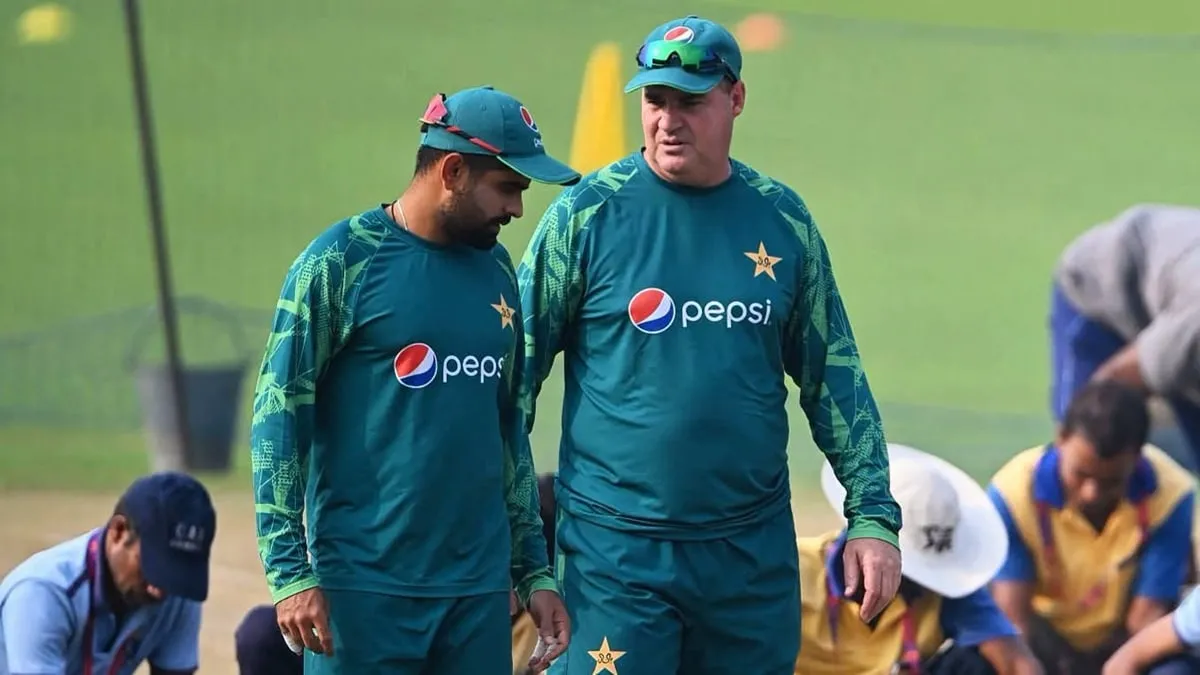
What Mickey Arthur Said About Babar Azam on The Super Over Podcast
Former Pakistan head coach Mickey Arthur has revealed that Babar Azam stopped speaking to him after he criticized the star batter's approach despite scoring a century against England in 2019. Speaking on The Super Over podcast, Arthur recalled the fourth ODI at Trent Bridge, where Babar scored 115 off 112 deliveries, helping Pakistan post 340/7.
However, the former head coach was unhappy with Babar's scoring rate as he approached his century, believing the batter had prioritized his personal milestone over the team's requirements. Arthur argued that accelerating earlier could have helped Pakistan score around 15 additional runs. England eventually chased down the target with three wickets and three balls to spare.
Arthur revealed that his decision to confront Babar in the dressing room surprised several players, who questioned why he was criticizing a batter who had just scored a century. Arthur recalled that the player did not talk to him for a week even though they were usually tight. Explaining his coaching philosophy, Arthur said coaches must understand what motivates individual players and, when necessary, challenge even their biggest stars in front of the team.
The 2019 ODI Series Context and Team Dynamics
The 2019 tour of England served as a crucial testing ground for Pakistan ahead of the ICC Men's Cricket World Cup hosted in England and Wales that same year. ODI cricket requires batsmen to constantly balance accumulating runs safely with maintaining a brisk run rate, especially against a formidable English white-ball team. Matches at Trent Bridge are historically high-scoring encounters due to flat pitches and small boundaries, placing a heavy premium on every single run.
Coaches often face difficult decisions when dealing with elite batters who anchor the innings. While centuries are celebrated by fans and analysts, team management must look at strike rates and match contexts to ensure total efficiency. Arthur sought to instill a culture of collective responsibility, pushing individual performers to think beyond personal milestones and focus entirely on maximizing the team total.
Confronting a senior player in front of the entire team carries significant risks in professional sports. Team harmony can be fragile, and public criticism of a talismanic figure often invites skepticism from teammates. Arthur acknowledged that such criticism could temporarily affect a player's confidence and strain relationships, but he maintained that it could ultimately bring out better performances.
How Babar Azam Responded During the 2019 World Cup
The former Pakistan coach believes the dressing room confrontation helped motivate Babar ahead of the 2019 World Cup. Arthur singled out Babar's match-winning century against New Zealand at Edgbaston as his finest innings during his tenure, saying the performance still gives him goosebumps.
Chasing 238, Babar scored an unbeaten 101 off 127 deliveries and shared a 126-run partnership with Haris Sohail to guide Pakistan to a six-wicket victory. The performance earned Babar the Player of the Match award, ended New Zealand's unbeaten run at the tournament, and kept Pakistan's semifinal hopes alive.
Babar went on to score 474 runs at the tournament, setting what was then a record for the most runs by a Pakistani batter in a single World Cup. This prolific run proved his ability to deliver under intense pressure on the global stage, validating Arthur's demanding approach to coaching elite athletes.
Understanding Coaching Philosophies in International Cricket
Managing a national cricket team like Pakistan demands a delicate balance of technical instruction and psychological management. Coaches must navigate intense media scrutiny, passionate fan bases, and high player expectations. When a coach calls out a player for slow scoring near a milestone, it highlights the friction between personal records and team tactics in modern limited-overs cricket.
Modern analytics track strike rates, dot-ball percentages, and boundary frequencies, giving coaches objective data to challenge player assumptions. While players naturally value centuries, coaches look at match-winning impact. Arthur's willingness to risk personal rapport with Babar demonstrated a strict adherence to his tactical blueprint for the squad.
The silent treatment that followed the dressing room incident illustrates the personal toll of high-performance sports management. Star players are accustomed to adulation, making direct criticism jarring and difficult to accept immediately. However, the subsequent performances in the World Cup suggest that the tough conversation served its intended purpose by sharpening Babar's competitive focus.
The Legacy of Arthur and Babar Partnership for Pakistan
During Mickey Arthur's tenure as head coach, Pakistan experienced notable developments in Test and limited-overs formats, eventually reaching the top of the Test rankings briefly in 2016 and winning the ICC Champions Trophy in 2017. Babar Azam emerged during this era as one of the finest contemporary batters across all three formats of the game.
The professional relationship between Arthur and Babar survived the initial tension at Trent Bridge, leading to years of mutual respect and productive collaboration. Coaches and players often go through turbulent moments, but shared goals on the cricket field frequently mend strained ties. The anecdotes shared years later on podcasts offer fans a rare glimpse into the intense environment of international dressing rooms.
As Babar continues his career as one of Pakistan's senior statesmen and record-breaking run-scorers, the lessons learned from early clashes with strict coaches remain part of his professional evolution. The 2019 episode stands as a defining chapter in the development of a world-class batsman who learned to align personal excellence with team demands.