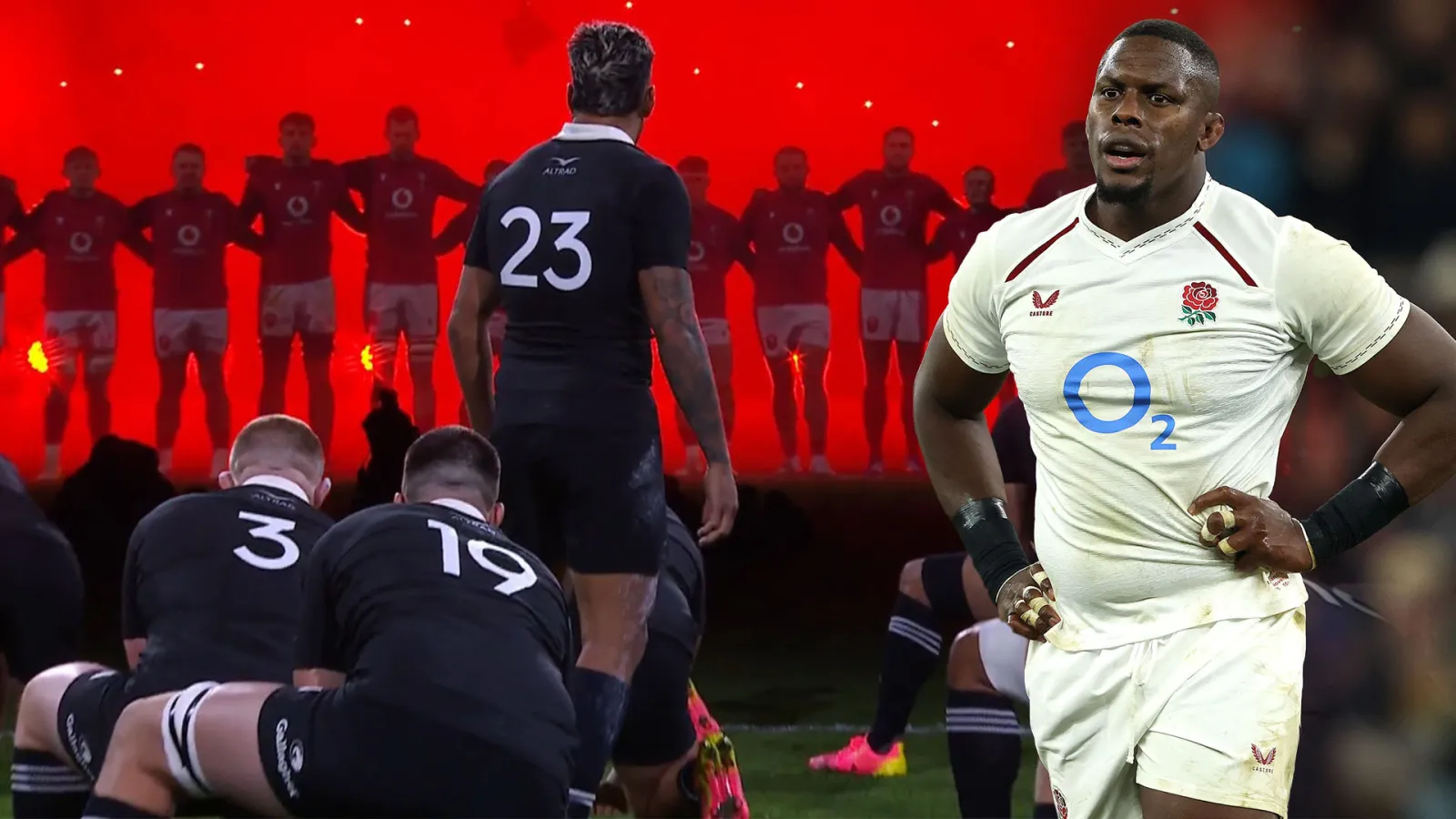
England are preparing to face New Zealand and their intimidating Haka this Saturday at Twickenham. Ahead of the fixture, captain Maro Itoje called a squad meeting to thrash out how his teammates will respond to the All Blacks before the pre-kick off routine takes place.
This planning comes on the back of last weekend's action where Wales stared down the traditional challenge in front of a stunning light show with red mist emerging from behind the team. That bold approach inspired Wales to record a stunning 35-28 win, ending a 73-year wait for victory against their lauded opponents. As the Dragons proved, teams do not have to simply stand by and watch the famous war dance without a counter-strategy.
How England Faced the Haka in the 2019 World Cup
The stage could not have been bigger when England faced off against the All Blacks in the semi-final of the World Cup at the International Stadium Yokohama. Usually, opposing teams face the Haka horizontally in a straight line, but England did something entirely different that day to disrupt the psychological advantage.
They formed a V-formation, as captain Owen Farrell stood in the middle of the line-up completely unperturbed, while throwing shade with a sly smirk. Tellingly, England progressed to the final by winning 19-7, proving that the psychological trick worked on the field. However, they were fined because some players at the tip of the V had crossed over the halfway line, including Joe Marler.
World Rugby rules state that teams have to remain in their own half when cultural challenges are taking place. This regulation was introduced to maintain order and prevent physical clashes before the match officially begins, meaning modern captains must be clever with their geometry rather than advancing too far forward.
France and the Fearless 2007 Quarter-Final Staredown
Before their 2007 World Cup quarter-final against New Zealand, France were really gutsy with their repost to the Haka. This was done before the rules were changed and teams had to respectfully keep their distance. The French gesture definitely took influence from Ireland captain Willie Anderson, who led a nose-to-nose staredown of the All Blacks before a 1989 clash at Lansdowne Road.
With the absolutely fearless France lock Sebastien Chabal in tow, Les Bleus looked down the gauntlet of the Haka and straight into the fearsome opposition eyes. A close-up of Chabal, nicknamed the Caveman, glaring at his opponents showed he was well up for the fight, or completely loopy.
France's stars stood their ground and could probably feel the All Blacks player's breath in their faces. Still, it worked because France pulled off a shock 20-18 win and advanced to the semi-finals. It remains one of the most iconic moments of resistance in rugby union history.
War Dances and Direct Responses From Pacific Rivals
New Zealand are not the only rugby nation to try and stoke fear into their rivals by performing a war dance before their matches. Fiji perform the Cibi, Samoa do the Sivi Tau, and Tonga have the Sipi Tau. It is the latter who enjoy going toe-to-toe with the All Blacks whenever they share a pitch.
Case in point, when Tonga met New Zealand in the 2003 World Cup at the pool stages and all hell broke loose. As the Kiwis began their Haka, Tonga responded with their challenge at the same time, refusing to yield any ground.
Following in that tradition, and refusing to be overawed, Tonga did it again in matches at the 2011 and 2015 tournaments. Despite their best efforts, though, New Zealand won all three of those matches, showing that musical or dance-based retaliation does not always guarantee a scoreboard advantage.
The David Campese Approach and Ignoring the Challenge
The only thing players have to remember nowadays, when responding to the Haka, is to stay in their own half. There is no written rule that says you have to observe the performance, although it remains a common courtesy among professional sports teams. You would have to really be made of thick skin to completely ignore it in front of a packed stadium.
That is exactly what Australian legend David Campese did before a World Cup semi-final in 1991. Instead of watching, Campese warmed up on his own by his own try line and practiced some kicking.
It worked for him because he scored after just six minutes of that match in a thrilling 16-6 victory. However, in 1996 the Australians thought they would do the same again in a game in Wellington and turned their back on the Haka.
This time, they were battered 43-6 by a rampant home side. Years later, then-captain John Eales revealed he regretted his team's actions and said it was management's call to snub the Haka.
He told the Sydney Morning Herald in 2017 that he knows other guys in the team did as well. Reflecting on the incident, he noted that looking back at certain things in life makes you wish you had not done them.
Musical Retaliation and Choral Power From Wales
During a clash in 2004, Wales responded to the Haka with a bit of opera in the shape of singer Wynne Evans. He belted out hymn Cwm Rhondda, and was joined in unison by 70,000 Welsh fans filling the stands with sound.
Then, before a match in 2005, the All Blacks granted permission for Wales to have anthems Hen Wlad Fy Nhadau and Cwm Rhondda played after they performed the Haka. A year later, Wales requested the same again, but the All Blacks blocked the request. A standoff between the countries meant that New Zealand had to perform the Haka in their changing room instead of on the pitch.
With all of this tactical history in mind, rugby fans are left wondering what Maro Itoje and the current England squad will choose to do at Twickenham. Whatever formation or silence they select, staying behind the halfway line will be the primary administrative rule they must obey to avoid a fine.