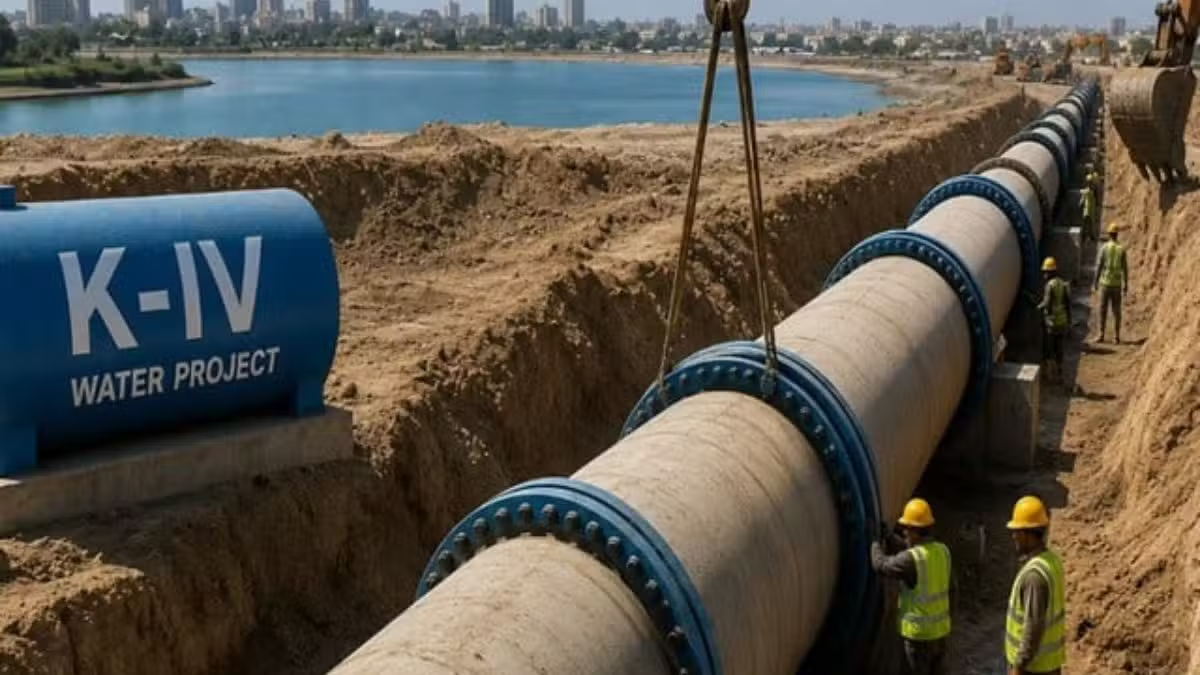
Karachi's long-delayed K-IV bulk water supply project is now expected to be completed by June 2027, extending its timeline once again as lawmakers seek accountability for repeated delays.
WAPDA officials shared the revised completion target during a meeting of a National Assembly sub-committee on Water Resources, where members reviewed the project's progress, design complications and planning issues. Lawmakers expressed concern over the prolonged delays, stressing that the scheme is essential to meeting Karachi's growing water demand and should face no further setbacks.
Background of the Karachi K-IV Water Supply Project
The project was conceived by the Sindh government in 2003 to address the city's drinking water shortage. Civil works began in July 2016, with an initial completion deadline of December 2018. However, design-related problems delayed progress, and a third-party investigation commissioned by the Sindh government later identified shortcomings in the original design.
As Pakistan's largest urban center and financial hub, Karachi has struggled with severe infrastructural strains for decades. The metropolitan area relies heavily on aging distribution networks and limited natural water sources. Successive municipal administrations recognized the urgency of tapping external water reserves to prevent chronic shortages.
Initial planning faced institutional hurdles and financial constraints. These obstacles hindered progress for over a decade after the initial concept emerged. The sheer scale of transporting millions of gallons across long distances required engineering expertise beyond local municipal capacities.
Federal Intervention and WAPDA Takeover
The federal government took over the project under the Karachi Transformation Plan in 2020. WAPDA assumed responsibility in April 2021 and began mobilisation in September 2022. Although the scheme was initially scheduled for completion by October 2023, the deadline has now been revised to June 2027. Officials said the revised design and planning have been submitted to the Planning Commission and federal government.
The Water and Power Development Authority brought central engineering oversight to resolve the structural deficiencies inherited from earlier provincial efforts. Transitioning authority from local bodies to a federal agency altered the operational framework. Federal planners initiated comprehensive reviews to correct the engineering mistakes flagged by independent investigators.
Financing and administrative hurdles accompanied the transition. Federal ministries coordinated with national financial institutions to secure steady funding streams. Despite these administrative realigning efforts, supply chain complications and planning revisions pushed the timeline further into the future.
Technical Scope and Phased Implementation
The K-IV project is designed to bring 650 million gallons per day (MGD) of water from Keenjhar Lake in Thatta to Karachi in three phases. Phase-I will provide 260 MGD through supply points at Pipri, North East Karachi and Manghopir. The remaining phases are planned to add another 390 MGD.
The first phase includes an intake structure at Keenjhar Lake, a gravity channel, pumping facilities, a pressurised pipeline, reservoirs and filtration plants. The Sindh government is responsible for the distribution network, power arrangements, land acquisition and right-of-way clearance.
Transporting water over long distances involves complex civil engineering feats. Gravity channels and massive pumping stations must work in tandem to overcome elevation changes between Thatta and the urban limits of Karachi. Water treatment facilities must also be constructed to purify the incoming supply before distribution.
Water Shortfall and Local Impact on Karachi
WAPDA officials told the committee that Karachi's water requirement stands at around 1,200 MGD, highlighting the importance of the project in addressing the city's supply shortfall. Once completed, the Karachi Water and Sewerage Corporation will take over its operation and maintenance.
Residents across numerous neighborhoods frequently experience irregular supply schedules and low water pressure. Industrial sectors also suffer production interruptions due to inadequate municipal water delivery. Closing the massive supply gap is vital for public health and economic stability in the region.
Local authorities face intense public pressure to resolve the utility crisis. Households often depend on private water tankers, incurring substantial monthly expenses. The completion of the bulk supply initiative remains the primary hope for stabilizing municipal distribution.