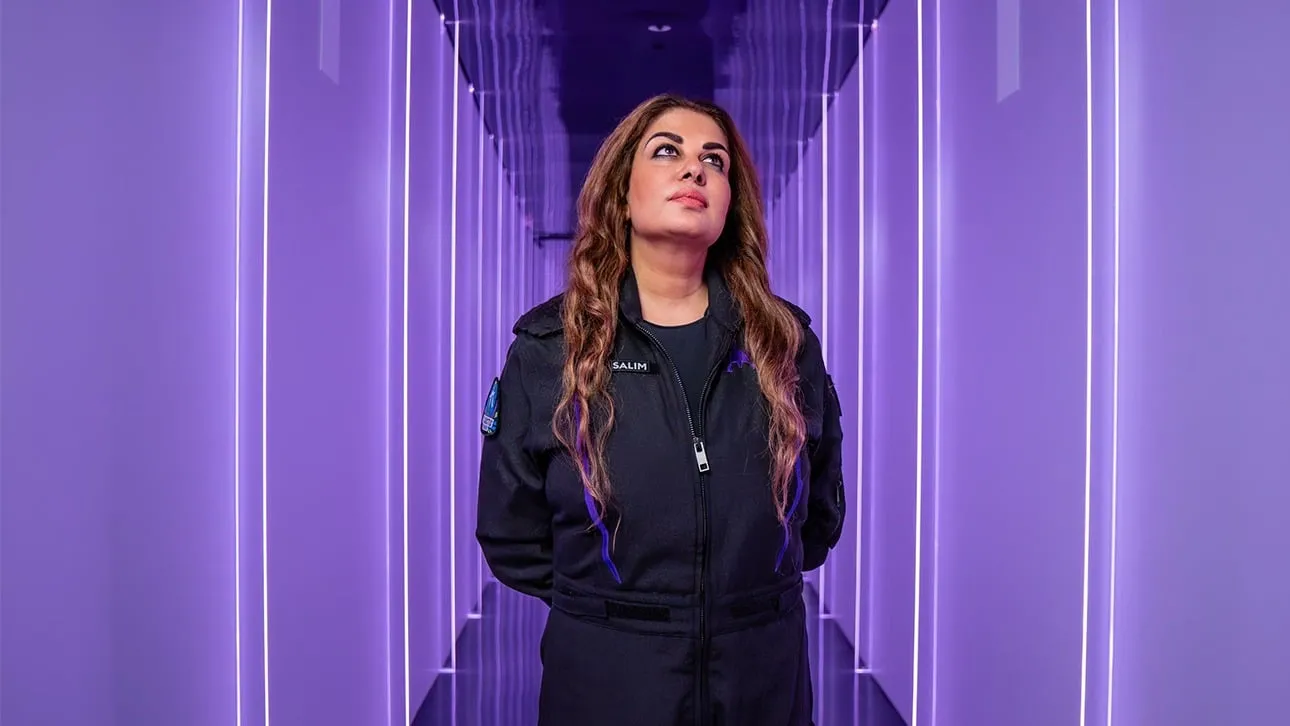
Namira Salim, who flew to space with Virgin Galactic in 2023, has welcomed Pakistan's human spaceflight mission with China but maintains that she is the country's first astronaut.
Speaking to Independent Urdu, Salim said the Pakistani government had officially recognised her as Pakistan's first astronaut in the past, but the same title is now being used for Muhammad Zeeshan Ali.
What Salim Says About Her 2006 Recognition
Salim said that in 2006, the Ministry of Information and Broadcasting officially launched her across the country as the first Pakistani astronaut. She explained that she bought her Virgin Galactic ticket that year, when private spaceflight was only just starting in the US, and that the company took around 18 years to complete its spaceline and test flights before flying its commercial astronauts.
She eventually flew to space on October 6, 2023, aboard Virgin Galactic's Galactic 04 mission. Salim stressed that although she lives outside Pakistan, she holds no other passport and still proudly carries her Pakistani one, which is why the government recognised her.
"If the government overlooks this and ignores the efforts of a private citizen, that is their problem," she said.
How the Two Milestones Differ
Zeeshan Ali has become the first Pakistani to reach Earth's orbit and the first foreign astronaut to enter China's Tiangong space station. Salim's Galactic 04 flight, by contrast, was a commercial suborbital trip that reached about 87.4 kilometres before returning to Earth. ProPakistani has explained how the two achievements differ.
Sub-orbital flights like Galactic 04 cross the Kármán line only partially, offering a few minutes of weightlessness before the capsule glides back to the ground. Orbital missions, such as Ali's Tiangong stay, achieve speeds of roughly 7.8 km per second, allowing the spacecraft to circle the planet and conduct experiments that require sustained micro-gravity.
Historical Context of Pakistan's Space Ambitions
Pakistan's space programme began in the 1960s under the aegis of the Pakistan Space and Upper Atmosphere Research Commission (SUPARCO). Early projects focused on atmospheric research, satellite tracking and modest launch-vehicle development. In the 1990s, SUPARCO launched its first communication satellite, Badr-A, marking a shift toward practical applications such as tele-medicine and education. The country's first astronaut-type claim emerged in the early 2000s when the government sought to promote a narrative of scientific progress. Salim's 2006 announcement fit that narrative, even though at the time private spaceflight was still experimental.
Why the Title Matters for National Identity
Being called the "first astronaut" carries symbolic weight. It signals a nation's entry into a domain traditionally dominated by a handful of space-faring powers. For Pakistan, a country of over 240 million people, the title can inspire a generation of engineers, scientists and students. Salim's claim also highlights the role of private citizens in space exploration. While most astronauts have historically been selected by government agencies, the rise of commercial operators such as Virgin Galactic and SpaceX has opened pathways for individuals who fund their own seats.
Impact on Youth and the Science Community
Salim praised the Chinese-Pakistani cooperation, saying it will help the country advance in science and technology and inspire young people who dream of going to space. Universities in Islamabad and Lahore have reported a surge in applications to aerospace engineering programs after the Tiangong mission was announced. Private spaceflight companies have also begun to hold informational webinars in Karachi, targeting students who want to understand the training, medical screening and financial commitments required for a sub-orbital flight.
What Comes Next for Pakistan's Human Spaceflight Plans
The Chinese partnership is expected to culminate in a crewed mission to Tiangong sometime in 2025, with Muhammad Zeeshan Ali slated as the lead Pakistani participant. The mission will involve joint scientific experiments on micro-gravity crystal growth and satellite-deployment techniques. Meanwhile, Salim said she wishes to fly again, indicating she may seek another commercial seat once Virgin Galactic expands its fleet. No official schedule for a second flight has been announced. For the government, the next steps include formalising a national astronaut selection framework, possibly through SUPARCO, to recognise future spacefarers who meet specific training and mission criteria.
Legal and Institutional Framework Explained
Pakistan's Ministry of Information and Broadcasting handles public recognition of national achievements, while SUPARCO is the technical authority for space activities. There is currently no legislation that defines the legal status of a "Pakistani astronaut" nor a formal award system. In contrast, the United States has the NASA Astronaut Badge, and Russia issues the title of "cosmonaut" through state decree.
If the government wishes to codify the title, it would likely need to amend the Pakistan Space Policy of 2021, which outlines goals for satellite development, remote sensing and international collaboration but does not address human spaceflight titles.
Public Reaction and Media Coverage
Social media in Pakistan has been split. Hashtags like #NamiraFirstAstronaut and #ZeeshanAliOrbit trended simultaneously after the Independent Urdu interview. Opinion pieces in major dailies have debated whether the distinction between sub-orbital and orbital flight should affect the title. Some analysts argue that Salim's flight, though sub-orbital, still represents a historic moment because it was the first time a Pakistani-born individual crossed the threshold of space, however briefly. Others contend that orbital achievement carries a higher scientific value and therefore deserves the primary claim.
Practical Takeaways for Aspiring Spacefarers
- Citizenship matters: Salim's claim rests on her holding only a Pakistani passport.
- Training requirements differ: Sub-orbital flights require a few days of pre-flight preparation, while orbital missions demand months of intensive physical and technical training.
- Funding routes vary: Commercial seats are purchased privately, whereas government-selected astronauts receive state-funded training and mission costs.
- Recognition may be political: Official titles can be granted by ministries, but scientific community acceptance often follows documented mission parameters.
Conclusion: A Dual Narrative of Progress
Namira Salim's insistence on her status as Pakistan's first astronaut underscores the evolving nature of space exploration, where private initiative and state-led programs intersect. Muhammad Zeeshan Ali's upcoming orbital flight with China adds a new chapter, marking Pakistan's first presence in Earth's orbit and the Tiangong station. Both milestones, though different in technical terms, contribute to a broader narrative of national ambition, scientific development and inspiration for future generations.