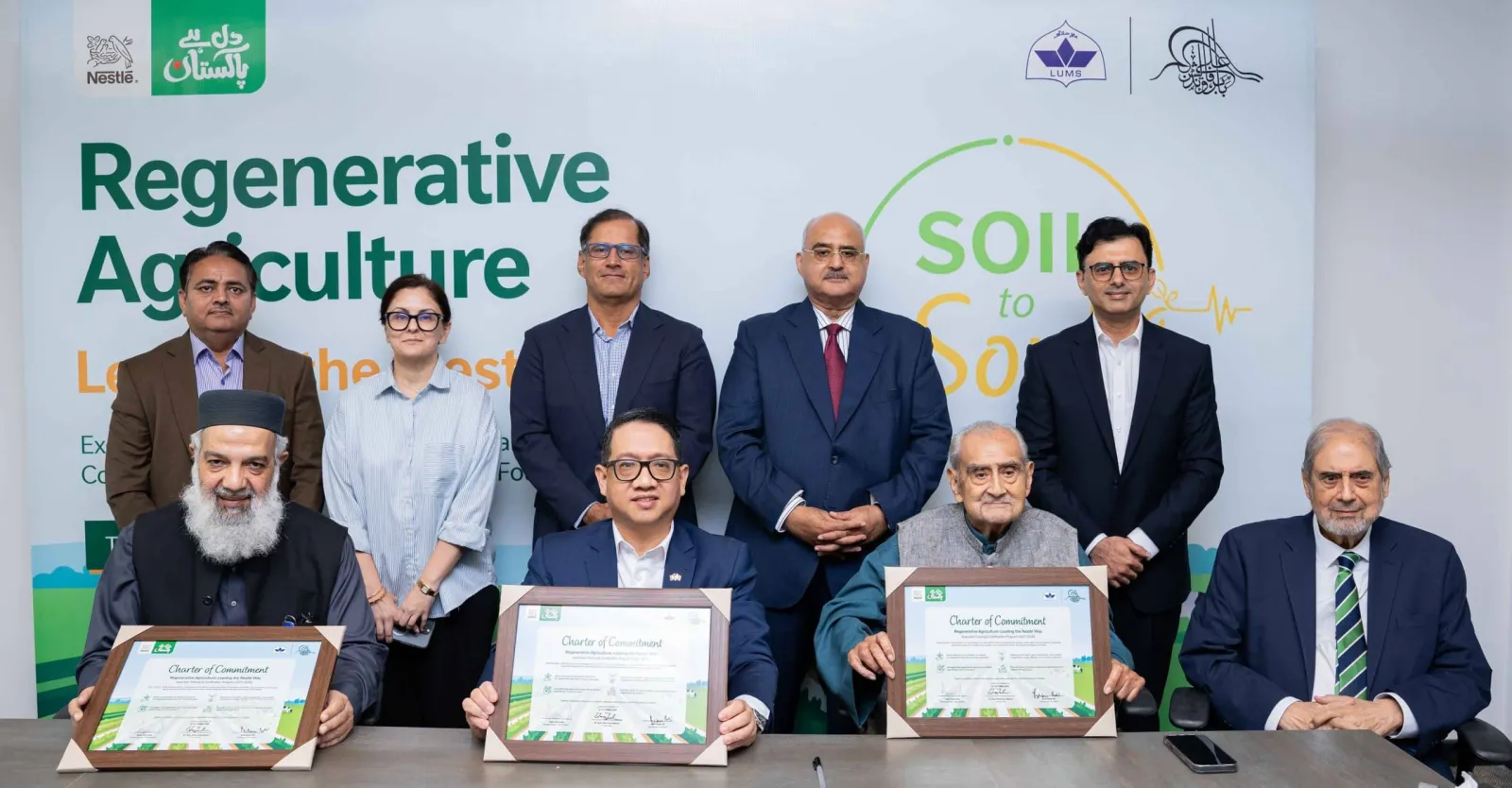
A new multi-year Executive Training and Certification Program has been established by Nestlé Pakistan, the LUMS Rausing Executive Development Centre (REDC), and the Syed Babar Ali Foundation to enhance knowledge and capabilities regarding regenerative agriculture.
Named Regenerative Agriculture: Leading the Nestlé Way, the curriculum seeks to foster regenerative farming leadership in Pakistan while supporting agricultural prosperity, environmental stewardship, and resilient food systems.
Enrollees will build their knowledge across two annual cohorts, covering topics such as soil health, crop nutrition, water stewardship, energy efficiency, farm economics, and emissions reduction. The project will additionally promote agripreneurship and innovation, incorporating precision irrigation methods.
Nestlé Pakistan CEO and Managing Director Jason Avanceña stated, \u201cThis program is an opportunity to build shared understanding and develop a network of informed advocates who can champion regenerative agriculture and keep Pakistan competitive with other leading agricultural economies around the world. For Nestlé, it is ultimately about creating shared value across our agricultural value chain.\u201d
Syed Babar Ali remarked on the project, \u201cI have always believed that the true value of education lies in what we are able to pass on to the generations that follow us. Agriculture remains central to the country, and the challenges facing it require us to equip a new generation of leaders.\u201d
Dr. Tariq M. Jadoon, Provost at LUMS, stated, \u201cThis program has been designed to move beyond theory by bringing together scientific understanding, business considerations and field exposure. Through areas such as soil health, water stewardship, climate resilience and farm economics, participants will be able to examine regenerative agriculture as an interconnected system and consider how these principles can be applied and scaled in Pakistan.\u201d
The course will operate annually with two batches scheduled each year, accommodating 25 attendees per session. Each edition lasts four days, featuring three days of classroom instruction at REDC, LUMS, alongside one day of practical field learning.
Nestlé Pakistan currently promotes regenerative practices throughout its supply chain, helping roughly 150 growers across about 9,330 acres. The corporation assists producers in using methods and technologies centered on climate resilience, water efficiency, and soil health. Nestlé targets sourcing 50% of its principal ingredients from producers using regenerative methods by 2030, supporting its broader goals of advancing sustainable food networks and reaching net-zero greenhouse gas emissions by 2050.