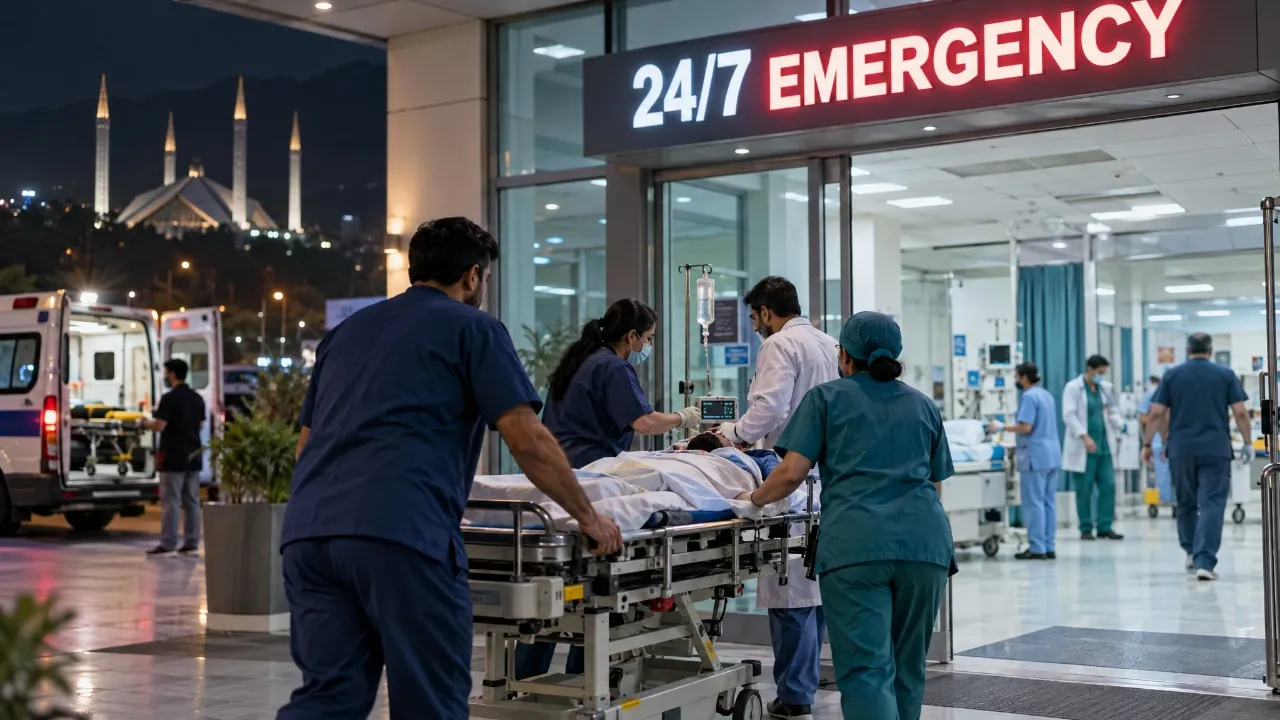
Pak-China Friendship Hospital Begins Round-The-Clock Free Emergency Services
The Pak-China Friendship Hospital has made its emergency department operational round the clock, expanding free healthcare access for residents of the federal capital. Managed by the Indus Hospital and Health Network (IHHN), the facility has deployed dedicated teams of doctors, nurses, and other medical professionals to provide emergency care and life-saving treatment at any time of the day or night. The hospital aims to improve access to quality healthcare by providing timely medical attention, particularly to patients requiring urgent treatment. The round-the-clock service is expected to facilitate residents of Islamabad and surrounding areas.
Expansion of Clinical Capacity and Surgical Services
The facility has also expanded its clinical capacity by introducing specialized medical and surgical services to meet the growing healthcare needs of the population. In a recent clinical milestone, the hospital successfully performed an Open Reduction and Internal Fixation (ORIF) ankle surgery under spinal anesthesia, marking progress in its provision of advanced surgical services. Head of Campus Dr. Khizzer Pervaiz appreciated the contributions of Dr. Danish, the orthopedic and anesthesia teams, and the hospital's support staff for their coordinated efforts in completing the procedure. The administration has reiterated its commitment to expanding quality healthcare services and strengthening clinical facilities to provide accessible and efficient medical care.
Public Response and Government Support for Healthcare Welfare
Citizens have appreciated the Government of Pakistan and the Ministry of National Health Services, Regulations and Coordination for supporting the welfare-oriented initiative, which provides free emergency healthcare services to residents of the federal capital. Public health initiatives of this scale rely on institutional partnerships and government backing to ensure that emergency rooms remain stocked with supplies and staffed by qualified personnel around the clock. The collaboration between public sector bodies and non-governmental health networks represents a growing model for delivering medical services to urban populations in Pakistan without imposing financial burdens on patients seeking urgent care.
Understanding Emergency Care Operations at Modern Hospitals
An emergency department operating on a twenty-four-hour schedule requires extensive logistical coordination, including continuous shifts for medical personnel, diagnostic laboratories ready for instant blood work, and imaging departments capable of immediate X-rays or ultrasounds. When a patient arrives with acute trauma or sudden illness, the triage system evaluates the severity of the condition to prioritize life-saving interventions. Facilities managed by experienced networks bring established protocols for patient intake, medication management, and surgical readiness, ensuring that sudden medical crises receive immediate attention from trained specialists.
Specialized Orthopedic Procedures in Regional Healthcare Facilities
Advanced surgical interventions such as the Open Reduction and Internal Fixation (ORIF) ankle surgery performed at the hospital demonstrate the growing capability of regional healthcare centers to handle complex physical injuries. ORIF is a surgical method used to fix severely broken bones, involving the repositioning of the bone into its normal alignment and securing it with plates, screws, or pins. Administering spinal anesthesia for such procedures allows patients to remain numb from the waist down while staying awake or lightly sedated, reducing recovery times and avoiding risks associated with general anesthesia. The successful execution of this procedure by Dr. Danish and the orthopedic and anesthesia teams highlights the technical proficiency available at the campus.
The Role of the Indus Hospital and Health Network in Public Health
The Indus Hospital and Health Network operates a growing network of healthcare facilities across Pakistan, focusing on delivering completely free treatment to all patients. By taking over the management of public infrastructure projects, such networks bring private sector efficiency and philanthropic funding to government-built assets. This operational model ensures that advanced medical technology and professional staff are directed toward underserved communities, easing the pressure on overburdened tertiary care hospitals in major urban centers like Islamabad.
What Next Steps Face Patients and Hospital Administrators
Hospital administrators will continue to monitor patient influxes in the emergency department to adjust staffing levels and resource allocation as demand grows across Islamabad and surrounding areas. Citizens using the facility should watch for future announcements regarding additional specialized clinics and expanded visiting hours for outpatient departments. The ongoing support from the Ministry of National Health Services, Regulations and Coordination will remain central to sustaining these free medical services over the long term.