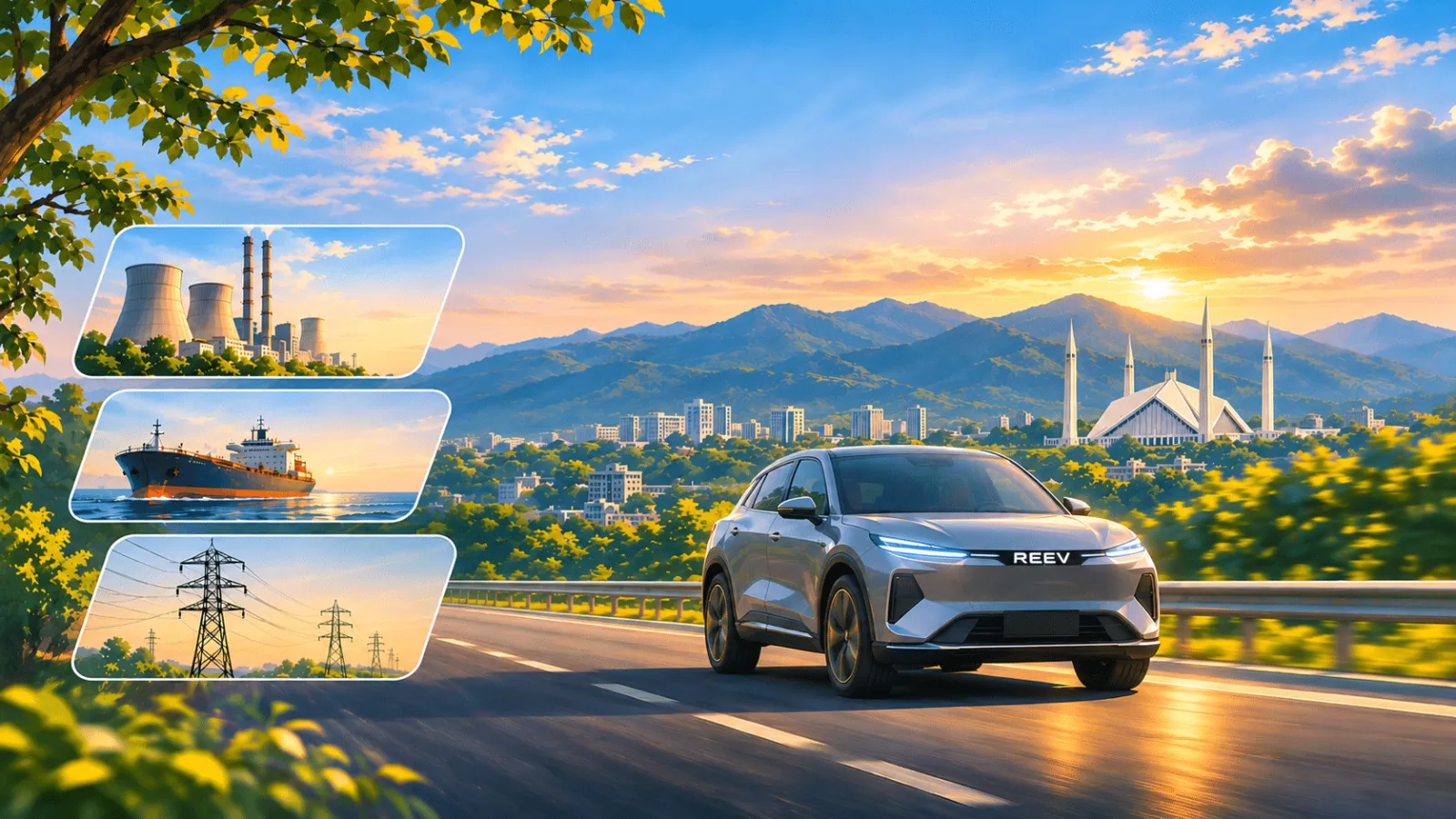
Why Pakistan Urgently Needs the Auto Policy 2026-31
Pakistan must finalise and implement the proposed Auto Policy 2026-31 without further delay. Continued dependence on imported petrol drains foreign exchange reserves, exposes domestic consumers to volatile global oil prices, and prolongs severe transport pollution across major urban centers. Official statistics highlight the immense scale of this challenge, showing that the petroleum import bill reached US$16.86 billion in FY2025-26, according to Pakistan Bureau of Statistics figures reported by Associated Press of Pakistan. The country urgently needs a clear regulatory framework that accelerates modern vehicle technologies capable of reducing this heavy national economic burden.
Policy uncertainty carries severe risks, including slowing vehicle adoption and discouraging much-needed industrial investment. The government must notify clear and consistent incentives for advanced vehicle types, support progressive local manufacturing, and publish a firm implementation timetable. Translating potential fuel savings into broader economic benefits requires decisive leadership, manufacturing investment, and the creation of skilled employment opportunities within the local automotive sector.
The Role of Range Extended Electric Vehicles in Pakistan
Range Extended Electric Vehicles offer a practical, immediate opportunity to act now rather than waiting for complete charging infrastructure buildouts. The wheels of these vehicles are driven entirely by electric motors, while an onboard petrol generator supplies electricity only when additional range is required for longer journeys. Regular charging enables everyday commuting to rely purely on electricity, with the range extender providing absolute confidence for trips where charging facilities are unavailable along the route.
Adopting this technology bridges the gap between traditional combustion engines and full battery electric vehicles, which still face infrastructure hurdles in developing markets. Drivers can transition their daily routines to electric power while retaining the flexibility needed for intercity travel. This dual-capability makes them uniquely suited for developing transport networks that are currently expanding their electricity grid capacity.
Economic Impacts and Foreign Exchange Savings
The economic case for shifting transport energy sources is straightforward and compelling. Shifting daily travel from imported petrol to electricity, particularly when using locally generated renewable power, directly reduces demand for foreign fuel and eases pressure on national foreign exchange reserves. An illustrative economic scenario involving 30,000 additional Range Extended Electric Vehicles annually could displace about 1.19 billion litres of petrol over a five-year period. At an assumed import value of US$0.90 per litre, this displacement equates to US$1.07 billion in direct savings.
Wider adoption paired with consistent charging habits can multiply these financial advantages across the entire macroeconomic landscape. For a nation actively seeking greater long-term energy security, reducing the volume of fuel required for everyday transport stands out as a paramount national priority. The arithmetic demonstrates that automotive policy reforms directly influence the stability of the national currency and trade balance.
Using Spare Electricity Generation Capacity
Pakistan currently pays for massive electricity generation capacity even when that infrastructure remains completely unused. Government data from the National Electric Vehicle policy document records just 49.8 percent utilisation of available generation potential in FY2023-24, leaving roughly half of the national capacity idle. Encouraging vehicle charging specifically during periods of spare capacity can put that underutilized infrastructure to productive use and spread fixed system costs across a larger volume of electricity sales.
Integrating vehicle charging with solar power generation offers another viable opportunity to reduce petroleum dependence without straining the national grid. Energy planners can harness daytime solar peaks to charge vehicle batteries, turning an intermittent power challenge into a logistical advantage for commuters. Aligning automotive growth with existing power sector surpluses creates a synergistic effect that benefits utility providers and vehicle owners alike.
Household Budgets and Public Health Benefits
The advantages of transitioning away from traditional liquid fuels extend directly to household budgets and public health outcomes. Regular charging can significantly lower daily driving costs for families, while battery-only operation produces zero tailpipe emissions on city streets. Avoiding 2,640 litres of petrol annually per vehicle, as projected in standard modeling scenarios, prevents around 6.2 tonnes of tailpipe carbon dioxide emissions per vehicle each year. Cleaner electricity generation combined with reduced internal combustion engine use strengthens this environmental advantage.
Urban air quality in major Pakistani cities suffers profoundly from vehicular exhaust, contributing to respiratory illnesses and rising healthcare expenditures. Removing thousands of tonnes of pollutants from densely populated streets improves public health and reduces the societal costs associated with air pollution. Cleaner mobility solutions are therefore not just an environmental luxury, but a public health necessity.
Broader Regional Resilience and Climate Context
Regional disasters reinforce the urgent need for comprehensive climate action and systemic economic resilience. Following Nepal's 26 August 2026 flash flood, the United Nations Population Fund reported 1,453 deaths and 5,285 people unaccounted for by the end of September, illustrating the unpredictable nature of regional weather events. While the full human toll of such disasters remains uncertain, they serve as stark reminders of the vulnerability of South Asian infrastructure to climate pressures.
Adapting transport policies to curb emissions and improve energy independence forms part of a broader strategy against climate vulnerability. Countries that fail to modernize their energy and transport sectors risk greater economic shocks from global commodity price spikes and environmental degradation. Proactive policy formulation remains the most effective defense against these interlocking global challenges.