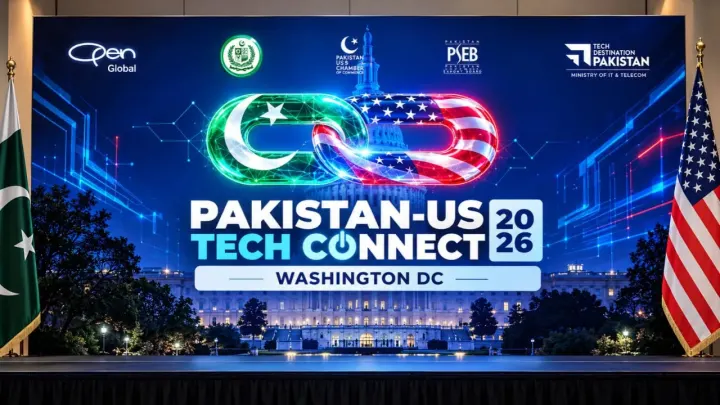
Pakistan US Tech Connect 2026 concluded its four-city American tour in Chicago on October 24, where Pakistani technology companies presented artificial intelligence, cloud computing, fintech and enterprise software solutions to hundreds of business leaders from the US Midwest. The event marks a clear transition in Pakistan's approach to marketing its tech sector, moving away from a low-cost outsourcing image toward a partnership model capable of delivering sophisticated digital solutions.
What Was Pakistan US Tech Connect 2026?
The initiative was a four-city roadshow designed to deepen business ties, attract investment and broaden Pakistan's footprint in the global tech market. Led by the Pakistan Software Export Board (PSEB), the itinerary included Silicon Valley on October 16, Dallas on October 19, Washington D.C. on October 21 and Chicago on October 23, 2026.
Co-organized by the Embassy of Pakistan in Washington D.C., PSEB and OPEN Global, the series gathered technology firms, policymakers, business executives and companies from across the American Midwest.
The program reflects Prime Minister Muhammad Shehbaz Sharif's goal of strengthening economic links with the United States by enabling direct B2B engagement between Pakistani tech firms and senior decision-makers such as chief information officers, chief technology officers and Fortune 1000 executives.
Who Attended the Chicago Stop?
Pakistan's Ambassador to the United States, Rizwan Saeed Sheikh, opened the Chicago conference, emphasizing the chance for deeper technology cooperation and for linking Pakistan's growing capabilities with American business needs through lasting partnerships.
Illinois State Representative Justin Slaughter and State Senator Laura Murphy also spoke, while Daniel Bellefleur, Vice President for Foreign Direct Investment at the Illinois Economic Development Corporation, offered the state's economic development viewpoint.
PSEB Chief Executive Officer Faisal Jeddy described Pakistan's IT landscape and emerging opportunities, noting a skilled workforce, competitive costs and the ability to deliver advanced solutions. Ignite CEO Bilal Abbasi highlighted the startup ecosystem, and OPEN Global President Tariq Khan pointed to collaboration prospects between Pakistani and American firms.
Consul General Zaman Mehdi concluded the event, thanking participants and partners and underscoring the joint effort of government, private sector and the Pakistani-American diaspora.
Which Pakistani Companies Were There?
Under PSEB's leadership, the roadshow assembled 16 established Pakistani technology firms and two emerging startups to engage with US businesses and investors.
The roster featured Systems Limited, 10Pearls, NETSOL Technologies, IBEX Global Solutions, Techlogix Pakistan, Arbisoft, Folio3 Software, CureMD Healthcare, Tkxel, Strategic Systems International, Emumba, Abacus, TMC, Nextbridge, Excellence Delivered and Addo AI.
Joining them were two startups, Swich and Heyeve.ai. Swich provides a Web3 merchant financial operating system, while Heyeve.ai delivers immersive, AI-driven legal training.
The delegation covered specialties such as artificial intelligence, enterprise software, cloud computing, financial technology, cybersecurity, healthcare technology, data engineering and customer experience management.
The Big Shift: From Outsourcing to Real Partnership
Coverage often missed the change in tone this year; the event was not about selling cheap code. A dedicated session on moving beyond outsourcing examined what US enterprise buyers and investors truly look for in Pakistani tech firms.
The ambassador noted that the 2026 conference series adopted a more focused, business-oriented format, featuring roughly 13 to 14 established companies with proven international experience. The aim was to move past merely showcasing Pakistan's sector to proving its capacity to deliver world-class solutions and forge commercially meaningful partnerships.
Panel discussions explored how Pakistani firms can build and scale enterprise partnerships across the United States, understand buying behaviour in the American middle market and develop effective market-entry strategies. Networking sessions allowed Midwest companies and the visiting delegation to discuss needs, identify potential partners and plan follow-up engagements.
Pakistan's IT Exports Hit a Record High
The Chicago event coincided with a record year for Pakistan's technology exports, which reached $4.6 billion in the fiscal year ending June 2026, a 21 percent increase over the prior year, according to IT Minister Shaza Fatima Khawaja.
The growth stemmed from strong performance in software development, business process outsourcing, gaming and SaaS. Companies also expanded earnings by tapping Asia-Pacific markets such as Japan and Singapore.
PSEB CEO Faisal Jeddy told attendees that Pakistan graduates about 70,000 IT and computer science students each year, and that IT exports have grown at an average annual rate of around 21 percent over the past four years, reaching roughly $435 million in September 2026 alone.
This monthly figure of $435 million is a target the Ministry of IT and Telecommunication aims to raise further, with events like the Chicago roadshow forming a direct part of that strategy. For Pakistani developers, software houses and startups watching from home, rising export numbers translate into higher demand for local talent and better salaries.
Alibaba Cloud's AI hackathon attracted 16,000 Pakistani applicants, another indicator of the country's growing appetite for global tech exposure.
Why This Matters for Pakistan's Tech Sector
The United States remains Pakistan's largest and most valuable technology export market, yet the Midwest is often overlooked in favour of coastal hubs. By staging the final stop in Chicago, PSEB is testing whether mid-sized American firms, less inundated with vendor pitches than those in San Francisco or New York, are open to Pakistani partnerships.
A dedicated session examined how Pakistani firms can move beyond traditional outsourcing models and better grasp US enterprise buyer expectations. The conversation aligns with the sector's need to demonstrate that Pakistani companies can own problems, not merely execute tasks.
Frequently Asked Questions
What is Pakistan US Tech Connect 2026?
Pakistan US Tech Connect 2026 is a four-city roadshow led by PSEB that took Pakistani technology firms to Silicon Valley, Dallas, Washington D.C. and Chicago to meet US businesses, pitch solutions and sign commercial partnerships.
Which Pakistani companies took part in the Chicago conference?
Sixteen established firms including Systems Limited, 10Pearls, Arbisoft, Folio3 and NETSOL Technologies attended, along with two startups: Swich (a Web3 fintech) and Heyeve.ai (an AI legal training platform).
How big are Pakistan's IT exports right now?
Pakistan's IT exports hit a record $4.6 billion in the fiscal year ending June 2026, up 21 percent year on year. Monthly exports reached roughly $435 million by September 2026, according to PSEB.
Why was Chicago chosen for the final stop of Pakistan US Tech Connect?
Chicago gives Pakistani firms access to the US Midwest market, which has many mid-sized enterprises that are less saturated with vendor pitches than coastal cities. Illinois state officials also attended, showing local government interest in the partnership.