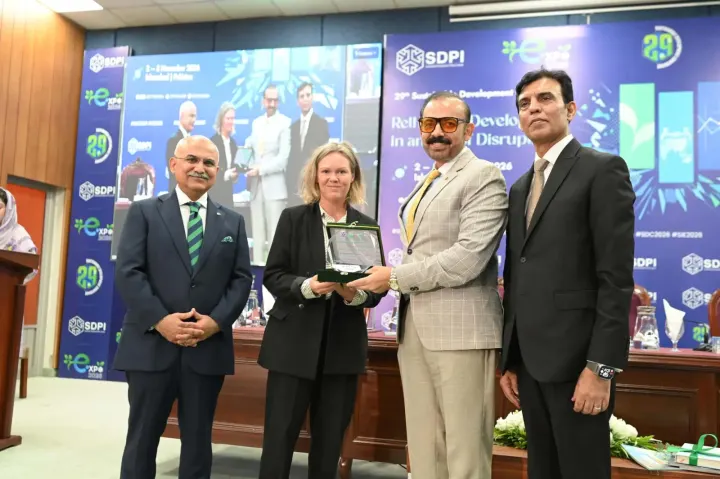
US Charge d'Affaires Marks Cisco Network Deployment at State Bank of Pakistan
Charge d'Affaires Natalie Baker joined State Bank of Pakistan Governor Jameel Ahmad and senior executive leadership from Cisco Systems Pakistan today at the SBP Head Office to celebrate the successful deployment of the State Bank's new core banking network and Software-Defined Data Center. This high-level gathering brought together key diplomatic and financial figures to mark a major upgrade in the technological capabilities of the country's central monetary institution. The event highlighted international cooperation in modernizing vital economic systems and ensuring that national financial operations meet high standards of reliability and performance.
The multimillion-dollar core banking network project, awarded to US technology leader Cisco, represents a major milestone in modernizing Pakistan's critical financial infrastructure. The project establishes a secure, agile, and resilient software-defined data center architecture designed to safeguard monetary stability and ensure reliable digital banking services nationwide. By upgrading these foundational systems, the central bank aims to handle higher volumes of digital transactions while protecting sensitive financial data from emerging cyber threats and operational disruptions.
The Strategic Importance of Modern Financial Infrastructure
Speaking at the ceremony, CDA Baker emphasized the strategic value of trusted and secure technology in underpinning modern financial systems and highlighted the growing commercial ties between the United States and Pakistan. Central banks operate as the backbone of national economies, managing everything from currency issuance to interbank settlements and monetary policy implementation. When these institutions upgrade their technological frameworks, the entire domestic economy benefits from faster, more secure, and more transparent financial transactions.
The central bank's infrastructure is a national asset that underpins economic stability and public confidence, according to CDA Baker. The State Bank of Pakistan's choice to partner with American industry demonstrates a commitment to technology quality, security, and long-term reliability. The United States values its long-standing commercial partnership with Pakistan, and we stand ready to continue connecting Pakistani institutions with world-class American innovation.
Engineering Execution and Operational Continuity
SBP Governor Jameel Ahmad and Cisco Country General Manager Kashif Ul-Haque praised the joint engineering effort that completed the complex implementation and migration while maintaining uninterrupted central banking operations. Migrating a nation's core financial ledger and data architecture without causing downtime for commercial banks or the public requires meticulous planning and execution. Technical teams from both organizations worked closely to ensure that the transition to the new software-defined data center went smoothly.
Maintaining continuous operations during such a massive technological overhaul prevents systemic shocks and maintains trust among commercial banks and individual account holders. The successful completion of this phase proves the technical competence of the teams involved and sets a high benchmark for future infrastructure upgrades across the region. Financial institutions increasingly rely on software-defined architectures to dynamically allocate resources, scale operations instantly, and maintain high availability during peak transaction periods.
Bilateral Trade and Economic Ties Between the United States and Pakistan
The event underscores the US government's ongoing commitment to fostering private-sector collaboration, promoting transparent and secure digital infrastructure, and deepening bilateral trade and investment relations between the United States and Pakistan. Economic partnerships involving major technology transfers often serve as a bridge for broader diplomatic and commercial engagement. American technology firms continue to play a prominent role in upgrading enterprise infrastructure in developing markets by providing advanced hardware, software, and technical training.
Bilateral trade discussions frequently center on expanding access to high-tech goods, improving regulatory environments, and encouraging foreign direct investment in key sectors like energy, agriculture, and information technology. By securing critical banking architecture with American technology, Pakistani authorities demonstrate an openness to international standards of cybersecurity and data management. Such investments reassure foreign investors and international financial institutions that the local market operates with modern, secure, and globally compatible systems.
What the New Software-Defined Data Center Means for National Banking
The deployment of a Software-Defined Data Center brings specific operational advantages to the State Bank of Pakistan. Traditional data centers rely heavily on physical hardware configurations to route traffic and manage data storage, which can create bottlenecks during high-demand periods. Software-defined networking virtualizes these resources, allowing administrators to manage network services through software abstractions rather than manual hardware adjustments.
This architectural shift provides the agility required to respond rapidly to changing cybersecurity threats and expanding digital payment volumes across the country. As citizens increasingly adopt mobile banking, electronic fund transfers, and digital wallets, the underlying central bank infrastructure must process clearing and settlement operations instantly. The new Cisco deployment equips the State Bank of Pakistan with the technological capacity to support these growing digital habits while maintaining strict regulatory oversight over the national payment ecosystem.