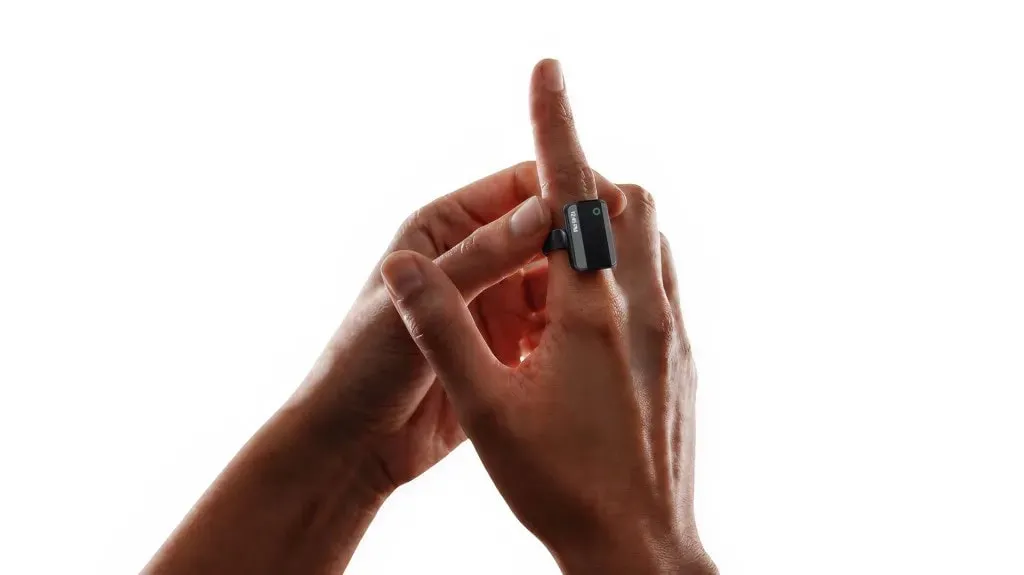
Most smart rings track your sleep and count your steps. Aina's new ring talks to AI agents, takes phone calls, and shows notifications on a tiny screen. It also has a joystick for navigation and a built-in speaker. At $399 for early-bird pre-orders, it is probably the most ambitious smart ring anyone has attempted.
What Makes Aina's Ring Different From Existing Wearables?
The hardware alone sets it apart from everything else in the category. A small display sits on the ring's surface, showing notifications from your phone and indicating which app you are controlling. A joystick handles navigation instead of touch gestures. The built-in mic lets you dictate notes, send prompts to AI agents, set reminders, and talk to your Mac through Wispr Flow or Aina's own dictation engine. Meanwhile, the speaker handles phone calls directly from the ring.
Most competing smart rings, such as Pebble Index 01, Sandbar Stream, Oasis and Natura, focus on voice recording or basic health metrics. None combine a visual interface, a tactile joystick and a speaker in a single finger-worn device. By adding those three elements, Aina creates a "controller for both AI and non-AI applications," a claim backed by founder Apoorv Shankar's description of the ring as an always-ready interface for proactive AI agents.
Why a Ring Is the Right Form Factor for AI Interaction
Shankar argued that phones and laptops were designed for browsing, where users actively open apps. Proactive AI agents, however, need a different type of interface that can surface information or accept commands without the user pulling out a phone. A ring sits on the finger, stays visible, and can be activated with a thumb-press or joystick movement, delivering a hands-free experience that mirrors how people naturally interact with voice assistants.
The ring's joystick replaces the swipe-or-tap gestures common on smartwatches. A single thumb press moves a cursor on the tiny screen, while left-right movements scroll through notifications or select options. The built-in speaker enables two-way audio, allowing users to answer calls or hear AI responses without needing a separate earpiece.
From Mirage Controller to Smart Ring: Aina's Design Evolution
The company previously made Mirage, a three-key controller for Mac. It let users map physical buttons to actions based on whatever app appeared on screen. On a Google Meet call, one button could toggle the camera. Another could mute the mic. Aina carried those lessons forward into the ring's gesture and context-aware controls, translating button-press logic into joystick movements and screen cues.
Shankar's background as former VP of hardware at Ultrahuman, another smart-ring maker, gives him direct experience with the constraints of ring-form-factor engineering. Battery life, antenna placement, durability against daily wear and the need to keep the device lightweight all influence the design choices seen in the new product.
Business and Funding Context
Aina raised $5.5 million in July to build this product. The capital will fund final hardware tooling, mass-production tooling, and the software platform that will host third-party apps. Early-bird pre-orders open on Thursday at $399; after the window closes the price rises to $499. The company plans to start shipping in January 2027.
The $5.5 million round places Aina among a handful of wearables startups that have secured venture backing for AI-focused hardware. Investors are betting on a shift from passive health tracking to active AI assistance, a trend accelerated by the recent release of large language models that can be queried in real time.
How the Ring Works: Hardware and Software Details
Display. A 0.5-inch OLED panel is etched onto the outer curvature of the band. It shows icons for incoming calls, messages, calendar alerts and the name of the AI app currently active. The screen refreshes at 30 Hz to conserve power while remaining readable in daylight.
Joystick. A miniature, click-type joystick is positioned on the inner side of the band where the thumb rests. It registers four directions and a press-in action, allowing users to navigate menus, scroll through AI responses or adjust volume.
Microphone and Speaker. A MEMS microphone captures voice commands with a signal-to-noise ratio comparable to smartphone mics. The built-in speaker, though small, can deliver clear audio for phone calls and AI replies, using bone-conduction technology to keep the sound private.
Connectivity. Bluetooth 5.2 links the ring to iOS and Android phones, as well as macOS devices via Wispr Flow. The connection supports low-latency audio streaming, enabling real-time call handling.
Battery. A custom 30 mAh lithium-polymer cell powers the device for up to 48 hours of mixed use, screen on, occasional calls and AI queries. A magnetic charging dock provides a quick 30-minute top-up.
Software. The ring runs Aina's proprietary OS, which layers a context-aware AI hub on top of standard notification handling. Developers can submit apps through an SDK that maps joystick actions to app functions. Early partners include a note-taking AI, a calendar assistant and a smart-home controller.
Market Landscape: Competitors and Differentiation
The smart-ring market has expanded from health-only devices to more interactive wearables. Pebble Index 01 offers a tiny e-ink display and voice activation, but lacks a speaker and joystick. Sandbar Stream focuses on biometric data and a simple tap-to-record function. Oasis and Natura prioritize minimalist design and health tracking, with no screen at all.
Aina's differentiation rests on three pillars: a visual interface, two-way audio and a tactile navigation system. Those features enable use cases beyond health, such as controlling AI agents, answering calls and managing smart-home devices, areas where competitors have not yet ventured.
Potential Impact on Users and Industries
For professionals who spend much of their day in meetings, the ring could replace the need to pull out a phone to mute a microphone or answer a call. AI-heavy workflows, like drafting emails with a generative model or querying a knowledge base, can be executed with a few joystick clicks and spoken prompts, keeping the user's hands free for other tasks.
In the consumer space, the ring may appeal to early adopters of AI assistants who want a discreet, always-on device. Its price point of $399 places it above most health-focused rings but below premium smartwatches, positioning it as a niche premium accessory.
What Comes Next: Shipping Timeline and Software Roadmap
Aina plans to begin shipping the ring in January 2027, following a six-month production ramp-up. Early-bird customers will receive the device first, with the $499 version slated for later release. The software platform will continue to evolve; the company has announced a quarterly "App Sprint" where developers can submit new integrations for the AI hub.
Regulators have not raised specific concerns about the ring, but standard Bluetooth-LE compliance and data-privacy guidelines will apply. Aina states that all voice recordings are processed locally on the device or encrypted before being sent to cloud AI services.
Watch for updates on the SDK launch, third-party app announcements and any firmware updates that improve battery life or add new gestures. The success of the ring will hinge on how quickly the ecosystem grows and whether users find the joystick-driven UI intuitive compared with voice-only assistants.