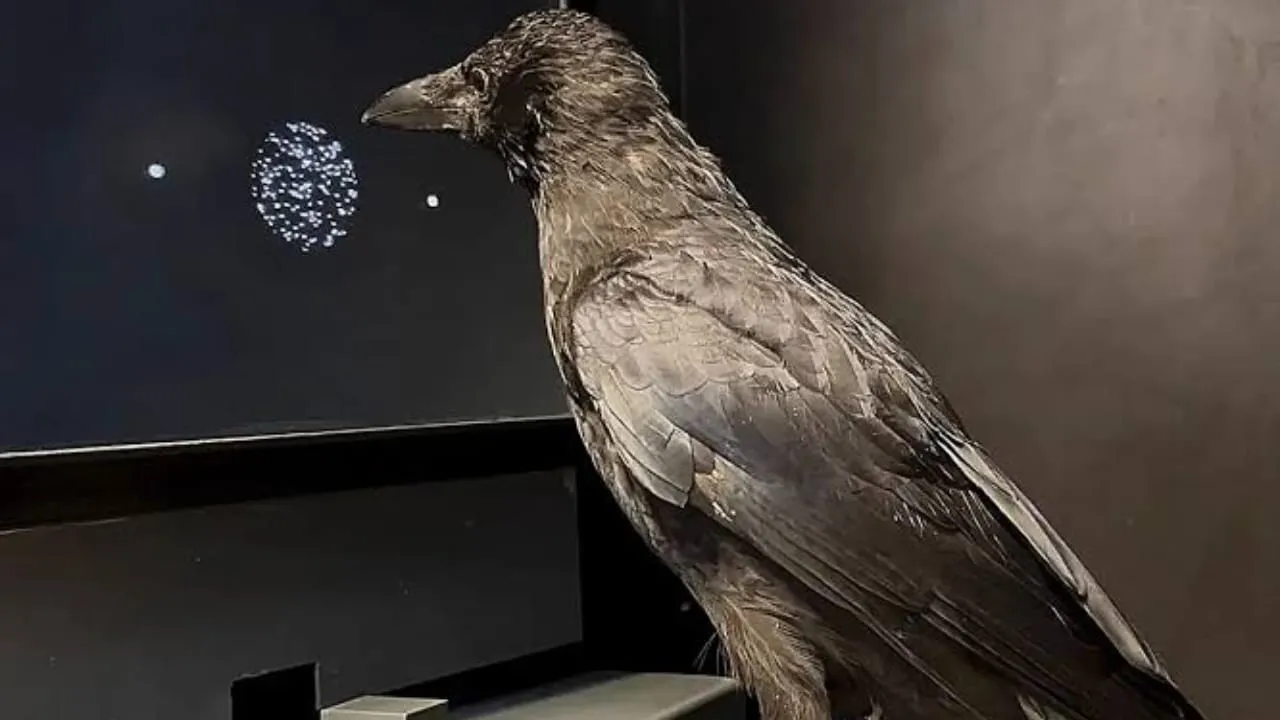
Visual decisions are made twice as fast by crows compared to humans and monkeys, according to a study by researchers at the University of Tübingen published in the journal Science. During tests, two carrion crows required an average of only 235 milliseconds to identify the direction of a moving dot pattern and select their answer accurately.
Philipp Schmidbauer and Professor Andreas Nieder, working at the University of Tübingen's Institute of Neurobiology, observed this rapid decision speed directly in the neural activity of the birds. The testing required the crows to determine whether moving dots on a touchscreen traveled left or right, and the animals indicated their choice by pecking a target on the corresponding side.
"Even when the patterns of motion were hard to recognise, the crows' decisions were still better than random choices," Schmidbauer said. "And with clear signals, they achieved an accuracy of nearly 100%."
Researchers recorded neuron activity in the nidopallium caudolaterale, a critical region of the crow brain comparable to the human prefrontal cortex. Only 70 milliseconds after the visual cue appeared, neurons displayed distinct signals for each motion direction prior to any physical response from the birds.
As decisions formed, neural activity built up gradually until reaching a threshold where the crow signaled its selection. The recorded neurons tracked both the strength of the visual data and the chosen direction.
"These findings show that neuronal dynamics in the avian brain are consistent with established models of decision-making in humans and nonhuman primates," Nieder said.
Despite lacking a layered cerebral cortex, differently organised bird brains execute comparable decision principles at twice the speed of primates. Nieder noted this velocity likely results from evolutionary demands for fast visual processing and motor reactions during flight and foraging.