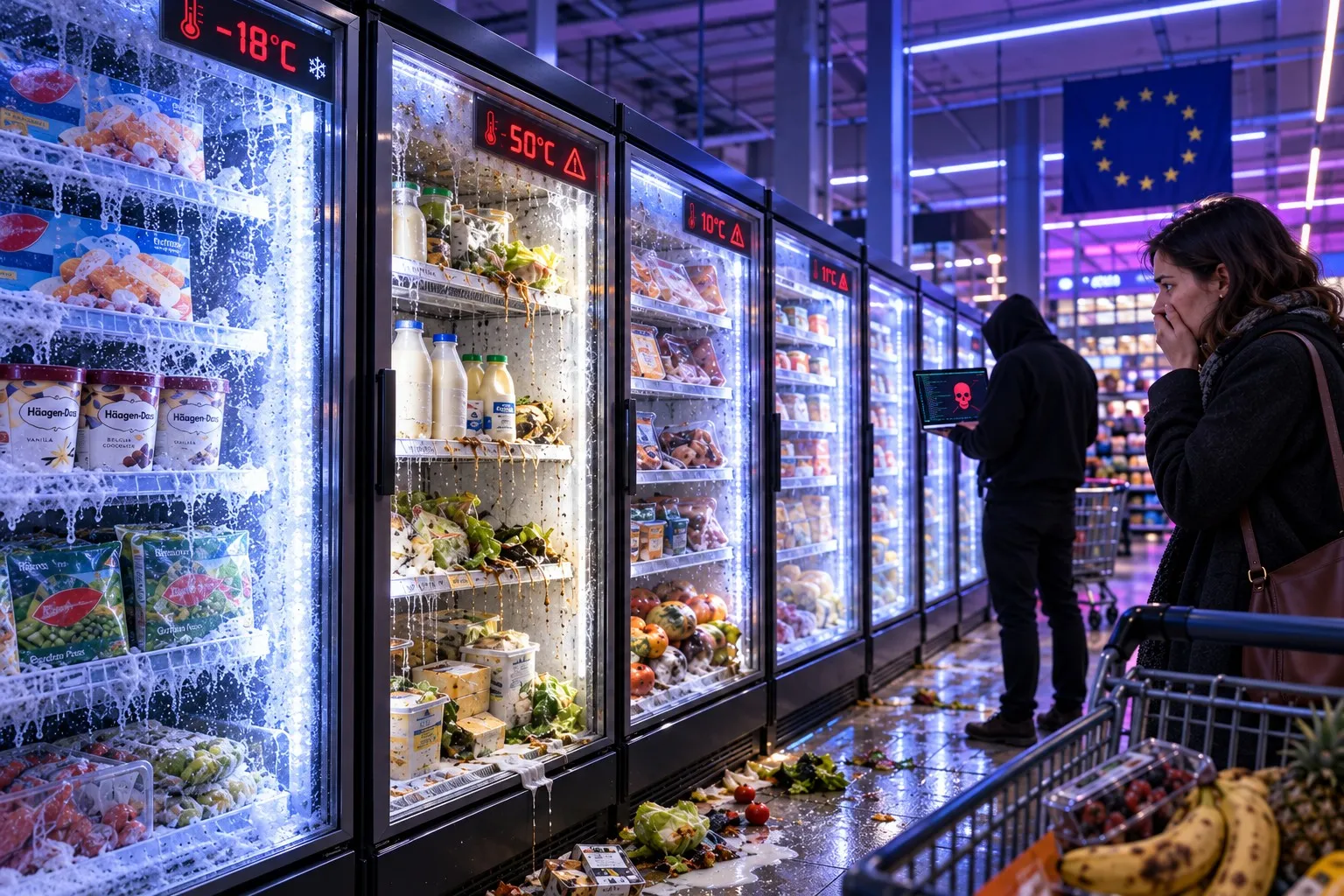
European Supermarket Refrigeration Systems Targeted by Hackers
Cyberattacks on hundreds of supermarket fridges and freezers across Europe have driven temperatures to between 50 and 70 degrees Celsius, spoiling large quantities of food. The incidents have affected several grocery chains, with Sweden opening investigations and retailers in Belgium and Ireland confirming disruptions.
The coordinated digital intrusions hit critical temperature-control infrastructure overnight, leaving store managers to discover the ruinous heat hours after the initial breach. Retail operations from Scandinavia to Western Europe now face urgent questions regarding the security of connected commercial hardware. Security analysts point out that modern retail facilities rely heavily on centralized digital management platforms to monitor perishable inventory across vast regional networks.
Freezers Heated Up Overnight Across Multiple Countries
According to Reuters, attacks on Monday disrupted refrigeration and freezer systems at supermarket chains from Sweden to Belgium. Dozens of stores in Belgium and Luxembourg were affected, while Swedish grocery chains ICA and Coop reported similar incidents.
Angela Ingvall, sales manager at an ICA franchise store in Stockholm, told Reuters that temperatures in all the store's freezers reached about 50 degrees Celsius after the attack. She said it happened at around 2 a.m. but was not discovered until several hours later, by which time products had spoiled.
The timing of the digital assault minimized immediate human oversight, allowing malicious commands to alter hardware settings while stores remained closed. Facility management software typically automates temperature adjustments for energy efficiency, but unauthorized external access bypassed standard operational safeguards.
Retailers Confirm Affected Stores and Inventory Losses
Retailers in Belgium and Ireland have outlined the impact on their networks. In Ireland, some chilled and frozen goods were withdrawn from sale as a precaution following the disruption.
- Carrefour said 15 of its 700 stores in Belgium were affected.
- Colruyt Group said refrigeration systems at five SPAR stores in its franchise network were targeted.
- Irish food wholesaler Musgrave said refrigeration systems at 13 SuperValu stores were affected by a cyber incident, prompting the precautionary removal of some products.
Store operators scrambled to assess inventory integrity as internal sensors reported extreme thermal spikes. Products that thawed or heated beyond safety thresholds were immediately condemned to prevent public health hazards. Supply chains face secondary strains as merchants rush to restock empty display units before regular customer traffic peaks.
Investigations Follow Earlier Attacks in France
Sweden's National Cyber Security Centre has begun investigating multiple incidents involving grocery stores across the country. Reuters reported that no group had claimed responsibility for the latest attacks.
The incidents follow cyberattacks on hundreds of supermarket cooling units in France last month. In those cases, hackers increased cooling-system temperatures, with fires reported at some locations and food going to waste.
It remains unclear whether the recent attacks in Sweden, Belgium and other European countries are connected to the earlier incidents in France. Law enforcement agencies across multiple jurisdictions are sharing technical indicators to trace the origins of the unauthorized network commands.
Connected Equipment Broadens Commercial Exposure
Cybersecurity experts say modern retail stores increasingly connect refrigeration, heating, security cameras, alarms, door controls and checkout systems to networks. Those connections create additional routes for attackers to exploit.
The latest incidents have heightened concerns in Europe that cyberattacks can reach beyond computers and data to disrupt physical and industrial systems used in everyday life.
Commercial refrigeration units often use standard operating software or remote management portals intended for vendor maintenance. When security protocols on these external access points remain unpatched, malicious actors can exploit vulnerabilities to alter physical parameters. Industry associations now urge members to audit connected operational technology assets immediately.
Understanding the Vulnerabilities in Commercial Cold Chains
The cold chain refers to the temperature-controlled supply chain that preserves the quality of perishable goods from farm to retail display. Disrupting this chain through digital means demonstrates a new vector for food security threats. Supermarket refrigeration units require precise calibration to maintain health standards for dairy, meat, and frozen meals.
When hackers override these settings to generate extreme heat, the damage extends beyond mere financial loss for franchise owners. The destruction of large volumes of foodstuffs creates localized supply shortages and increases waste within the agricultural distribution network. Authorities continue to monitor store telemetry data to detect abnormal commands before thermal damage occurs.
What Watchdogs and Retailers Are Doing Next
National cybersecurity authorities across Europe are issuing urgent advisories to commercial property managers. Retail enterprises are reviewing network segmentation policies to separate corporate administrative computers from physical store infrastructure. Hardware vendors face increased pressure to implement stronger authentication requirements for remote diagnostic tools.
As investigations proceed, store operators are implementing manual temperature verification checks during overnight hours. Watchdogs advise the public to watch for official updates from food safety agencies regarding retail supply chain stability. Future security frameworks will likely mandate stricter compliance standards for all connected Internet of Things devices deployed in commercial spaces.