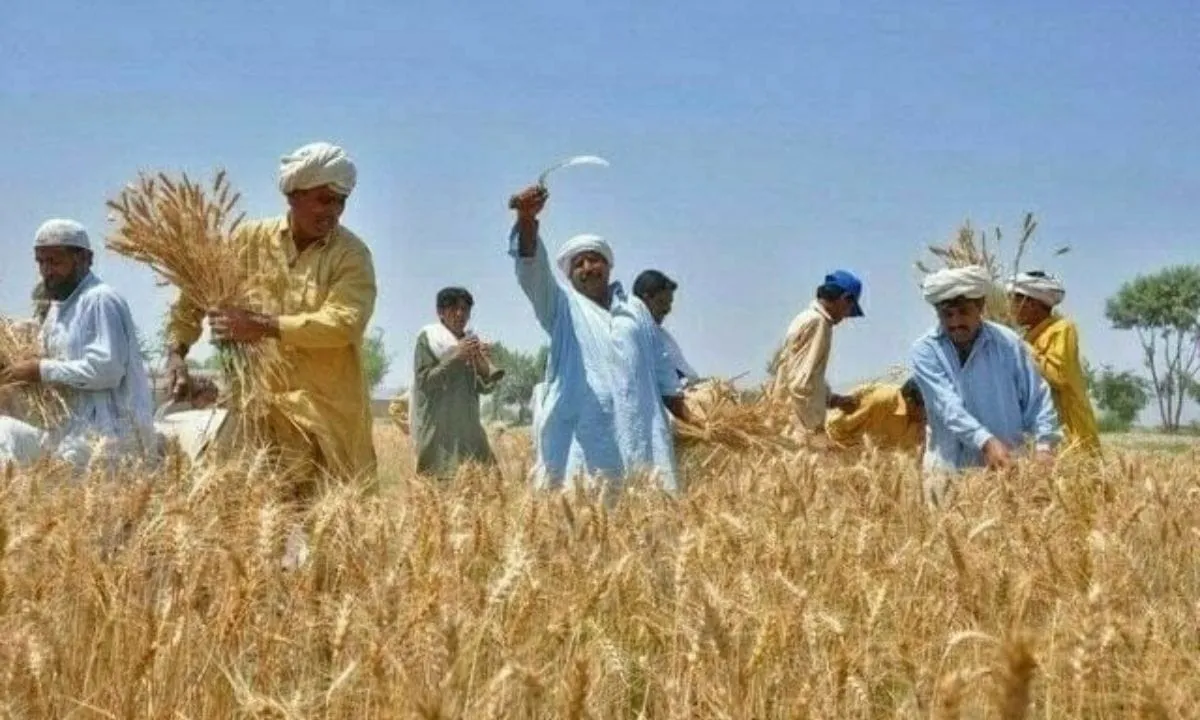
Punjab Chief Minister Maryam Nawaz Sharif revealed 10 major projects for agricultural workers on Wednesday, featuring the establishment of the initial Apna Kisan Bank, interest-free financing reaching up to Rs100 million, an increased Kisan Card credit limit, and a dedicated olive farming package.
During a speech before an audience of small, medium, and large growers, she stated that the administration will execute the wheat support rate of Rs4,500 per maund, following the choice made by the central government. She also boosted the Kisan Card credit maximum by Rs3,500 per acre, moving it from Rs30,000 to Rs33,500.
Based on the planned credit structure, agricultural workers can secure borrowings up to Rs100 million with zero markup. Borrowings up to Rs300 million will feature a two per cent interest charge, while those up to Rs500 million will carry a five per cent rate.
The chief minister mentioned that the administration is supplying Rs17 billion in discounted farm credit. Over one million small growers currently benefit from the Kisan Card initiative, with digital systems guaranteeing merit-based distribution and cutting down reliance on middlemen. She noted that credit repayment stayed near 100 per cent, and measures are underway to bring tenant growers and leaseholders into the scheme.
She stated that Punjab satisfies about 70 per cent of the nutritional needs across the nation. She further noted that the administration pushed back against International Monetary Fund pressure regarding agricultural income levies while maintaining oversight over fertilizer availability and costs.
Regarding farm mechanization, she reported that 25,000 tractors have already been distributed through subsidies, while an additional 50,000 are being made available via the Green Tractor Scheme. The administration is setting aside Rs70 billion for advanced agricultural mechanization. Domestic manufacturers build roughly 30,000 tractors, and the region prepares to build its first harvester assembly and tractor production facilities.
Agricultural processing zones are being developed in Sargodha, Bhakkar, Khanewal, and Okara. These sites will offer sorting, processing, and warehousing services for mangoes, kinnow, oranges, potatoes, and alternative harvests to cut down post-harvest waste and back overseas sales. She stated that higher wheat yields will additionally enable the export of processed goods like pasta.
Through the Apna Khet, Apna Rozgar project, agricultural workers are gaining bonuses and monetary aid for wheat farming. A wheat purchasing strategy and a web portal for digital handling will debut shortly. The administration has assigned 1,500 agricultural interns, with each receiving Rs70,000 monthly, and is rolling out portable soil-fertility and water-testing units.
Concerning irrigation, the chief minister stated that the administration is supplying high-capacity irrigation setups and constructing 400 small dams within the Potohar zone. Water channels will receive lining, canal clearing will be enhanced, and the push against water theft will persist.
She additionally unveiled a specialized bundle and financial aid for olive farming and congratulated Pakistan on achieving permanent membership in the International Olive Council, following prior years as an observer.
Within livestock, 400,000 animals underwent fattening during the past year, and the administration plans to prepare another 600,000 in the current year. The chief minister asked growers to halt the burning of harvest waste to help fight smog and mentioned that their suggestions will receive review for execution in stages.
Provincial Agriculture Minister Ashiq Hussain Kirmani expressed gratitude to the chief minister for dedicating her birthday to agricultural workers and stated that processing projects are being initiated to guarantee better profits for producers.
Growers Hassan Raza, Amir Hayat Bandesha, Bilal Khan, and Sajjad Ali expressed approval for the wheat support rate, the Kisan Card, and the push against water theft. Bilal Khan stated that olives cultivated in Punjab could become ready for export within two to three years.