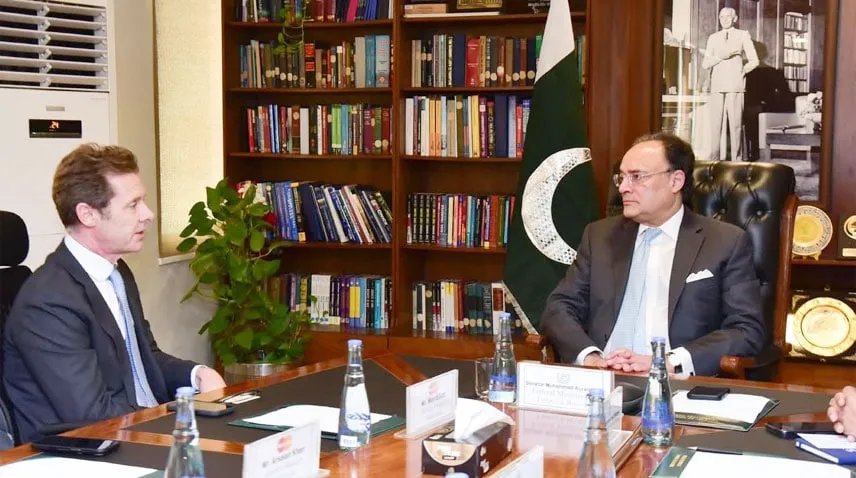
Federal Minister for Finance and Revenue Senator Muhammad Aurangzeb met a Mastercard delegation led by Mark Elliott, Division President for East Arabia, to discuss cooperation in digital payments, financial inclusion and cybersecurity as Pakistan continues its efforts to promote a cashless economy.
What Was Discussed at the Meeting?
The meeting focused on three core areas: expanding digital financial services, strengthening payment infrastructure and enhancing cybersecurity. Aurangzeb highlighted the government's commitment to expanding digital financial services, improving transparency and increasing access to banking facilities. He emphasized the role of digital payments in supporting agriculture, small and medium enterprises (SMEs) and underserved communities under the Prime Minister's cashless economy initiative.
Both sides also discussed strengthening digital payment infrastructure, improving cross-border remittances and enhancing cybersecurity and fraud prevention. Mark Elliott reaffirmed Mastercard's long-term commitment to Pakistan and expressed interest in supporting the country's digital transformation through its global expertise and technology.
Why Is Pakistan Pursuing a Cashless Economy?
Pakistan's cashless agenda dates back to the 2018-2022 period when the government introduced the "Digital Pakistan" vision. The strategy aims to reduce reliance on cash, lower transaction costs, and improve tax compliance. By digitising payments, the state hopes to broaden the tax base, curb informal economic activity and increase financial inclusion for the estimated 100 million unbanked adults.
Key policy instruments include the State Bank of Pakistan's (SBP) "Digital Payments Strategy 2023-2027," which mandates electronic payment channels for government disbursements, encourages mobile money agents and sets standards for interoperable platforms. The strategy also requires banks to offer low-cost digital accounts and to integrate biometric verification for security.
How Do Public-Private Partnerships Fit Into the Plan?
Public-private partnerships (PPPs) are central to Pakistan's digital payments roadmap. The government leverages the expertise of global card networks, fintech firms and technology providers to accelerate infrastructure rollout. Mastercard, Visa and other card schemes have previously partnered with SBP to launch the "Pakistan Card" initiative, which provides low-cost debit cards linked to mobile wallets.
In this context, the meeting between Aurangzeb and Elliott is a continuation of an existing collaboration framework. Mastercard's long-term commitment, as reaffirmed by Elliott, includes providing technical assistance, sharing best practices on fraud detection and supporting the development of a secure, interoperable payment ecosystem.
What Are the Expected Benefits for Agriculture and SMEs?
Agriculture accounts for roughly 20 % of Pakistan's GDP and employs a large share of the rural population. Digital payments can streamline subsidy delivery, reduce leakages and enable farmers to receive payments directly on mobile wallets. For SMEs, electronic transactions lower the cost of cash handling, improve cash flow management and open access to credit scoring models that rely on transaction histories.
By integrating digital payment solutions, the government hopes to create a data-driven environment where creditworthiness can be assessed more accurately, leading to increased lending to small businesses. This, in turn, supports job creation and economic diversification.
How Will Cybersecurity and Fraud Prevention Be Addressed?
Cybersecurity is a critical component of any digital payments strategy. The meeting highlighted the need for robust fraud-prevention mechanisms, real-time transaction monitoring and secure authentication protocols. Mastercard brings its global security suite, including tokenisation, biometric verification and AI-driven fraud analytics, which can be adapted to Pakistan's regulatory environment.
The State Bank of Pakistan has issued guidelines on cyber risk management for banks and payment service providers, requiring regular vulnerability assessments and incident-response plans. Collaboration with Mastercard is expected to help local institutions meet these standards and to build capacity among regulators.
What Are the Immediate Next Steps?
Both sides agreed to maintain engagement and explore further opportunities for cooperation. Specific next steps include:
- Establishing a joint working group to map gaps in the current digital payment infrastructure.
- Conducting a pilot project for cross-border remittances that leverages Mastercard's global network.
- Developing a roadmap for integrating biometric authentication into mobile wallets for rural users.
- Organising a series of workshops on cybersecurity best practices for banks, fintech firms and regulators.
The timeline for these initiatives will align with the State Bank's Digital Payments Strategy milestones, which set quarterly targets for transaction volume growth and reduction of cash-based payments.
Impact on Citizens, Businesses and the Economy
For ordinary citizens, especially those in underserved regions, the push toward digital payments promises faster, more transparent access to government benefits and salaries. For businesses, especially SMEs, the move reduces transaction costs, improves cash management and opens pathways to digital credit. At the macro level, increased electronic transaction data can enhance tax collection, support monetary policy monitoring and attract foreign investment in the fintech sector.
What Challenges Remain?
Despite the enthusiasm, several challenges persist. Internet penetration remains below 40 % in rural areas, limiting the reach of mobile-based solutions. Financial literacy gaps mean many potential users are unfamiliar with digital wallets or electronic banking. Additionally, cybersecurity threats continue to evolve, requiring ongoing investment in security infrastructure and talent development.
Addressing these challenges will require coordinated action across ministries, the central bank, private sector players like Mastercard and civil society organisations that promote digital literacy.
What to Watch for in the Coming Months?
Stakeholders should monitor the establishment of the joint working group and the launch of any pilot projects. Announcements from the State Bank of Pakistan regarding updated cybersecurity regulations or new digital payment standards will also be key indicators of progress. Finally, any public statements from Mastercard about further investments or technology deployments in Pakistan will signal the depth of the partnership.