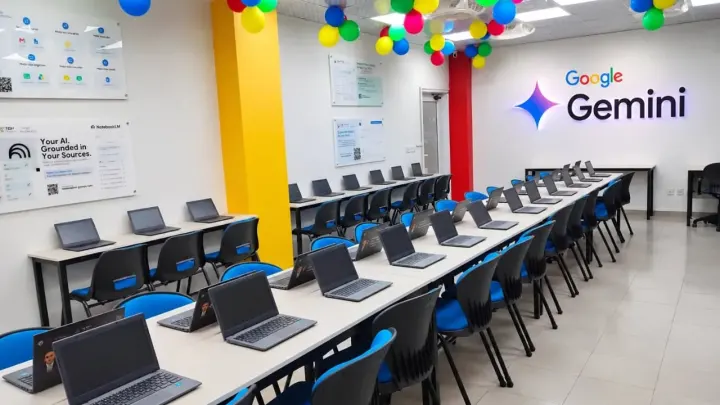
Google faced swift backlash on Tuesday after announcing that educational institutions using its K-12 software platforms will lose access to Google Search unless they choose to opt in to artificial intelligence tools. The announcement arrived on a busy Election Day, yet it immediately drew condemnation from prominent lawmakers and public figures who questioned the fairness of tying a basic information tool to unproven classroom technology.
Chris Phillips, vice president for education at Google, explained the technical justification to reporters by stating that search functions and artificial intelligence are deeply integrated. He noted that if a student attends a school that declines to use artificial intelligence programs such as Gemini, those students will not have access to search, and they will see a message from their school that indicates it is not available.
Why Lawmakers and Regulators Are Criticizing Google
The policy change triggered immediate protests from political figures who view the move as an aggressive tactic to force adoption of new digital products. Critics argued that educational institutions should retain the freedom to regulate technology use without facing penalties that disrupt student learning.
Senator Bernie Sanders accused Google of extortion through a public statement on social media. He wrote that Google is threatening schools by stating that if they stop students from using artificial intelligence, the company will cut off access to Google Search.
Senator Richard Blumenthal also voiced strong objections on social media. He stated that the corporation appears more concerned with forcing Gemini into classrooms than with enabling students to succeed.
Antitrust Concerns and Market Dominance
The controversy renewed scrutiny over the market power of major technology companies and their control over essential public infrastructure. Observers pointed out that bundling products together creates unfair conditions for institutional buyers who rely on standard digital tools.
Lina Khan, the former Federal Trade Commission chair and an outspoken critic of monopolies, condemned the decision as anti-competitive behavior. She wrote that the situation highlights the danger of allowing an unregulated monopolist to control an essential service.
She added that multiple courts have found Google liable for violating antitrust laws, and this latest move shows the company remains unchastened. New York City Mayor Zohran Mamdani similarly accused the technology giant of monopolistic overreach, commenting that no corporation should have the power to dictate how children are taught.
President Trump claimed that AI oligarchs could regulate themselves because they “love our country.”
— Sen. Bernie Sanders (@SenSanders) November 3, 2026
Now, Google is threatening schools: if you stop your students from using AI, we will cut off your access to Google Search.
That’s not love. That’s extortion.
PAUSE AI NOW.
The Practical Impact on Students and Chromebook Users
The restriction poses significant hurdles for millions of students who rely on Chromebook laptops and Google software packages mandated by their districts. While Google Search remains a fundamental tool for gathering information, educators harbor deep concerns that built-in artificial intelligence overviews discourage students from conducting independent research and critical thinking.
For students whose hardware and software environments are strictly managed by school IT departments, switching to an alternative search engine is not a simple fix. Operating systems and browser policies on institutional devices often lock users into default ecosystems, leaving students with few workarounds if search capabilities are disabled.
Google is using its search monopoly to coerce schools into adopting AI. This highlights the danger of allowing an unregulated monopolist to control an essential service.
— Lina Khan (@linamkhan) November 3, 2026
Multiple courts have found Google liable for violating antitrust laws, and this latest move shows it remains… https://t.co/eajJN9yfQF
Google Response and the Proposed Guided Learning Tool
In defense of the new framework, Google highlighted an upcoming feature called Guided Learning designed specifically for student accounts within Search. The company intends for this feature to walk students through the process of solving a problem or finding information rather than simply delivering a direct answer.
For example, if a student struggles with a mathematics problem, the system might prompt them to refresh their memory regarding the rules for dividing exponents instead of spitting out a final number. Google also pointed out via social media that it listened to educators by turning off access to artificial intelligence products by default.
The company noted that schools possess the technical ability to turn on Gemini, Gemini Notebook, and Search individually.
We want to clarify what we announced today about our education services. Today’s announcements give schools more choice, not less. Here’s what we announced:
— News from Google (@NewsFromGoogle) November 3, 2026
– Gemini, Gemini Notebook, and Search will be OFF 🔴 by default. This is based on K-12 schools asking for more control…
Future Outlook for School Technology Policies
Google defended its overall strategy by releasing a formal statement addressing the feedback gathered from educational professionals in recent months. The company stated that it understands concerns regarding students using artificial intelligence to shortcut schoolwork and that schools want greater oversight.
The technology firm insisted that the current adjustments directly respond to educator feedback and promised to continue engaging closely with schools. The stated goal is to provide institutions with more choices, better administrative controls, and improved search functionality tailored for learning environments.