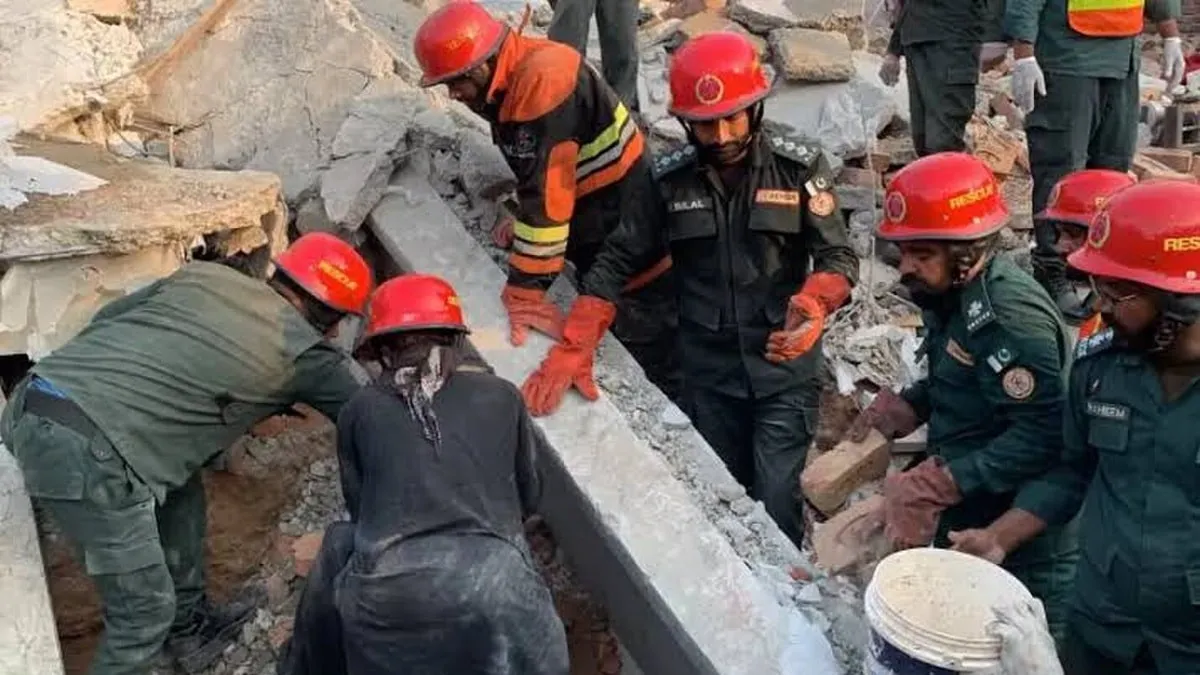
A 28-year-old laborer died and another was rescued after a large mass of soil collapsed at an underpass construction site in Jamil Chowk on the outskirts of the provincial capital on Tuesday.
Rescue 1122 confirmed that two laborers were trapped when the soil gave way, prompting an emergency response that included two ambulances and a dedicated search team.
What Happened at the Jamil Chowk Construction Site?
According to the official statement from Rescue 1122, the collapse occurred during routine excavation for an underpass that is part of a broader urban road-improvement scheme. The site is located at Jamil Chowk, an intersection that lies on the periphery of the provincial capital and serves as a key entry point for commuters traveling to the city centre.
When the soil mass shifted, it buried two laborers under a thick layer of earth. Rescue crews arrived within minutes, deploying two ambulances and a team of trained personnel equipped with shovels, hand-held metal detectors, and breathing apparatus to locate and extricate the victims.
One worker was pulled out alive after a coordinated effort that lasted roughly thirty minutes. The second worker, later identified as 28-year-old Naveed, was not found until after an extended search. His body was recovered later in the day, confirming the tragic loss.
Why Is the Underpass Project Important for the Region?
The underpass at Jamil Chowk is part of a provincial government initiative to de-congest traffic on the main arterial road that connects the capital with surrounding towns. The project aims to provide a grade-separated crossing that will allow vehicles to bypass the busy surface intersection, reducing travel time and improving safety for commuters and pedestrians.
Similar underpasses in the province have reduced average commute times by up to 15 minutes during peak hours, according to a 2022 transport study conducted by the provincial planning department. The Jamil Chowk underpass is expected to serve an estimated 40,000 vehicles per day once completed.
How Do Rescue Operations Work in Construction Accidents?
Rescue 1122, the provincial emergency response agency, follows a standard protocol for construction-site incidents. The steps include:
- Immediate dispatch of the nearest ambulance and rescue team.
- Site assessment to determine the stability of the collapsed material.
- Use of hand tools and, where available, lightweight lifting equipment to carefully remove debris.
- Medical triage on-site for any survivors, followed by rapid transport to the nearest hospital.
- Recovery of deceased personnel, with documentation for legal and compensation processes.
In this incident, the team adhered to these steps, successfully rescuing one laborer and later recovering Naveed's body.
What Safety Measures Are Typically Required on Construction Sites?
Pakistani labour law and provincial safety regulations mandate several safeguards for workers engaged in earth-moving activities:
- Provision of personal protective equipment (PPE) such as helmets, safety boots, and high-visibility vests.
- Regular geotechnical assessments to evaluate soil stability before excavation begins.
- Shoring or benching of excavation walls to prevent collapse.
- Presence of a qualified site supervisor trained in occupational safety.
- Immediate reporting of any signs of ground movement or water seepage.
While the article does not specify whether these measures were in place at Jamil Chowk, the occurrence of a sudden soil collapse suggests that either the geotechnical assessment was insufficient or that unexpected soil conditions arose.
Impact on Workers, Contractors, and the Local Community
The loss of Naveed, a 28-year-old laborer, reverberates through his family, coworkers, and the broader community of construction workers who often rely on daily wages for livelihood. Labor unions in the province have historically called for stricter enforcement of safety standards, and incidents like this tend to reignite those demands.
For the contractor responsible for the underpass, the accident may trigger an internal safety audit, possible fines, and a review of insurance coverage. The provincial government could also launch an investigation to determine if any regulatory breaches occurred.
Local residents who depend on the underpass for smoother traffic flow may experience temporary delays as the site remains cordoned off for investigation and any necessary remedial work.
What Are the Next Steps After the Collapse?
Following the recovery of Naveed's body, the standard procedure involves several actions:
- Police and the provincial labor department will open a case to determine the cause of the collapse.
- The site will be secured, and a structural engineer will conduct a detailed geotechnical survey.
- Depending on the findings, the contractor may be required to redesign excavation support systems before work can resume.
- Compensation claims will be processed for Naveed's family under the provincial workers' compensation scheme.
- Rescue 1122 will debrief the operation to identify any procedural improvements for future incidents.
No timeline has been announced for when construction can safely restart, but authorities have indicated that work will not resume until the investigation is complete and any identified safety gaps are addressed.
How Families and Communities Can Seek Support
In the event of a worker's death, the provincial labor department provides a one-time compensation package to the next of kin, typically calculated based on the worker's age and average earnings. Families can also approach local NGOs that offer counseling and financial assistance to bereaved households.
Workers' unions often step in to ensure that the deceased's family receives the full entitlement under the law and to advocate for improved safety training for all laborers on the site.
What to Watch for in Future Reports
Stakeholders should monitor official statements from the provincial labor department, the contractor's press releases, and any court filings that may arise from the investigation. Updates on the geotechnical findings and any policy changes regarding construction safety in the province will also be key indicators of how the incident influences broader regulatory practices.
For now, the focus remains on supporting Naveed's family, ensuring the safety of the remaining workforce, and completing a thorough investigation to prevent similar tragedies.