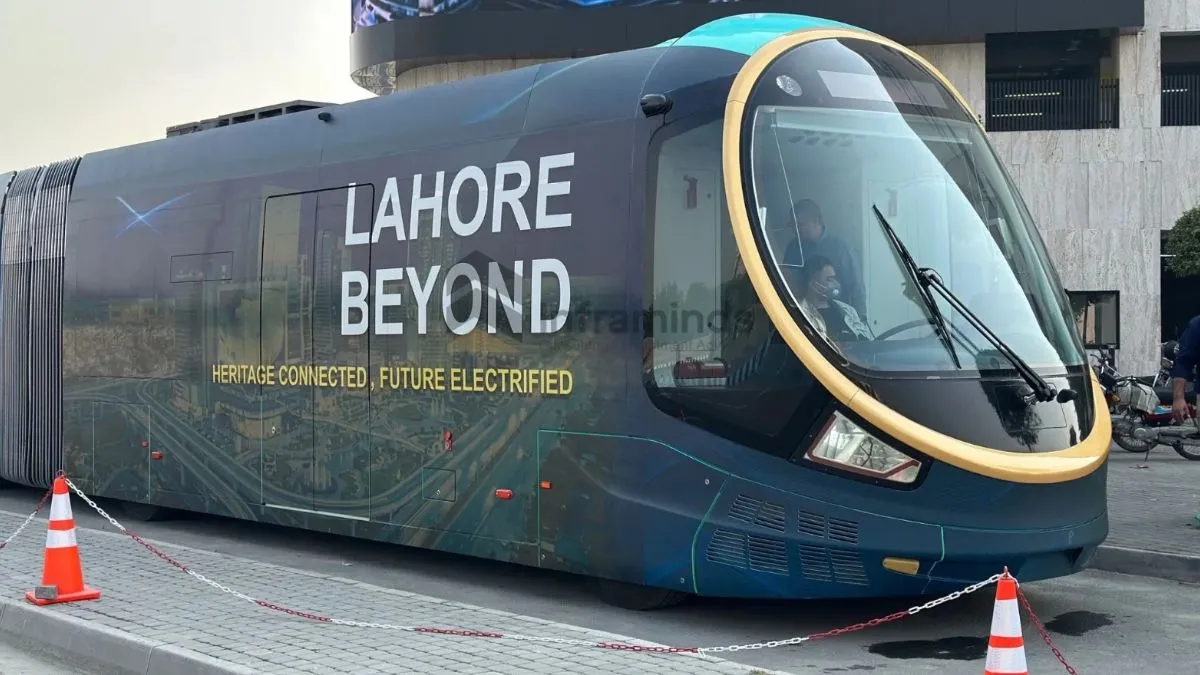
Punjab Chief Minister Maryam Nawaz announced Lahore's trackless electric tram is set to begin operating on city roads next week. The three-coach vehicle, designed with gold-trimmed windshields and artwork depicting Lahore's most iconic landmarks, will join the city's existing Metro bus and Orange Line services as a new high-capacity public-transport option.
The launch marks the culmination of a multi-year effort involving the ZKB–BT joint venture (Zahir Khan & Brother and Bilal Travels) and Inframinds Consulting, which acted as transaction advisor from bid preparation through contract signing.
What the New Tram Looks Like Inside and Out
The tram's dark blue exterior is wrapped with the "Lahore Beyond" branding and vivid illustrations of Lahore Fort, Badshahi Mosque, and Minar-e-Pakistan. A portrait of Maryam Nawaz and the slogan "Heritage Connected, Future Electrified" appear prominently, reinforcing the government's narrative of blending cultural pride with modern mobility.
Three coaches are linked by accordion-style joints, creating a flexible yet stable unit. The windshields feature gold trimming that catches sunlight, giving the tram a distinctive visual identity on the city's streets.
Inside, orange seats line the walls, leaving a wide aisle for standing passengers. Overhead rails and orange hand straps run the length of the cabin, while digital displays above each door provide route information and service announcements. The driver's cab is equipped with a steering wheel and multiple screens that monitor vehicle diagnostics, passenger count, and navigation data.
Planned passenger amenities include air conditioning, closed-circuit television (CCTV) for security, and Wi-Fi connectivity, aligning the tram with contemporary expectations for comfort and safety.
How the Trackless Tram Operates
The vehicle is a Chinese-made Super Autonomous Rapid Transit (SRT) system that runs on rubber tires rather than steel rails. An array of cameras, lidar sensors, and electronic guidance modules enables the tram to follow a virtual track defined by GPS waypoints and road markings. This technology eliminates the need for costly rail installation and allows the tram to navigate ordinary city roads.
Powered by a high-capacity battery pack, the tram produces no direct exhaust emissions, contributing to Lahore's air-quality improvement goals. It can accommodate roughly 250 to 320 passengers per trip, a capacity comparable to traditional trams but with the route flexibility of a bus.
Why Lahore Chose a Trackless System
Lahore's rapid urban growth has strained its existing public-transport network. The Metro bus system, launched in 2013, and the Orange Line metro, inaugurated in 2020, have eased congestion but still fall short of meeting peak-hour demand. A trackless tram offers a middle ground: higher capacity than a standard bus, lower infrastructure cost than a rail-based tram, and the ability to be deployed on existing roadways.
Financially, the trackless system reduces capital outlay because it avoids the excavation, track laying, and signaling works required for conventional trams. The involvement of Inframinds Consulting as transaction advisor helped structure financing that balances public investment with private sector participation through the ZKB–BT joint venture.
Background of Lahore's Public-Transport Evolution
Since the early 2000s, Lahore has pursued a series of transport upgrades to address chronic traffic congestion and air pollution. The Metrobus, a dedicated-lane bus rapid transit (BRT) system, added 27 km of corridor and over 70 stations. The Orange Line, a 27.1 km elevated metro, became the city's first heavy-rail urban rail line, carrying an average of 250,000 passengers daily.
Despite these investments, the city's population, estimated at over 13 million, continues to outpace capacity. Studies by the Lahore Development Authority (LDA) and the Punjab Planning and Development Department have repeatedly highlighted the need for additional high-capacity, low-emission options, especially in densely populated inner-city districts.
Project Timeline and Key Players
The trackless tram project began with a public-private partnership (PPP) tender issued in early 2022. ZKB–BT formed a joint venture to bid, leveraging Zahir Khan & Brother's construction expertise and Bilal Travels' transport operations experience. Inframinds Consulting was appointed as transaction advisor, guiding the consortium through financial modeling, risk allocation, and contract negotiations.
After a competitive evaluation, the contract was awarded in mid-2023. Manufacturing and assembly of the SRT vehicles were completed in China, followed by shipping to the Port of Karachi and overland transport to Lahore. Final testing on a dedicated stretch of road near the Lahore Ring Road concluded in February 2024, confirming compliance with safety and performance standards set by the Punjab Transport Authority.
Impact on Commuters and the City
When operational, the tram will run on a 12-km corridor linking key commercial and residential zones, including Gulberg, Model Town, and the historic Old City. By providing a high-capacity, zero-emission alternative, the tram is expected to reduce private-car trips, alleviate congestion, and lower ambient particulate matter (PM2.5) levels.
For daily commuters, the tram promises smoother rides, shorter travel times during peak periods, and the convenience of digital passenger information. The inclusion of Wi-Fi and air-conditioning addresses comfort expectations for middle-income riders who currently rely on crowded buses.
What Comes Next: Operational Details and Future Plans
The inaugural service is slated for next week, with a soft-launch phase that will test passenger flow, fare collection, and real-time monitoring systems. Fares will be integrated with the existing Metrobus smart-card platform, allowing seamless transfers across modes.
Punjab's transport ministry has indicated that, pending successful operation, additional trackless tram corridors could be explored in other high-density corridors such as the Shahdara-Ravi Road and the Lahore-Islamabad Motorway feeder routes.
Stakeholders are watching the pilot closely. The Punjab Planning and Development Board will publish a performance report after six months, evaluating ridership numbers, operational reliability, and environmental impact. Those metrics will inform any decisions on scaling the technology city-wide.
Practical Takeaways for Residents
Commuters should prepare for the new service by ensuring their Metrobus smart-cards are topped up, as cash payments will not be accepted on the tram. Digital displays at stations will announce the exact boarding points; the first stops are expected to be near Mall Road and the Lahore Railway Station.
Businesses along the tram corridor can anticipate increased foot traffic, especially near stations featuring the heritage artwork that doubles as a tourist draw. Local vendors may benefit from higher passenger volumes, but should also plan for possible temporary road closures during final route fine-tuning.
Overall, the launch represents a tangible step toward a more sustainable, integrated urban mobility system for Lahore, aligning with Pakistan's broader climate-action commitments under the Paris Agreement.