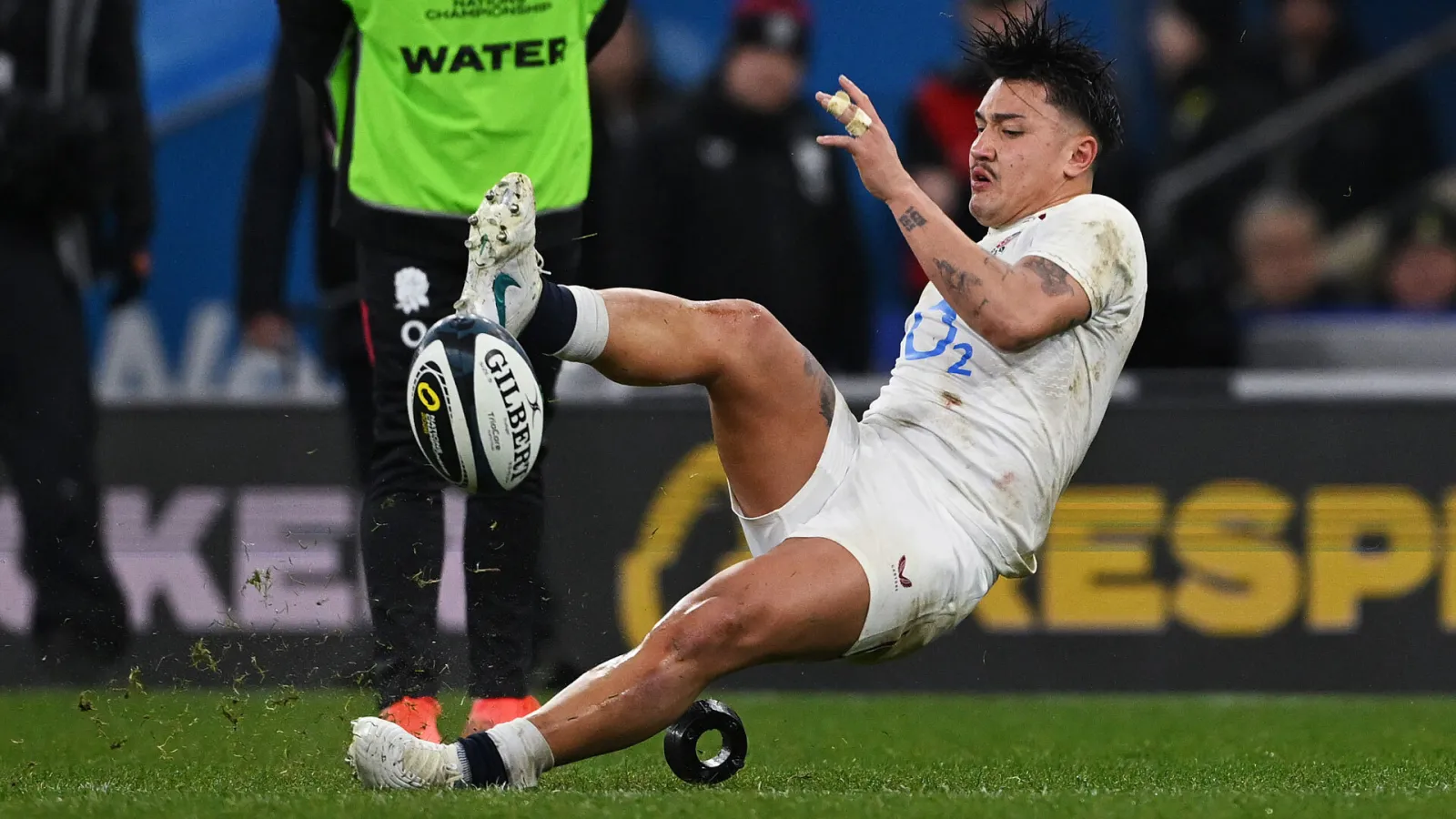
England fly-half Marcus Smith suffered a painful slip while attempting a conversion in the Nations Championship third-place final, as New Zealand beat England 26-8 at Twickenham on Sunday.
The 27-year-old was sent tumbling after Jamie George's 74th-minute rolling-maul try, and the mishap underscored a night that saw England drop two places to fifth in the World Rugby rankings.
What Happened During the Conversion Slip?
Smith lined up a routine conversion from the 22-metre line after England trailed 23 points. As he planted his left foot on the sodden grass, the footing gave way and he slipped onto his bum. The ball bobbled to the right, allowing All Blacks playmaker Richie Mo'unga to attempt a charge-down. Smith recovered quickly, but the missed point left England with a widening deficit.
England had been hoping the conversion would narrow the gap and give the bench-substituted Smith a chance to inject momentum. Instead, the slip became a visual metaphor for England's overall performance, which fans on social media described as "the worst performance ever."
How the Match Unfolded: Key Moments and Scoring Timeline
New Zealand opened the scoring in the 16th minute when number eight Wallace Sititi crossed for a try, putting the three-time Rugby World Cup winners ahead. England responded quickly, with outside centre Henry Slade slotting a long-range penalty inside the first two minutes, a reminder of the earlier 78-15 victory over Japan where Slade was preferred at the tee.
After Sititi's try, the All Blacks maintained pressure. Scrum-half Cam Roigard added a try shortly after half-time, and his halfback partner Mo'unga contributed a conversion and four penalties. England's discipline faltered when back-row Henry Pollock and Northampton teammate Alex Coles were each sin-binned, further limiting their ability to mount a comeback.
Jamie George's rolling-maul try in the 74th minute sealed the result. The conversion attempt that followed produced the slip, and New Zealand's lead stretched to 26-8.
Why the Slip Matters: Impact on Rankings and Future Fixtures
New Zealand's victory temporarily lifts them to third in the World Rugby rankings, overtaking France ahead of the French-South Africa Nations Championship final on Sunday. England's loss drops them to fifth, two places lower than before the match. The ranking shift reflects not only the result but also the points differential, which heavily favoured the All Blacks.
For England, the defeat means a less favourable seeding for the upcoming 2027 Rugby World Cup and may influence selection decisions ahead of the 2026 Autumn Internationals. The coaching staff will need to address both the technical issue of set-piece execution on wet surfaces and the broader discipline concerns that led to two sin-bins.
Background: England's Recent Form and the Nations Championship Context
England entered the third-place match after a record-breaking 37-12 win over New Zealand in the pool stage, a result that sparked optimism across the country. However, the team's form dipped in the semi-final, where they were edged out by South Africa 19-13. The third-place game was therefore a chance to finish the tournament on a high note.
The Nations Championship, the premier annual competition for the six northern-hemisphere rugby powers, is a key barometer for World Cup preparation. England's performance this year has been mixed: dominant against Japan, resilient against South Africa, but inconsistent against New Zealand.
Explaining the Conversion Process and Why Footwork Is Critical
A conversion is taken after a try and is worth two points if the ball is kicked between the uprights and above the crossbar. The kicker must place the ball on the ground and plant a stable foot while striking. On a wet pitch, the plant foot can slip, reducing power and accuracy. In Smith's case, the sodden grass at Twickenham compromised his footing, leading to the slip and a missed conversion.
Professional teams often adjust by using a tee or a small mound of sand to provide a firmer surface. England's decision to have Smith kick directly from the ground, despite the conditions, reflects a tactical choice that backfired.
Reactions from Fans and Media
Social media users were quick to comment. One fan on X wrote, "Marcus Smith with maybe the worst performance off the bench you'll ever see." Another added, "That Marcus Smith slip summing up England's evening." A third fan said, "This is the funniest tweet I've seen this year, and I'm a huge fan of Marcus Smith." The comments highlight the disappointment felt by supporters and the scrutiny placed on bench players in high-stakes matches.
Rugby analysts on television noted that England's bench impact was limited, and the decision to bring Smith on in the second half may have been premature given the wet conditions. The slip will likely be used as a case study in future coaching clinics on set-piece preparation under adverse weather.
What Comes Next for England and New Zealand
England will regroup ahead of the Autumn Internationals, where they face a series of southern-hemisphere opponents. Coach Steve Borthwick is expected to review the match footage, focusing on discipline, set-piece stability, and the decision-making around kicker selection.
New Zealand, now third in the rankings, will prepare for the final of the Nations Championship against France. Their victory over England reinforces their reputation for depth and adaptability, especially in wet conditions.
Practical Takeaways for Rugby Fans and Players
- When playing on wet turf, consider using a tee or sand mound for conversions to improve footing.
- Discipline remains a critical factor; sin-bins can swing momentum in tightly contested matches.
- Bench players must be ready to adapt quickly to changing conditions, especially in knockout-stage games.
The slip may be a minor footnote in the broader narrative of the 2026 Nations Championship, but it encapsulates the fine margins that separate victory from defeat in elite rugby.
Beautiful by Marcus Smith #ENGvNZ pic.twitter.com/0dtqwpYDMA
— Phil McGrath (@PhilMMcG) November 28, 2026