Current Gold and Silver Rates in Pakistan Today
Precious metals are experiencing heavy selling pressure across global markets, bringing down rates for everyday buyers and investors alike. After peaking near $5,600 per ounce in January 2026, gold has slid to around $3,500-$3,580 per ounce in mid-to-late November. Consequently, the yellow metal has hit its lowest levels in over a year, impacting markets worldwide including Pakistan.
Similarly, silver has suffered a steep downturn after surging to record highs around $120 per ounce early in the year. Today, silver trades at roughly $45-$50 per ounce, marking its lowest level in over a year as well. Local rates in Pakistan reflect these international shifts, providing a new pricing reality for domestic jewelers and bullion traders.
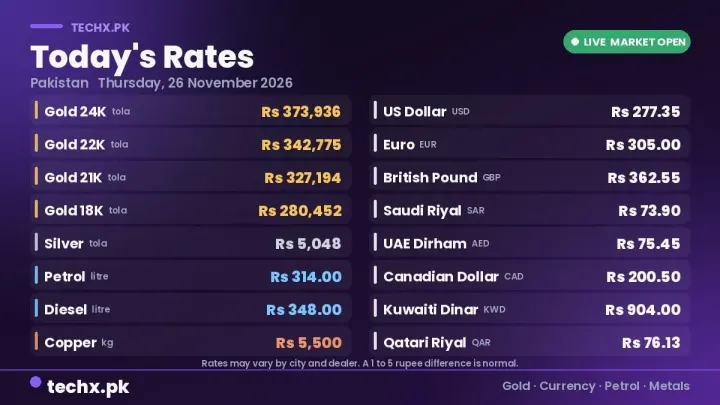
In the local market, the breakdown of gold rates for 24K metal shows per tola pricing at Rs. 370,131. Buyers purchasing 10 grams of gold will find the rate set at Rs. 317,333.30, while a single gram costs Rs. 31,733.33. These figures mark a substantial shift from the elevated peaks seen earlier in the calendar year.
Silver rates in Pakistan have dropped alongside gold, offering some relief to industrial users and retail buyers. The local price for 24K silver stands at Rs. 4,320.77 per tola. For smaller quantities, 10 grams of silver are priced at Rs. 3,704.40, and 1 gram is available at Rs. 370.44.
International spot benchmarks provide the foundation for these domestic figures. Spot gold trades at $3,581.92 per troy ounce on global exchanges. Meanwhile, spot silver changes hands at $41.786 per troy ounce, reflecting the ongoing correction across precious metal commodities.
Why Gold Prices Are Falling Globally
Several macroeconomic forces are pushing gold prices downward right now. First, sticky inflation has forced markets to price in further U.S. Federal Reserve interest rate increases, including expectations around the December meeting. As a result, higher rates and rising Treasury yields increase the opportunity cost of holding gold, which pays no interest or dividends.
A stronger U.S. dollar is also weighing heavily on bullion. Rising rate expectations and higher bond yields have lifted the greenback. Because global markets price gold in U.S. dollars, a stronger currency makes bullion costlier for buyers using other currencies. Therefore, international demand has softened significantly over recent weeks.
Meanwhile, stock market losses are triggering forced selling across financial sectors. Steep sell-offs in equities, particularly tech and artificial intelligence stocks, have pushed investors and funds to sell liquid assets like gold. In short, traders are cashing out bullion to cover equity losses, meet margin calls, or raise cash during market downturns.
Profit-taking and weaker retail buying have added to the downward momentum. Following steep gains in 2025 and early 2026, traders have actively locked in their profits. At the same time, elevated prices and persistent inflation pressures have curbed discretionary jewelry purchases among everyday consumers.
What Drives the Silver Price Downturn
Just like gold, silver faces intense pressure from U.S. monetary policy and currency strength. Inflation concerns and hawkish Federal Reserve signals have fueled expectations of additional rate hikes. Consequently, higher yields make interest-bearing assets far more attractive than silver, pulling investment capital away from the metal.
Moreover, a stronger U.S. dollar makes dollar-priced silver more expensive for overseas buyers. However, silver also suffers from weaker industrial and solar demand. Slower factory and manufacturing activity, especially in major consuming nations like China, has reduced industrial usage across multiple sectors.
High prices earlier in the year pushed manufacturers toward thrifting and material substitution, particularly in solar applications. Producers sought cheaper alternatives to protect profit margins when silver traded near record highs. This structural shift reduced baseline industrial consumption.
Additionally, market positioning has accelerated the downturn. Heavy profit-booking after the sharp early-2026 rally, alongside position liquidations and investor outflows, has dragged prices lower. Finally, silver carries higher volatility than gold. Because silver operates in a smaller market with heavy industrial exposure, its price swings much more sharply during broad commodity pullbacks.
Understanding the Economic Impact on Local Buyers
The sudden drop in precious metal prices alters purchasing strategies for households and investors in Pakistan. Families planning weddings or purchasing traditional jewelry find that while prices remain high compared to historical norms, current rates offer a discount from the peaks of January 2026. Retailers report fluctuating foot traffic as buyers try to time market bottoms.
Investors holding physical bullion face short-term losses if they purchased near the peak. However, long-term holders who accumulated assets years ago maintain substantial gains. Financial advisors note that commodities remain a cyclical asset class where rapid surges are frequently followed by sharp corrections.
The broader economic environment continues to dictate market direction. As long as central bank policies remain focused on controlling inflation through elevated interest rates, precious metals will face headwinds. Market participants monitor upcoming economic data releases and central bank announcements to gauge future price movements.
Historical Context of the 2026 Precious Metal Market
To understand the current market environment, it helps to examine how the situation developed over the past year. Precious metals began 2026 with unprecedented momentum. Gold reached historic highs near $5,600 per ounce in January, driven by safe-haven demand, central bank purchases, and geopolitical tensions. Silver followed a similar trajectory, surging to record levels around $120 per ounce.
During that period, retail demand surged as inflation fears dominated global headlines. Investors sought tangible assets to protect purchasing power against currency depreciation. However, markets cannot sustain exponential growth indefinitely without economic backing.
As central banks maintained higher interest rates longer than many analysts anticipated, the financial calculus changed. Yields on government bonds rose, making fixed-income investments more appealing than non-yielding bullion. The subsequent unwinding of speculative positions created the downward cascade observed in mid-to-late November.
Market analysts point out that commodities frequently experience boom-and-bust cycles driven by liquidity shifts. The transition from a speculative buying frenzy to widespread profit-taking illustrates the cyclical nature of global trading. Observers watch inventory levels and industrial orders to determine when stabilization might occur.
Practical Takeaways for Investors and Consumers
Navigating volatile commodity markets requires careful risk management and a clear understanding of personal financial goals. Investors participating in bullion markets must account for the high volatility inherent in both gold and silver. Short-term price swings can cause substantial losses for leveraged traders.
For retail consumers purchasing jewelry or small bars for personal milestones, timing the exact market bottom is rarely practical. Experts suggest focusing on long-term value rather than attempting to predict daily price fluctuations. Buying in gradual increments can help average out costs over time.
Keeping informed about international macroeconomic indicators, such as U.S. employment reports, inflation data, and Federal Reserve statements, provides valuable context for local price trends. Because domestic rates in Pakistan tie directly to international spot values and currency exchange rates, global events translate quickly to local markets.