Federal Government Shifts to Daily Petrol and Diesel Price Updates
The Federal Government has officially transitioned to a strategy of adjusting petrol and diesel prices daily. Effective July 17, 2026, the Oil and Gas Regulatory Authority (OGRA) has started revising the ex-depot prices of petroleum products, including petrol and diesel, every 24 hours. The government implemented this drastic measure to shield the local economy from extreme market volatility.
The newly revised prices show a downward trend for consumers. OGRA has announced a decrease in the price of Motor Spirit (MS), commonly known as petrol. Meanwhile, the price of High Speed Diesel (HSD) has also seen a significant decrease.
Latest Fuel Price Figures and Tariff Changes
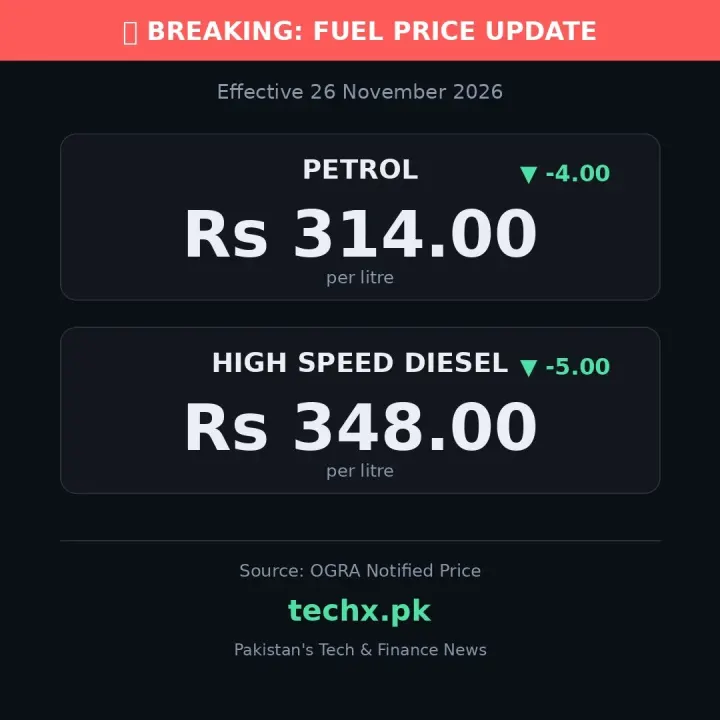
Consumers across the country closely monitor daily fuel revisions to manage transportation and operational costs. For the pricing period ending on 26-Nov-2026, the updated charts reflect notable reductions for both major automotive fuels. These revisions apply directly to ex-depot rates managed by regulatory authorities.
Motor Spirit decreased from Rs. 318.00 to Rs. 314.00, marking a reduction of Rs. 4.00 per litre. High Speed Diesel moved down from Rs. 353.00 to Rs. 348.00, reflecting a decrease of Rs. 5.00 per litre. These figures provide immediate relief at the pump after weeks of unpredictable international market fluctuations.
Weekend and Public Holiday Pricing Rules
Managing a daily pricing structure requires clear guidelines for non-business days and national holidays. The regulatory authority established specific protocols to maintain stability during weekends and official breaks. Markets remain closed during these periods, requiring specialized handling of pricing schedules.
These daily adjustments will remain unchanged during weekends (Saturdays and Sundays) and public holidays.
This rule ensures that fuel stations and consumers do not face sudden surprises on days when financial markets are closed. The rates fixed on the preceding business day carry through the weekend until the next active review cycle begins.
Global Energy Crisis and the Strait of Hormuz Blockade
This pricing shift directly results from the largest disruption to the world energy supply since the 1970s. The 2026 US-Israel war on Iran triggered a massive global fuel crisis. In late February, Iran blocked shipping traffic through the Strait of Hormuz. This critical maritime chokepoint previously handled about 25% of the world's seaborne oil trade. The United States retaliated with an extensive naval blockade on Iranian ports.
A temporary ceasefire briefly restored hope in June. However, the truce completely collapsed on July 8 following renewed strikes on commercial vessels. Iran immediately closed the strait again. The US military subsequently launched consecutive rounds of airstrikes to force it open. These relentless crossfires and blockades continue to strangle global oil shipments. Consequently, OGRA must now manage the crisis with daily adjustments in petrol and diesel prices at the pump.
Background on Energy Regulation and Pricing Mechanisms
Understanding how petroleum prices function involves looking at the role of regulatory bodies like OGRA. Historically, energy prices in many regions underwent fortnightly or monthly reviews. Such long intervals worked well during periods of steady international crude oil trade. However, intense geopolitical conflicts render traditional fortnightly reviews obsolete because crude values shift by the hour.
Transitioning to a 24-hour pricing cycle allows regulatory authorities to pass international savings down to consumers much faster. Conversely, it also exposes the domestic market to rapid upward corrections if foreign supplies tighten unexpectedly. Citizens must adapt their fuel consumption habits and household budgets to account for this constant state of flux.
Economic Impact on Citizens and Businesses
Fuel costs directly influence nearly every sector of the domestic economy, from public transit to agricultural supply chains. When diesel prices fluctuate, the cost of moving goods across regions changes immediately. Transport companies adjust freight charges, which eventually affects the retail price of consumer goods and food items.
The recent downward revision offers temporary relief for motorists and transport operators who faced steep inflationary pressures earlier in the year. Small business owners relying on delivery vans and trucks can experience slight margin improvements when diesel decreases by Rs. 5.00 per litre. Households using petrol vehicles for daily commutes also benefit directly from the Rs. 4.00 reduction per litre.
What to Watch for in Future Fuel Price Revisions
Market observers and ordinary citizens must monitor international maritime security developments in the Middle East to anticipate fuel trends. Because domestic pump rates depend entirely on crude availability through the Strait of Hormuz, any diplomatic breakthrough or escalation dictates the daily numbers at local stations. Consumers should check daily notifications issued by regulatory channels rather than relying on outdated weekly assumptions.