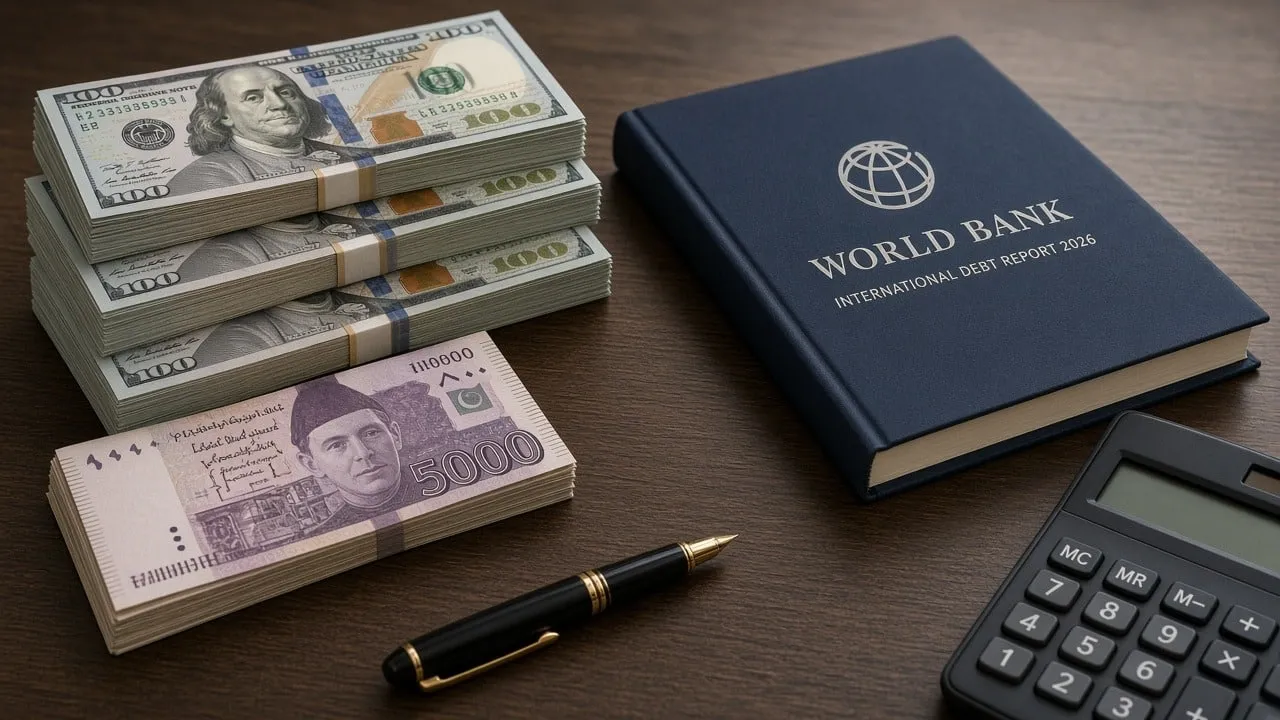
Pakistan's foreign loans have risen 97% over the past decade, climbing from $68.7 billion in 2015 to $135.1 billion in 2025, according to the World Bank's International Debt Report 2026.
The jump of nearly $66.4 billion shows how heavily the country has relied on outside borrowing to cover its financing needs. Public and publicly guaranteed debt made up the bulk of the stock at $107.1 billion. Private non-guaranteed debt stood at $17.6 billion, while short-term debt was $10.5 billion.
What Drives Pakistan's External Borrowing?
Pakistan's external debt trajectory is rooted in a series of fiscal and balance-of-payments pressures that began in the early 2010s. Persistent current-account deficits, high import bills for oil and machinery, and limited domestic capital markets forced successive governments to turn to multilateral, bilateral and private lenders. The 2018 currency depreciation accelerated the need for foreign exchange, prompting larger loan packages.
In addition, large-scale infrastructure projects, especially those linked to the China-Pakistan Economic Corridor, required financing that the Treasury could not raise through domestic bonds alone. The World Bank's International Debt Report 2026 captures the cumulative effect of these policies, showing a steady climb in total external obligations.
Who Pakistan Owes
Within the public and publicly guaranteed portion, multilateral lenders held $56.8 billion, bilateral creditors $42.4 billion, and private creditors $7.8 billion.
China remained Pakistan's largest single creditor with $22.4 billion outstanding. The World Bank followed with $19.2 billion, and the Asian Development Bank with $16.8 billion.
Official creditors still offer softer terms than private markets. Their loans carried an average maturity of 16 years, a four-year grace period, and an average interest rate of 3.6%. Private credit was far costlier, with an average interest rate of 8.6%, a three-year repayment window, and only a one-year grace period.
How the Debt Mix Affects the Economy
Higher foreign loans mean a larger share of tax revenue goes into interest and principal payments instead of schools, hospitals, or power projects. Soft official loans help, but any shift toward expensive private borrowing raises the bill households eventually carry through taxes, tariffs, and slower growth.
The Middle East, North Africa, Afghanistan and Pakistan region saw its external debt-to-gross national income ratio rise from 26.7% to 29.4% in 2025, the steepest one-year climb of any region. That points to debt still building even as some service ratios improve.
Recent Developments in 2025
In 2025, China stretched the maturities on $2 billion of loans to Pakistan. The International Monetary Fund also released $2.3 billion under the Extended Fund Facility and the Resilience and Sustainability Facility to support longer-term stability.
Globally, external debt of low- and middle-income countries hit a record $9.4 trillion in 2025, up 5.5%. For context on how Pakistan's load has been tracked at home, see ProPakistani's earlier coverage of the Finance Ministry's $138 billion debt breakdown and Sindh's foreign loans surge.
What This Means for Households and Businesses
When a larger slice of the budget is earmarked for debt service, discretionary spending on public services contracts. Schools may receive fewer resources, hospitals face delayed equipment purchases, and power-sector reforms can stall. For businesses, tighter fiscal space can translate into higher corporate taxes and reduced incentives for private investment.
Consumers may notice higher utility tariffs or indirect taxes on goods as the government seeks to raise revenue. The cost of borrowing for firms also rises if the sovereign rating is affected by the growing debt burden.
Policy Options and Next Steps
Pakistan's finance ministry has outlined several avenues to manage the rising debt load. These include restructuring existing loans, seeking longer-term concessional financing, and expanding domestic bond markets to reduce reliance on foreign currency borrowing.
Negotiations with bilateral partners, especially China, are expected to continue as both sides seek to align repayment schedules with Pakistan's projected growth path. The IMF's ongoing program will likely require periodic reviews of debt sustainability metrics.
Stakeholders are watching for any new sovereign bond issuances, as well as potential legislative changes that could affect the legal framework for external borrowing.
How to Track Future Changes
The World Bank updates its International Debt Report annually, providing detailed breakdowns of external debt by creditor type, maturity and interest rate. Pakistan's State Bank also publishes quarterly external debt statistics, which can be cross-checked with IMF staff-level reports.
Analysts recommend monitoring three indicators: the debt-to-GDP ratio, the share of debt serviced by export earnings, and the average cost of borrowing. Shifts in any of these will signal whether the debt trajectory is stabilising or accelerating.