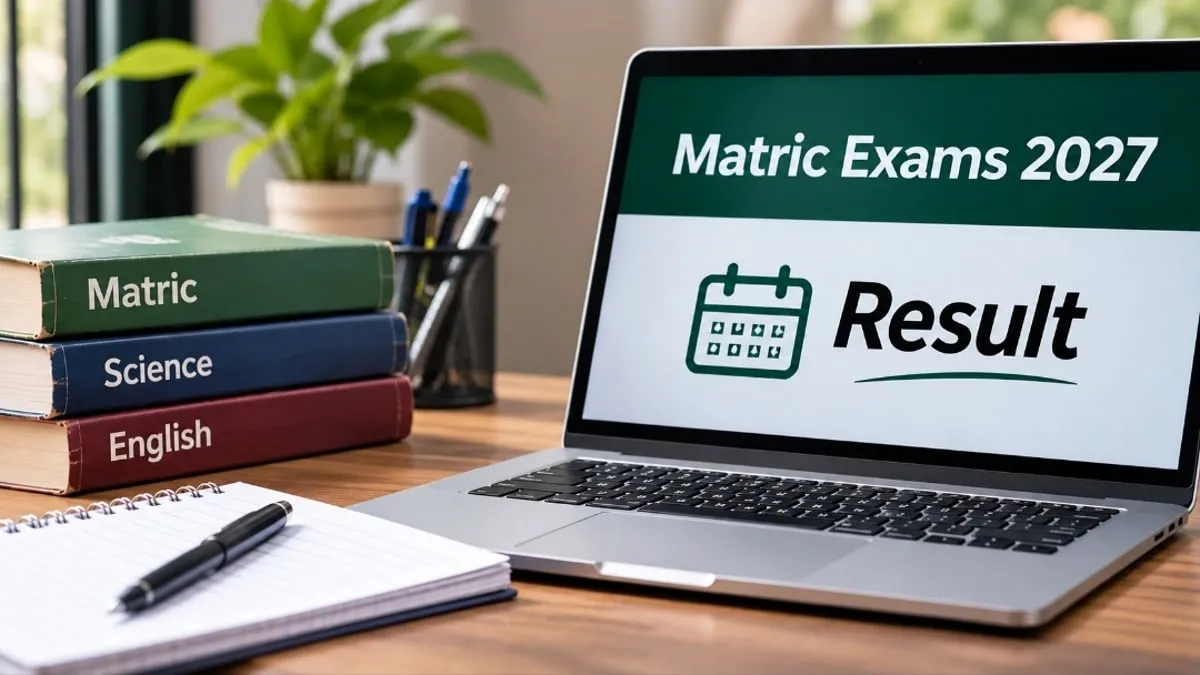
Students appearing in Punjab's 2027 matriculation examinations can now plan ahead as the provincial boards have announced the date for declaring the annual examination results.
According to a notification issued by the Punjab Boards Committee of Chairpersons on November 10, the boards will declare the results of the Secondary School Certificate (SSC) Part II first annual examinations on July 20, 2027.
The committee approved the online admission schedule for the examinations as proposed by the Board of Intermediate and Secondary Education (BISE) Lahore, while the notification also confirmed the examination and admission dates.
The matric Part II first annual examinations will begin on March 16, 2027. The announcement gives students a clear timeline for the examination process, from admission submissions to the expected result date.
What Is the SSC Part II First Annual Examination?
The Secondary School Certificate (SSC) Part II, commonly known as Matriculation, marks the completion of grade 10 in Pakistan's public and private school system. The first annual examination is the standard assessment for students who have completed the academic year without needing a supplementary or repeat exam. Results of this exam determine eligibility for higher secondary education (FA/FSc) and influence scholarship allocations.
How the Punjab Boards Committee of Chairpersons Functions
The Punjab Boards Committee of Chairpersons is a statutory body that brings together the heads of all provincial examination boards, including BISE Lahore, BISE Faisalabad, BISE Rawalpindi, and others. Its mandate includes coordinating exam schedules, standardising assessment procedures, and issuing unified notifications such as the one released on November 10.
Decisions are taken by consensus after reviewing proposals from individual boards. In this case, BISE Lahore submitted an online admission schedule, which the committee evaluated for technical feasibility, security, and alignment with national education policies before granting approval.
Why the Announcement Matters for Students and Parents
Providing a fixed result date reduces uncertainty for millions of students and their families. In Punjab, roughly 1.8 million candidates sit for the SSC Part II exams each year. Knowing that results will be out on July 20, 2027 allows parents to arrange tuition, plan for college applications, and manage financial commitments such as tuition fees for higher secondary institutions.
Moreover, the clear timeline helps schools schedule counseling sessions, and it assists private coaching centers in aligning their programs with the official calendar.
Background: Evolution of Exam Timelines in Punjab
Historically, the SSC Part II results in Punjab were released in late June or early July, but occasional delays occurred due to logistical challenges, paper processing, or security concerns. Over the past decade, the provincial education department has invested in digitising the marking process, introducing optical mark recognition (OMR) and later, computer-based evaluation for certain subjects.
These technological upgrades have gradually shortened the turnaround time between exam completion and result publication. The current schedule, with exams starting on March 16 and results on July 20, reflects a four-month window that aligns with the national benchmark set by the Federal Board of Intermediate and Secondary Education (FBISE).
Explainer: Online Admission Process Approved by the Committee
BISE Lahore proposed that candidates submit their admission forms online through the official board portal. The process includes:
- Creating a secure account using a CNIC number.
- Filling in personal and academic details.
- Uploading scanned copies of photographs, signatures, and required certificates.
- Paying the examination fee via bank transfer or authorized payment gateway.
- Receiving a confirmation email with a unique admission reference number.
The Punjab Boards Committee of Chairpersons reviewed the platform for data protection compliance, server capacity, and real-time verification of fee payments. Their approval on November 10 means the online system will be operational for the March 16 admission window.
Impact on Educational Institutions and Policy Makers
Universities and colleges in Punjab rely on SSC Part II results to allocate seats in intermediate programs. The July 20 result date enables them to release admission lists by early August, ensuring that the academic year for higher secondary education can begin on schedule.
Policy makers use aggregate result data to assess the effectiveness of curriculum reforms, teacher training initiatives, and resource allocation. Timely results provide a more accurate picture for the upcoming annual education review.
What Comes Next: Key Dates and Procedures After the Result Release
After the July 20 announcement, the following steps are expected:
- Students will be able to download their individual result slips from the board's website.
- Schools will verify results and issue official certificates within two weeks.
- Higher secondary institutions will open their admission portals for the 2027-2028 academic session.
- The Punjab Boards Committee will convene in September to evaluate the examination cycle and consider any adjustments for the next year.
Stakeholders are advised to monitor the official board website and local news outlets for any supplementary notifications, especially regarding re-evaluation requests or special provisions for disadvantaged students.
Practical Takeaways for Candidates
1. Mark March 16 as the start of the SSC Part II first annual exams and begin revision early.
2. Complete the online admission form as soon as the portal opens to avoid last-minute technical issues.
3. Keep the admission reference number handy; it will be needed to access the result slip on July 20.
4. Verify the result against the school's official record before proceeding with college applications.
By adhering to the announced schedule, students can minimise stress and focus on academic performance, while schools and colleges can streamline their administrative workflows.