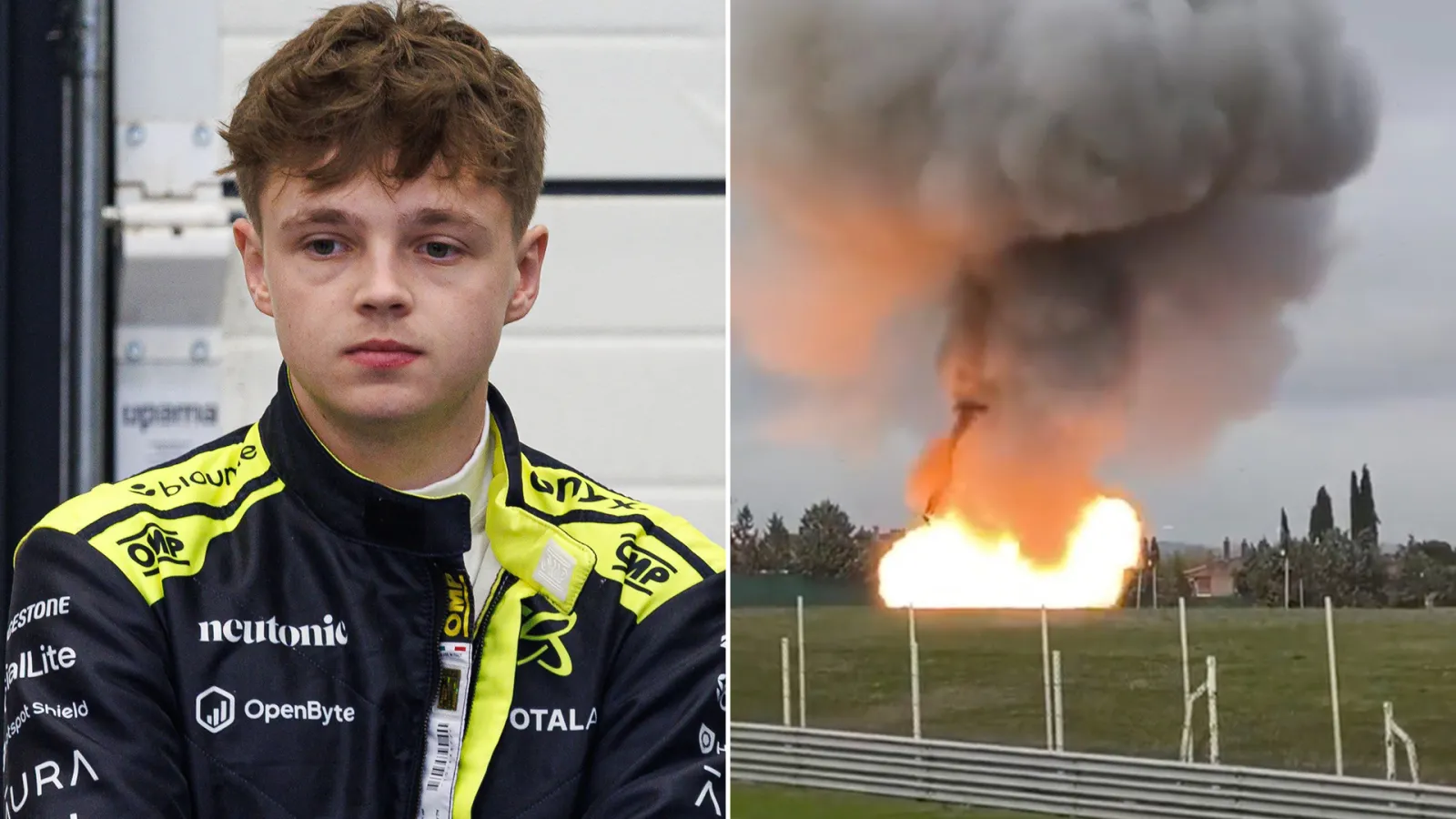
Taylor Barnard Escapes Fireball Crash During Formula E Testing
British driver Taylor Barnard was involved in a terrifying crash as his car exploded into a fireball during Formula E pre-season testing. The incident occurred near the end of the Friday session at the Jarama circuit, where teams are preparing for the upcoming campaign. Barnard, who is 22 years old and hails from Norwich, managed to climb out of the burning vehicle unaided before the flames engulfed the machine. Emergency services rushed to the scene as a massive plume of black smoke rose into the air above the track.
The accident brought an abrupt halt to the day's running as race marshals waved the red flag. Officials deployed the safety car and directed other competitors into the pit lane by driving the opposite way around the circuit. A joint statement issued by Formula E and the FIA confirmed that emergency crews responded immediately to the situation. The governing bodies also confirmed that there were no injuries and announced that a thorough investigation would take place to determine the root cause of the sudden blaze.
What Caused the Formula E Fire at Jarama?
The exact trigger for the explosion in the Porsche customer car remains unknown as technical teams and officials begin their inquiries. Prior to the dramatic incident, the session had been proceeding smoothly, interrupted only by standard reliability teething problems typical of pre-season work. The fire broke out shortly after Barnard went off track near the end of the Friday running. Investigators from the FIA and the series technical department are currently examining the wreckage to understand how the flames ignited so rapidly after the impact.
Electric racing machinery presents unique challenges for safety and recovery crews due to the high-voltage battery systems involved. Formula E has spent years refining safety protocols for emergency responders handling all-electric single-seaters. Marshals and medical teams train specifically to deal with high-voltage hazards and thermal events. The quick response of the track personnel ensured the situation remained contained while Barnard walked away safely.
Taylor Barnard and the Gen4 Formula E Era
The 2027 season marks the introduction of the Gen4 machinery, bringing the next generation of all-electric racing cars to the grid. Teams are currently pushing these new prototypes to their limits during testing phases to uncover performance limits and reliability issues. Barnard drives for Fusion and entered this testing block with high expectations following a strong performance in the previous campaign. He holds the record as the youngest ever race winner in the championship, having secured a victory during the season finale at the last London E-Prix.
Transitioning to a new car generation requires extensive mileage to understand tire degradation, energy management, and powertrain efficiency. Engineers gather vast amounts of telemetry data during these sessions to optimize software and mechanical setups. Incidents during testing, while dramatic, often provide crucial data for manufacturers working to ensure durability over a grueling championship calendar. The investigation into the Jarama fire will likely focus on both structural components and electrical subsystems within the Porsche customer package.
Changes to the 2027 Formula E Calendar
The 2027 championship schedule has undergone several notable revisions ahead of the opening round. Organizers initially planned to kick off the season in December in Jeddah, Saudi Arabia. However, growing safety concerns in the region prompted officials to postpone the Saudi event to April. Consequently, Mexico will now host the season opener in January, setting a different rhythm for the opening months of competition.
British fans will also experience a venue change for the home round of the championship. The UK leg of the tour has moved away from the ExCel Centre in London to the historic Brands Hatch circuit in Kent. Track enthusiasts can mark their calendars for May 29 and May 30, when the electric single-seaters take on the traditional road course. These calendar adjustments require teams to adapt their logistical planning and car preparation timelines significantly.
Understanding Formula E Safety and Emergency Response
Motorsport safety standards have evolved drastically over the decades, with modern circuits equipped to handle complex emergencies swiftly. When a red flag stops a session, every team must follow strict protocols to ensure personnel safety in the pit lane. The deployment of the safety car allows officials to control the movement of cars still on the circuit while rescue vehicles access the incident zone. In cases involving fire, marshals use specialized extinguishing agents designed to suppress chemical and electrical blazes effectively.
The swift egress of Taylor Barnard highlights the importance of driver safety equipment and extraction training. Drivers must pass rigorous tests to prove they can exit the cockpit within a strict time limit wearing full gear. The fact that Barnard walked away from a fireball without injury serves as a testament to the stringent safety cell regulations enforced by the FIA. As testing resumes at other venues, teams and officials will apply the lessons learned from the Jarama incident to protect drivers and staff throughout the upcoming championship.