Understanding Inkling 2 Mini by Thinking Machines
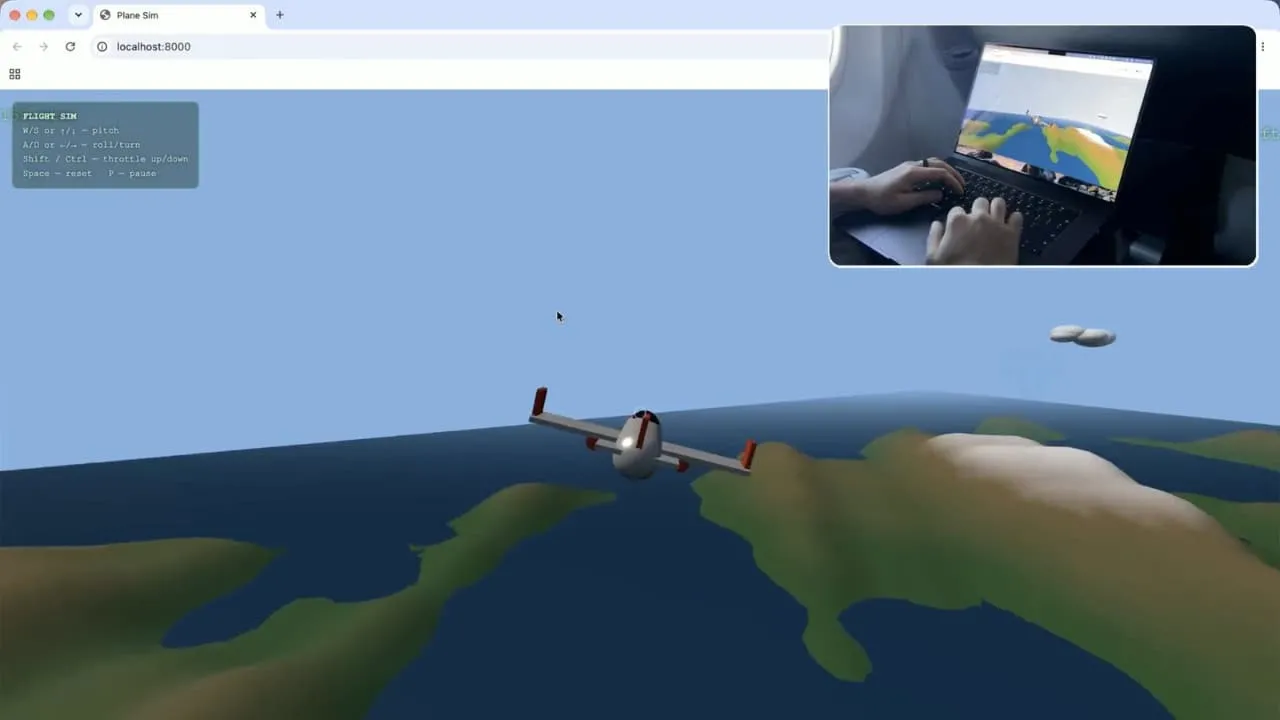
Thinking Machines Lab has released Inkling 2 Mini, an open-weights artificial intelligence model small enough to operate directly on a standard laptop. Founded by former OpenAI Chief Technology Officer Mira Murati, the company reports that this new release outperforms every other open-weights model under 100 billion parameters on standard coding benchmarks. To demonstrate its offline capabilities, the development team built a playable flight simulator entirely without internet access on a MacBook Pro running in airplane mode.
The core innovation behind this system is a technique known as looping. Instead of sending each token through the model layers just one time, Inkling 2 Mini processes its middle layers three times for every single token. This design choice enables the software to reason more deeply and thoroughly without needing to write out longer, explicit chains of thought in text.
"Looping allows the model to reason longer without writing its reasoning down," Thinking Machines wrote in its announcement.
How the Architecture and Looping Mechanism Work
Beneath the surface, Inkling 2 Mini uses a mixture-of-experts architecture. The system contains 26.4 billion parameters in total, but it activates only 3.4 billion of those parameters per token. When factoring in the three internal processing loops, that active figure reaches 5.4 billion weight activations for every token processed. Its 24 layers are organized into four blocks of six. The first and final blocks run only once, while the two middle blocks execute three times each, allowing the entire model to fit into roughly 20 gigabytes of memory.
The laboratory trained the majority of the weights directly in NVIDIA's 4-bit NVFP4 format. Consequently, users experience no quality loss that would normally stem from post-training conversion processes. During the training phase, the team also pruned two-thirds of the model experts before retraining it on one trillion tokens derived from a larger internal Inkling model.
Coding Benchmark Results and Performance Speed
Performance metrics on standardized tests show strong results for the compact system. Inkling 2 Mini achieved a score of 48.2 percent on DeepSWE v1.1 and 77.9 percent on a rigorous set of SWE-bench Pro tasks. For comparison, Alibaba's Qwen3.8-27B model scored 42.2 percent and 73.8 percent on those identical tests. Independent evaluation firm Artificial Analysis assigned Inkling 2 Mini a score of 20 on its Intelligence Index, matching the performance of Qwen3.8-27B while using roughly five times fewer active parameters.
Financial and time metrics highlight a sharp contrast in operational efficiency. Artificial Analysis determined that completing each task cost $0.59 and required nine minutes using Inkling 2 Mini. By contrast, the same task cost $3.53 and demanded 38.2 minutes when processed through Qwen3.8-27B. These figures make the Thinking Machines release about six times cheaper and four times faster per task, though it does consume approximately 38 percent more output tokens to achieve the same score. For broader context, OpenAI's GPT-6 Luna earned a score of 28 on that index at a cost of $0.15 per task.
Limitations and Safety Considerations of Local AI
Despite its high coding performance, the software does possess distinct boundaries. Thinking Machines acknowledged that Inkling 2 Mini is not the strongest small model available for multi-turn chat applications. It also encounters difficulties when handling instructions that contain multiple constraints simultaneously, an area where Qwen3.8-27B demonstrates superior capability. Furthermore, it trails larger models on difficult reasoning tests because the looping mechanism does not expand its capacity to store factual information.
The reliance on internal looping also introduces a unique safety question for researchers. Artificial intelligence laboratories typically monitor models by reading their written reasoning chains to ensure safety and alignment. Because a looped model performs a significant portion of its thinking internally, human monitors cannot observe all of its intermediate reasoning steps. Thinking Machines addressed this concern by releasing a research model capable of looping between one and five times. Their tests revealed that reasoning at five loops produced less than half the text volume of a single loop, yet the laboratory observed no meaningful reduction in the ability of monitors to evaluate the model's thinking processes at this scale.
Hardware Compatibility and Local Deployment
As per Thinking Machines:
Efficient intelligence makes Inkling 2 Mini a great choice for inference where speed is paramount, or for running on local hardware. At launch we support Inkling 2 Mini running on any Mac system (MacBook, Mac Mini) with at least 32GB RAM via Ollama. With native NVFP4 training and inference precision, Inkling 2 Mini runs efficiently on NVIDIA's DGX Spark desktop AI computer. Quantized GGUF versions are available via Unsloth and llama.cpp for local inference.
Users can operate Inkling 2 Mini on Apple Macintosh computers equipped with at least 32 gigabytes of memory by using Ollama. The model weights are hosted publicly on Hugging Face under an Apache 2.0 license, and the software supports an expansive context window of one million tokens.