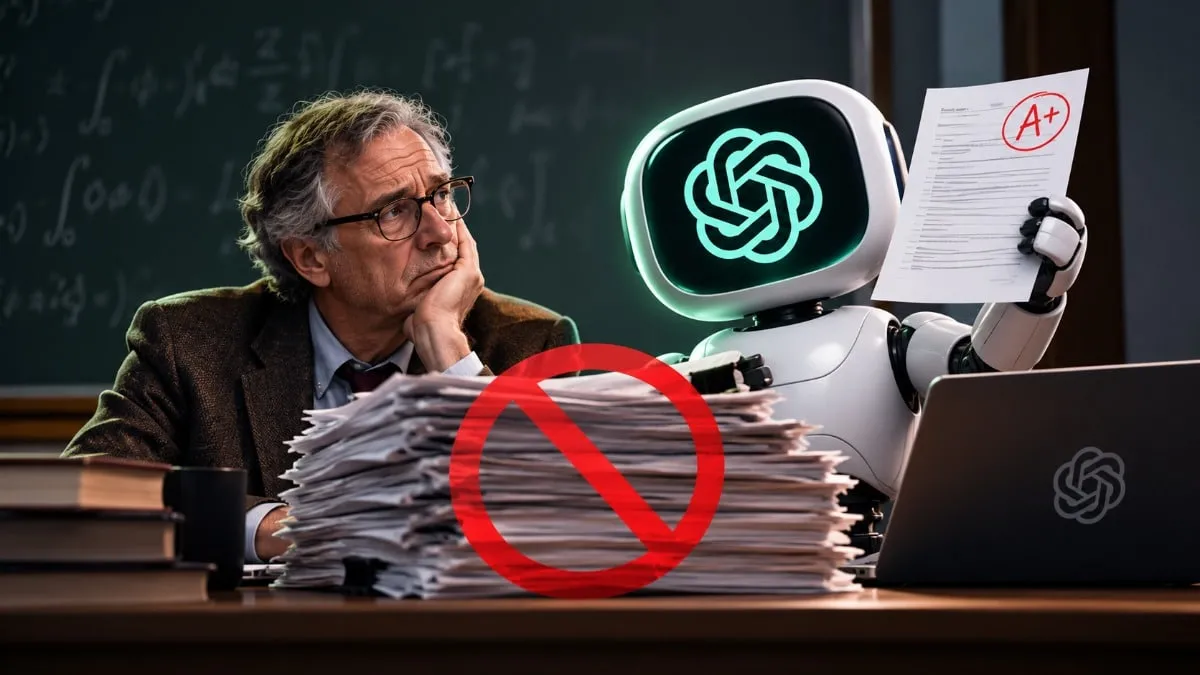
Richard Borcherds, a Fields Medal winner and mathematics professor at the University of California, Berkeley, halted grading student homework for correctness because numerous students use artificial intelligence tools to finish their assignments.
According to the renowned mathematician, artificial intelligence programs make it hard to know if learners tackle problems independently. After observing consistently high scores, he determined hiring teaching assistants to verify answers lacked purpose. Now, Borcherds grants credit simply for submitting work, bypassing whether solutions are right.
AI Is Changing How Students Are Graded
Borcherds conceded his alternative grading system lacks perfection, noting he found no superior option. He maintains that widespread access makes blocking artificial intelligence use in homework increasingly hard. His remarks followed an announcement from OpenAI stating its systems generated a claimed solution for the Navier-Stokes existence and smoothness problem, a major mathematical challenge.
This breakthrough prompted questions regarding how artificial intelligence might alter mathematical education and study. Borcherds cautioned that if technology advances at its current rate, machines might surpass human mathematicians across all tasks in a few years.
Professor Questions the Future of Mathematics Careers
Borcherds voiced doubt regarding whether learners ought to pursue jobs in mathematics. Five years ago, mathematics seemed safe from artificial intelligence disruption, but recent progress altered his perspective. He even asked ChatGPT for career guidance advice to give students, though the chatbot failed to deliver a definitive response.
Despite worries, Borcherds thinks universities might require years to react to shifts. Academic institutions often sustain traditional methods long after new technology renders them obsolete. He cited printed academic journals as unnecessary for roughly twenty years. He likened artificial intelligence effects on math to machines replacing hand weaving and automobiles replacing horses, though math never faced this specific disruption before.
University Struggles to Detect AI-Generated Homework
UC Berkeley is currently evaluating classroom artificial intelligence policies. Assistant vice provost for undergraduate education and chief academic technology officer Anne Marie Richard stated that instructors must outline their artificial intelligence rules in course syllabi. Professors retain authority to set individual policies based on the subject and course level.
Campus trials of detection software like Turnitin and Rumi showed the programs lacked reliability for mandatory campus implementation. The institution runs an online AI Hub providing educators with sample policies, training resources, and instructional guidance. Currently, the campus leaves choices regarding artificial intelligence up to teachers as the technology transforms student learning and assignment completion.