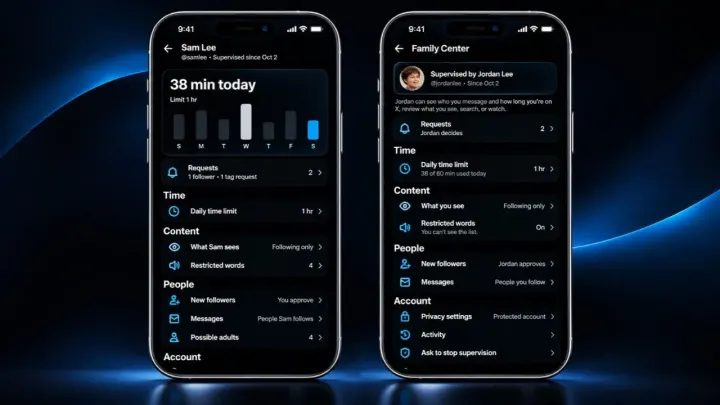
The new X parental controls let parents and guardians set daily time limits, approve new followers, and see who their teen is messaging. The messages themselves stay private, and teenagers can see every restriction applied to their account. X announced the controls on November 26, 20 years after the social network began.
What X Parental Controls Let Families Manage
X says accounts belonging to children above the age of 13 and below 17 will use "protected mode" by default. Teens in this age group won't see sensitive content or receive targeted ads.
Parents and guardians can review how much time their teen spends on X each week and set a daily limit. They can also restrict feed recommendations and videos to accounts the teen already follows, filter specific words, and turn off sensitive media.
The controls distinguish between following an account and contacting it directly. Parents can require approval for each new follower. Separately, they can choose who may send their teen direct messages and see who their teen exchanges messages with.
However, Parents cannot read private messages, view search or viewing history, or publish posts as their teen. Teenagers retain ownership of their accounts and can see each change a parent or guardian makes.
Michael O'Herlihy, X's head of safety, explained the thinking behind that design in a blog post. He said:
Parents want practical tools, and teens deserve room to grow.
He further added that families could choose restrictions that suit their household while teens retain control of their accounts and know which settings have changed.
Why the Rollout Matters for Younger Users
The rollout follows criticism earlier this year over gaps in safeguards that allowed people to use X's AI chatbot to generate sexualized images of children and women. The platform has also faced longstanding problems with child sexual abuse material, AI bots, and the spread of misinformation. It also permits users to post pornography.
Although X has generally catered to an older audience, a 2024 study found that nearly one in three Gen Alpha children had an X account. The platform sets its minimum age at 13. For teens who meet that requirement, protected mode now determines what they can see by default, while families can set additional limits on their time, feed, and contacts.
How Protected Mode Works for Teens Aged 13-16
Protected mode activates automatically for accounts that report an age between 13 and 16. The algorithm blocks content flagged by X's internal safety team as sensitive, which includes graphic violence, sexual content, and hate speech. Targeted advertising is also disabled, meaning that ad networks cannot serve personalized ads based on the teen's activity.
Teen users still see a regular feed, but recommendations are limited to accounts they already follow. If a teen follows a public figure, the platform may still surface public posts from that figure, but any algorithmic suggestion that would push new accounts or topics is suppressed.
Parents can toggle the level of restriction. The default setting is the most restrictive, but guardians may relax certain filters, such as allowing educational videos that contain mild language, by adjusting the word-filter list.
What Parents Can See and What Remains Private
When a guardian links their own account to a teen's profile, a dashboard appears in the parent's X app. The dashboard displays a weekly summary of screen time, a list of accounts that have requested to follow the teen, and a log of direct-message contacts. The log shows usernames and the date of the most recent exchange, but it does not reveal the content of any messages.
Parents cannot view the teen's search queries, browsing history within the app, or any posts the teen has authored. The design intention is to give adults enough oversight to protect safety while preserving the teen's sense of privacy and autonomy.
Technical and Policy Background Behind the New Features
Since its launch in 2004, X has faced regulatory scrutiny in multiple jurisdictions over child safety. In the United States, the Children's Online Privacy Protection Act (COPPA) requires platforms to obtain verifiable parental consent for users under 13. X's age-verification system now prompts users to confirm their birth year, and accounts that fall below the threshold are automatically disabled.
In Europe, the Digital Services Act (DSA) mandates that large platforms take "reasonable steps" to protect minors from illegal content. X's protected mode aligns with the DSA's requirement to limit algorithmic amplification of harmful material to users identified as minors.
From a technical standpoint, the new controls rely on a combination of machine-learning classifiers and human-review teams. The classifiers flag potentially sensitive media in real time, while human reviewers verify borderline cases before they reach a teen's feed.
Impact on Families, Educators, and the Platform
For families, the dashboard offers a concrete way to discuss digital habits with teens. Schools that incorporate digital-citizenship curricula can use the data to illustrate real-world examples of screen-time management.
Advertisers on X will see a reduced audience for personalized ads among users in protected mode. However, the platform will still serve generic, non-targeted ads, preserving revenue streams while complying with the new restrictions.
For X, the rollout is a response to mounting public pressure and a pre-emptive move ahead of possible legislative mandates. By providing a built-in safety layer, X hopes to reduce reliance on third-party parental-control apps that often require invasive device permissions.
Next Steps and What to Watch For
X will roll out the parental-control dashboard globally over the next six months. Users will receive an in-app notification prompting them to link a guardian account. The company has pledged to publish quarterly transparency reports on how many accounts are in protected mode and how many parental requests have been approved.
Regulators in the United Kingdom and Australia have expressed interest in monitoring the effectiveness of the new tools. Industry analysts will likely track adoption rates and any changes in the prevalence of reported harmful content among teen users.
Practical Takeaways for Parents
- Link your own X account to your teen's profile to access the dashboard.
- Set a daily screen-time limit that fits your household routine.
- Review follower requests and approve only trusted accounts.
- Use the word-filter feature to block language you find inappropriate.
- Remember that you cannot read private messages; the tool is for oversight, not surveillance.
By following these steps, parents can balance safety with the teen's right to privacy, a balance that X's design explicitly tries to achieve.