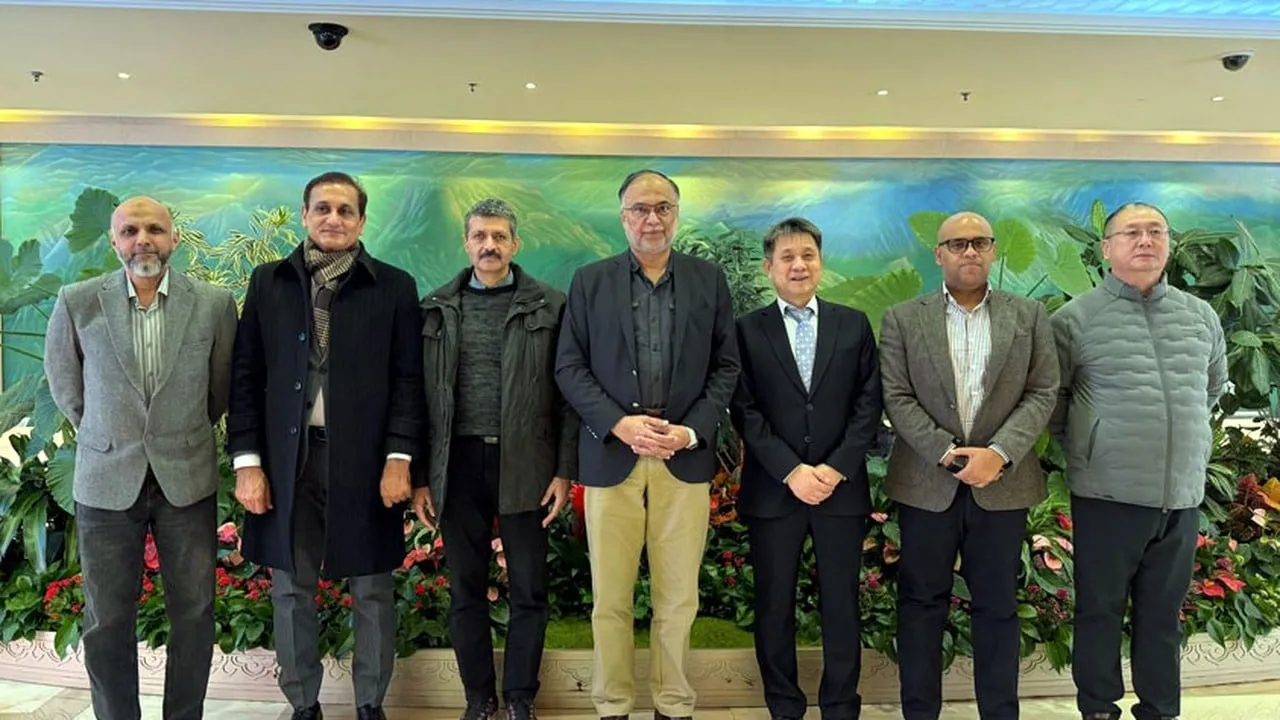
Federal Minister for Planning, Development and Special Initiatives Professor Ahsan Iqbal has arrived in Beijing to attend the departure ceremony of Pakistan's first astronaut, who is set to become the first foreign guest aboard China's space station.
Iqbal was received at Beijing Airport by Yang Yunli, Vice President of China Great Wall Industry Corporation (CGWIC), and officials of the Embassy of Pakistan, according to the Ministry of Planning. The minister will travel to the space mission centre on Monday, where he will meet the two Pakistani astronauts who have completed their training. One of the two will be finally selected for the mission before the spaceflight.
A Historic Moment for Pakistan and Bilateral Ties
Speaking about the upcoming journey, Iqbal said the flight of Pakistan's first astronaut will be a historic moment for the entire nation and a new symbol of the ironclad brotherhood between Pakistan and China. The arrival of the minister in the Chinese capital highlights the diplomatic priority both governments place on high technology cooperation and joint scientific exploration.
Explaining the emotional and cultural resonance of the mission, Iqbal stated that this flight represents Pakistan's journey towards space, carrying the dreams of our youth beyond the Earth. He also remarked that the Pakistan-China friendship, higher than the Himalayas, will soar even higher than the skies with this historic flight. State planners view this partnership as a continuation of decades of diplomatic trust, extending now from terrestrial infrastructure projects into Earth orbit.
The collaboration reflects changing dynamics in international space exploration, where traditional spacefaring nations increasingly open their orbital habitats to international partners. By participating in this crewed mission, Pakistan joins a very small group of countries that have sent citizens beyond the atmosphere.
Background of the Pakistan and China Space Agreement
The pathway to this orbital flight began through formal diplomatic channels and institutional frameworks established early last year. The two candidates representing Pakistan, Muhammad Zeeshan Ali and Khurram Daud, have spent months undergoing rigorous preparation at China's astronaut training centre in Beijing. Their selection followed a demanding three-stage assessment process.
This assessment was conducted under a cooperation agreement that Pakistan and China signed in Islamabad in February 2025. Following the completion of their training cycle, one candidate will fly on the upcoming mission while the other will serve as backup, ensuring mission readiness and continuity.
The China Manned Space Agency announced on November 7 that a Pakistani astronaut would join China's Shenzhou-24 crewed mission as a payload specialist. This appointment makes the selected individual the first foreign national to visit the Tiangong space station.
Understanding the Shenzhou-24 Mission and Tiangong Operations
The mission architecture involves sophisticated spacecraft transfers and orbital mechanics. The Pakistani astronaut will make a short stay in orbit before returning to Earth aboard the Shenzhou-23 spacecraft. This marks the first joint spaceflight involving Chinese and foreign astronauts in the history of China's crewed space programme.
As a payload specialist, the astronaut will focus on specific scientific experiments and operational tasks during their time aboard the Tiangong space station. Tiangong, which means heavenly palace, is a modular space station placed in low Earth orbit. It serves as China's national space laboratory, hosting various scientific instruments and habitation modules.
The mission carries unique national symbolism for Pakistan. The official mission emblem for Shenzhou-24 incorporates a distinct Pakistani touch, featuring the country's national flower, jasmine, included in its design. This artistic detail acknowledges the partnership between the two nations.
Timeline and Future Space Exploration Goals
Preparations have accelerated in recent weeks leading up to the launch window. Iqbal had earlier announced that Pakistan's first astronaut would fly to space on November 25, setting a definitive date for the public to anticipate. The delegation led by Iqbal will observe these final preparations on the ground.
Looking beyond the immediate horizon, Pakistan has established long-term ambitions in extraterrestrial exploration. Iqbal has stated that Pakistan has set a target of landing on the moon by 2035. While ambitious, this target outlines the strategic direction for scientific institutions and educational bodies within the country over the next decade.
The current mission serves as the foundational step for these broader national aspirations. By gaining hands-on experience in orbital operations, training protocols, and mission control procedures, Pakistani scientists and engineers acquire valuable expertise for future domestic or joint space ventures.
As the delegation settles in Beijing for the scheduled events on Monday, attention turns to the final announcement regarding which of the two candidates will take the primary seat on the spacecraft. The international aerospace community continues to monitor these developments as a demonstration of expanding cooperative space frameworks outside traditional Western alliances.