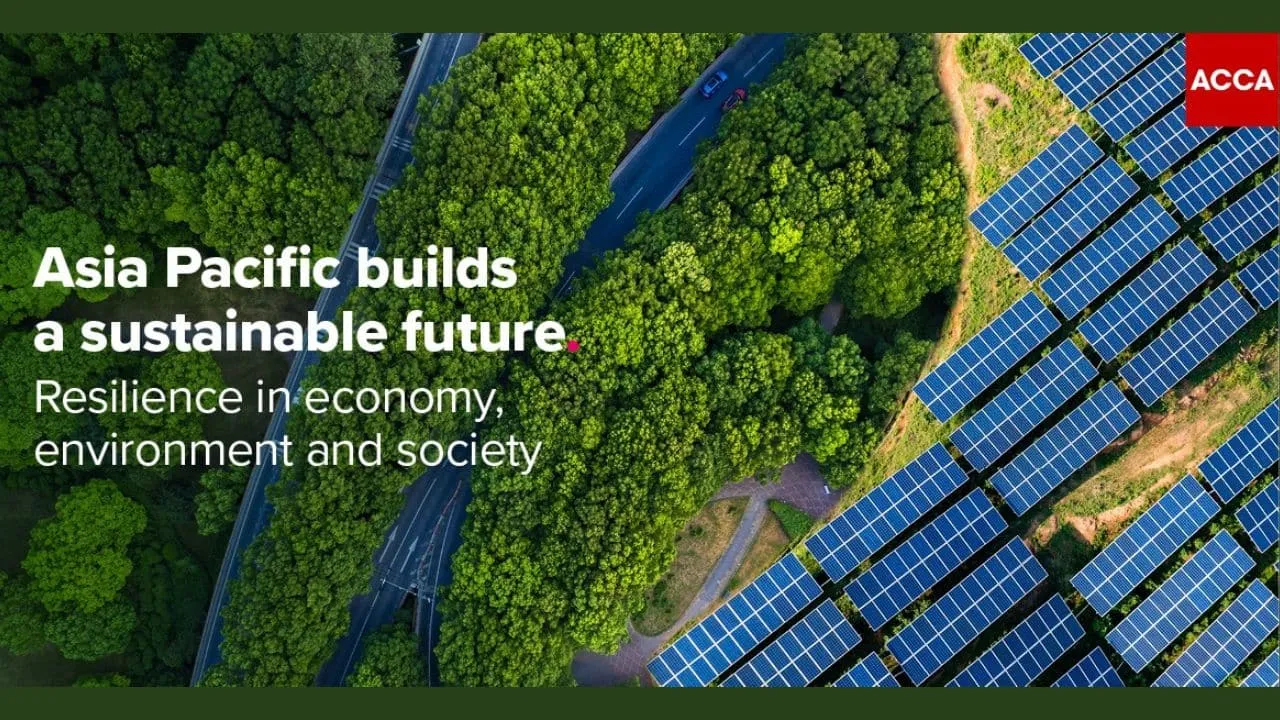
Asia Pacific Leads Global Adoption of Sustainability Reporting Standards
Asia Pacific is leading the global adoption of sustainability reporting standards, but businesses and policymakers must move beyond regulatory compliance and translate sustainability commitments into economic resilience, investment and long-term business value, according to new research by ACCA (the Association of Chartered Certified Accountants).
The report, titled Asia Pacific Builds a Sustainable Future: Resilience in Economy, Environment and Society, finds that more than 80% of ASEAN economies, measured by GDP, have adopted or plan to adopt standards issued by the International Sustainability Standards Board (ISSB). Including Chinese mainland, economies that have adopted represent approximately US$60 trillion, or 47% of global GDP.
This rapid integration of reporting frameworks establishes a new baseline for corporate transparency across the region. Financial institutions and market regulators are increasingly aligning their expectations with international norms to attract foreign capital and maintain competitive advantages in global markets. However, institutional leaders emphasize that publishing reports is only the first step toward genuine operational transformation.
What the ACCA Research Reveals About Economic Resilience
The findings carry particular relevance for Pakistan, where economic recovery and the energy transition are increasingly linked to climate resilience and sustainable investment. Pakistan's economy recorded growth of 3.65% in FY2025-26, according to updated national accounts estimates. Meanwhile, installed electricity generation capacity reached 49,651MW, including 7,319MW from solar net metering, reflecting the growing role of distributed renewable energy.
Sharath Martin, Senior Policy Consultant, ACCA Asia Pacific, stated that the overarching narrative requires a fundamental shift. What they heard consistently in regional roundtables is that the focus must move past disclosures alone toward making commercial enterprises inherently durable. Decarbonization not only reduces emissions but also protects corporations and national markets from fossil fuel price volatility, rising costs and supply shocks.
Helen Brand OBE, Chief Executive of ACCA, noted that the region was building the architecture of sustainability reporting faster than anywhere else. At the same time, she cautioned that adopting standards was not the same as achieving actual decarbonization or resolving wider environmental pressures.
Challenges Facing Pakistan in the Energy and Climate Transition
Despite progress in renewable adoption, the green transition presents significant obstacles for developing nations. Pakistan faces financing constraints, grid integration difficulties, energy storage deficits, project bankability hurdles and the pressing need for stronger institutional capacity.
The country also remains highly exposed to climate-related hazards, including floods, extreme heat, water stress and glacial melt. These environmental threats carry direct implications for agricultural productivity, critical infrastructure, local livelihoods and overall macroeconomic stability.
Policymakers and industry leaders must address these structural bottlenecks to ensure that green investments yield tangible benefits. Without targeted financial mechanisms and modern infrastructure, local markets risk falling behind in the global shift toward low-carbon commerce.
Water Stress and Extreme Heat as Defining Economic Risks
Water scarcity and extreme heat are identified as potentially defining economic risks of this century. The ACCA report notes that, if left unaddressed, water and heat-related risks could reduce GDP by 10-15% in lower-income countries by 2050.
Vulnerability to natural disasters remains a persistent threat across the entire geographic footprint. Floods alone accounted for more than half of the 7.2 billion people affected by disasters across Asia Pacific between 1970 and 2024.
These statistics illustrate the heavy human and financial toll of climate change on vulnerable populations. Governments must factor these long-term environmental projections into national budgets and fiscal planning.
Strategic Priorities for Businesses and Policymakers
The ACCA report calls on businesses to integrate climate and nature-related risks into corporate strategy, budgets and investment decisions. Simultaneously, the publication urges policymakers to mobilize capital, strengthen reporting and assurance capacity, and accelerate renewable energy investment.
Decarbonization is not simply about reducing carbon emissions. It is also essential for energy security and economic resilience, helping businesses and governments manage fossil-fuel price volatility, geopolitical disruptions and supply-chain risks.
Renewable energy generation and storage therefore need to be treated as strategic economic priorities, supported by investment and financing mechanisms that make projects commercially viable. Pakistan has already taken initial steps in this direction through the Securities and Exchange Commission of Pakistan's phased adoption of IFRS Sustainability Disclosure Standards and its subsequent ESG disclosure guidelines.
Asia Pacific Builds a Sustainable Future draws on research, interviews and roundtable discussions with 44 finance and accountancy professionals and subject experts. Stakeholders across the region now face the challenge of executing these recommendations before climate pressures outpace institutional response capabilities.