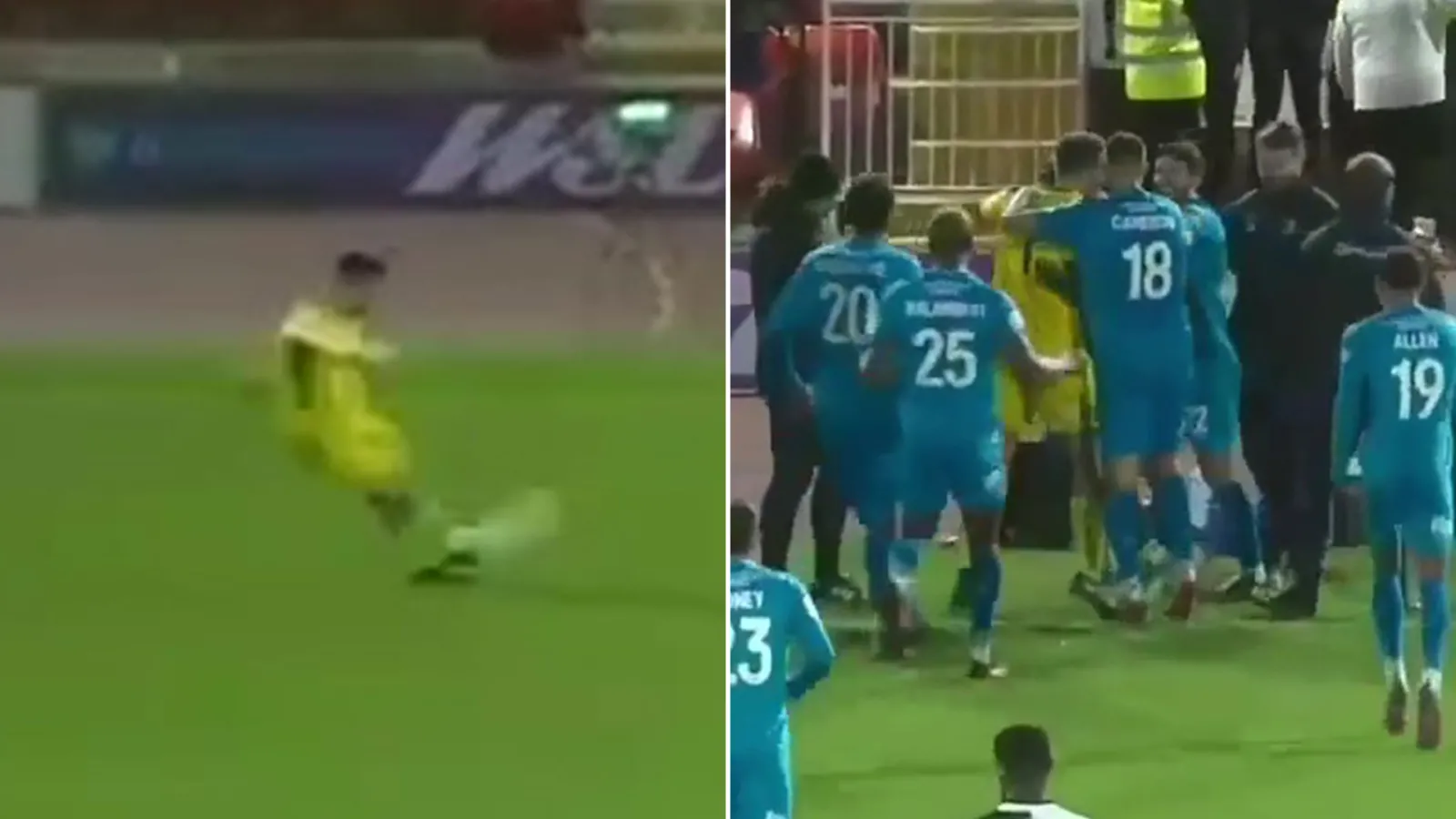
Barrow goalkeeper Ben Winterbottom smashed a goal-of-the-year candidate in the National League after scoring from his own half against Gateshead. Fans, however, argue the strike should be recorded as an own-goal because Gateshead forward Max Thompson caught the ball before it slipped from his hands.
The Barrow keeper took a free-kick from his own half eight minutes before full-time, sending a long ball that travelled the length of the pitch into the opposite penalty area. Thompson, 22, initially secured the ball but misjudged its force and height, losing possession and nearly colliding with his own post. The ball then crossed the line behind Gateshead's net, giving Barrow a 3-0 lead at the Gateshead International Stadium.
Winterbottom was officially awarded the goal, yet a chorus of non-league fans on social media insisted it should be logged as an "oggie" - football slang for an own-goal. One tweet read: "Surely an own-goal. He catches it then chucks it in." Another commented: "That's an OG." A third simply wrote: "Own-goal!"
Further comments echoed the same sentiment. One fan posted: "Nah that's an own-goal, the keeper has full on caught it and dropped it into his own goal." Another added: "That's an own-goal." Yet another remarked: "What a (own)goal!"
What Exactly Happened During the Goal?
At the 82nd minute, Barrow earned a free-kick just inside their own half. Winterbottom, who is 25, elected to launch the ball directly upfield rather than playing a short pass. The ball sailed over the midfield line, bounced once inside Gateshead's penalty area, and landed near Thompson.
Thompson, a 22-year-old forward, reached up and secured the ball with his hands. In the split second that followed, he appeared to lose grip as the ball rebounded off his palm and rolled toward the goal line. Because the ball crossed the line before any Barrow player could touch it, the referee signalled a goal.
According to the Laws of the Game, a goal is awarded when the whole ball crosses the line between the goalposts and under the cross-bar, provided no infringement has occurred. The incident did not involve a foul, handball, or off-side, so the decision stood.
Why Fans Believe It Should Be an Own Goal
Supporters base their argument on the interpretation of an own-goal in football. Typically, an own-goal is recorded when a defending player's direct action causes the ball to enter his own net, regardless of whether the ball subsequently touches an attacker.
In this case, Thompson was the last Gateshead player to touch the ball before it entered the net. Although Winterbottom's long ball created the opportunity, the decisive touch that sent the ball over the line came from Thompson's mishandling. Hence, many fans argue that the goal should be credited to Thompson as an own-goal.
The debate mirrors similar high-profile incidents, such as the 2013 Premier League clash where a goalkeeper's long clearance led to an own-goal after a defender mis-controlled the ball. In those cases, the governing bodies have consistently awarded the goal to the attacking side, reinforcing the principle that the final touch determines ownership.
Background: Goalkeepers Scoring in the National League
Goalkeeper goals are rare at any level of football, but they are not unheard of in the English National League, the fifth tier of the English football pyramid. The league has seen a handful of keepers score from set-pieces, penalties, or even open play. Notable examples include:
- Lee Camp, who scored a long-range free-kick for Northampton Town in 2014.
- Jordan Ibe's dramatic header for Barrow in 2021, though not a goalkeeper, highlighted the league's propensity for surprise goals.
Winterbottom's strike joins this exclusive list, and the distance - from his own half - places it among the longest recorded in the competition's history.
Explaining the Rules: How Own Goals Are Recorded
The International Football Association Board (IFAB) outlines the criteria for own-goals in Law 10 (The Goal). The key points are:
- If a defending player deliberately redirects the ball into his own net, the goal is recorded as an own-goal.
- If the ball rebounds off a defender after an attacking player's shot, the goal is credited to the attacker.
- If the ball reaches the goal line after a deflection that is not a deliberate play, the goal is usually awarded to the attacker.
In Winterbottom's case, the ball was not a shot on target; it was a long clearance. The decisive touch that caused the ball to cross the line came from Thompson, who unintentionally dropped it. Under the IFAB guidelines, the goal is credited to the attacking side because the final touch was not a deliberate act to score.
Impact on Barrow and Gateshead
The goal extended Barrow's lead to 3-0, effectively sealing the match. The three-point victory bolsters Barrow's position in the National League table, providing valuable points in a tightly contested promotion race.
For Gateshead, the own-goal controversy may affect morale but does not alter the result. The club will likely review defensive positioning on long balls, a common vulnerability for lower-division sides facing teams with strong aerial distribution.
From a fan-engagement perspective, the incident has generated significant buzz on social media, increasing visibility for both clubs. Viral tweets and discussions can translate into higher attendance for future fixtures and greater interest from sponsors seeking exposure in the non-league arena.
What Comes Next: Official Review and Future Implications
National League officials typically review contentious goal decisions post-match. However, because the referee's decision aligns with the IFAB rulebook, a formal overturn is unlikely.
Barrow's coaching staff may analyse the set-piece execution to replicate the success in future games. Conversely, Gateshead's defensive coaches are expected to drill players on handling long balls under pressure, reducing the risk of similar incidents.
Fans and pundits will continue to debate the classification of the goal, but the official record will stand as a goal for Barrow, credited to Ben Winterbottom.
Practical Takeaways for Players and Coaches
For goalkeepers, Winterbottom's strike demonstrates the potential upside of aggressive long-range distribution. Coaches may encourage keepers to assess wind, pitch conditions, and opponent positioning before launching such attempts.
Defenders, especially those tasked with intercepting long balls, should practice secure catching techniques and maintain spatial awareness to avoid losing possession near their own goal.
Supporters should recognize that while social media commentary can influence perception, official statistics follow the established rulebook, ensuring consistency across all levels of the game.
🚨 GOALKEEPER GOAL 🚨
— National League on DAZN (@DAZN_NationalLg) November 14, 2026
BARROW KEEPER BEN WINTERBOTTOM FROM WAY INTO HIS OWN HALF 🤯🤯🤯 pic.twitter.com/0SA3fKcOiD