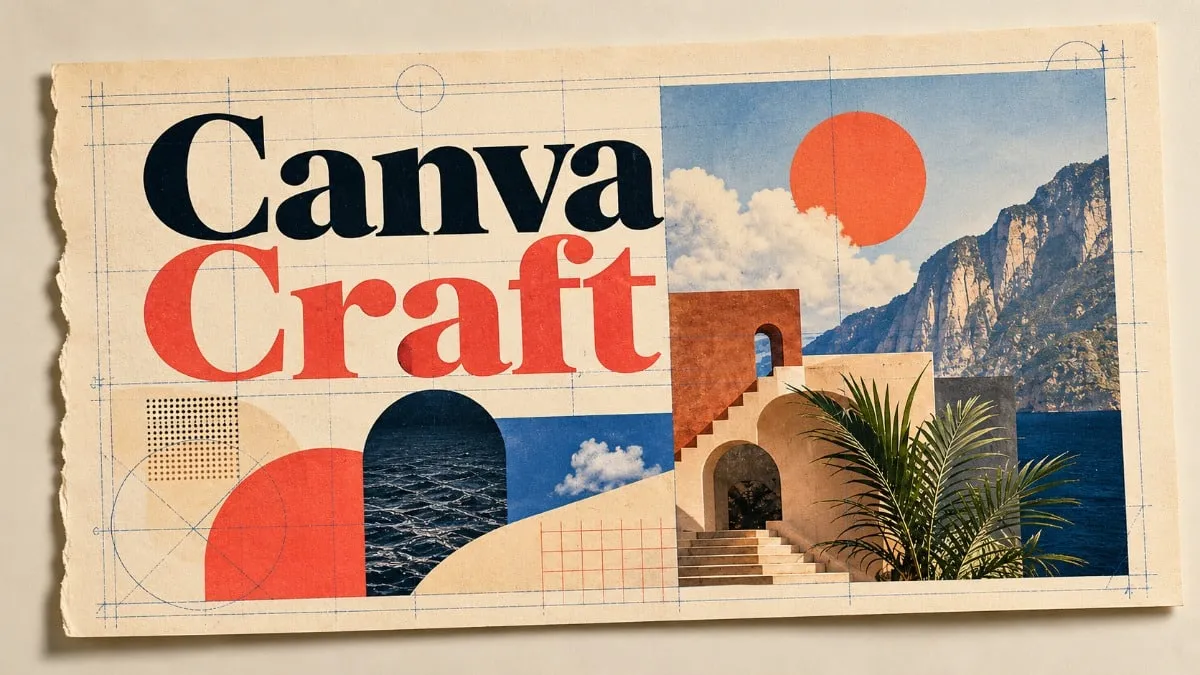
Canva rolled out its first internally built AI image generator, named Canva Craft, to rival similar tools from Google, OpenAI, ByteDance and Meta.
The system can produce pictures that include legible text, accurate object details and allow exact edits. Users can also convert AI-created visuals into layered designs editable within Canva.
Canva Craft is now accessible to every user via the platform's Dream Lab area, with further support slated for external apps.
How Canva Craft Works
Canva Craft follows a two-stage workflow to turn text prompts into images.
First, the model interprets the user's directions and drafts a design plan covering object placement, size relationships, visual hierarchy and text layout.
Second, it creates the image based on that plan, supporting up to 2K resolution and 30 aspect ratios.
Canva says this method boosts image accuracy and lets users edit single elements without altering the rest of the picture.
| Feature | Canva Craft |
|---|---|
| Maximum resolution | 2K |
| Supported aspect ratios | 30 |
| Generation process | Two stages |
| Training data | Human-designed templates |
| Text rendering | Supports readable text |
| Editing | Precise image adjustments |
| Availability | Canva Dream Lab |
| Developer access | Canva API |
Trained on Design Templates
Rather than relying mainly on photographs, Canva taught Craft using human-crafted designs from its template library.
The training set includes posters, social media graphics, presentations, infographics, menus and typography-heavy layouts.
This strategy helps the model learn how text, images and other elements should be arranged in a design.
Canva Craft also works with Canva Magic, the firm's image-to-design tool, enabling generated pictures to be turned into editable layers.
The feature builds on Canva's AI design model launched in 2025 to recognize individual design components and layers.
ChatGPT and Gemini Integration
Canva intends to offer Craft through third-party AI assistants such as ChatGPT and Google's Gemini via its Model Context Protocol (MCP) integration.
This would let users create images via supported chatbots while accessing Canva's design functions.
The company also plans to expose Canva Craft via its API so developers can embed the technology in their applications.
Faster Models Coming Soon
Two more versions of the image generator, called Craftfast and Craft-ultrafast, are in development.
Both aim to lower generation costs and speed up processing, though release dates have not been disclosed.
Previously, Canva depended on several external AI image generators. Building its own solution could cut API fees and give the firm tighter control over image quality and performance.
Researchers from Leonardo.ai, the AI media platform Canva bought in 2024, also helped create Craft.
Canva Faces Rising AI Costs
The debut arrives as Canva grapples with growing expenses tied to AI development and infrastructure.
The firm was on track for roughly $4 billion in revenue in 2025, but later trimmed its 2026 growth outlook because of mounting AI costs.
External analysts note Canva's valuation fell from $42 billion to $35 billion after the forecast revision.
By building its own image generation models, Canva seeks to lessen dependence on third-party AI providers, boost performance and manage operational costs.