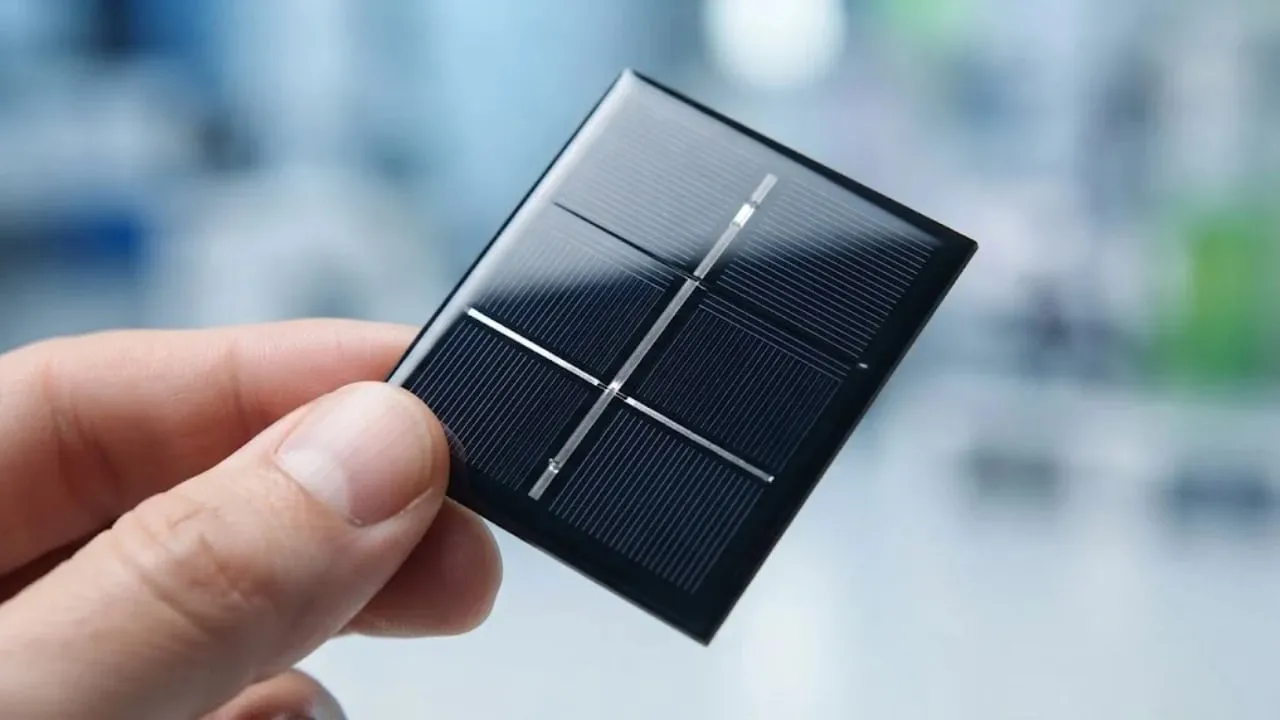
Researchers at China's Ningbo Institute of Materials Technology and Engineering announced on October 21 that their organic solar cells reached 20.4% power conversion efficiency, while a 15.6 cm² module achieved a record 18.8% efficiency, according to a study published in Joule.
The team used a molecular-locking approach, inserting an ultra-thin indium chloride layer between the electrode and the active film. Heating the assembly caused a reaction that permanently bonded the film to the electrode, creating a dense network of molecular links.
With the layers securely locked, the small-area laboratory cells attained 20.4% efficiency and retained over 85% of their output after 2,000 continuous hours. Scaling the process to a 15.6 cm² module maintained high performance, supporting the method's suitability for mass production.
Prof. LIU Quan of the Chinese Academy of Sciences led the work at NIMTE and is listed as the corresponding author. He said, "We scaled the technique to large-area modules with an aperture area of 15.6 cm2, reaching a record active-area PCE of 18.8%."
The researchers suggest the technique could become a universal platform for producing organic solar panels, which are lighter, flexible and potentially see-through compared with traditional silicon panels that deliver 20%-25% efficiency but are heavy and rigid. Funding came from the National Natural Science Foundation of China.
"We scaled the technique to large-area modules with an aperture area of 15.6 cm2, reaching a record active-area PCE of 18.8%," said Prof. LIU Quan, corresponding author of the study.
You can read the research paper here.