Understanding Vault Particles and the 40-Year Biological Mystery
Some of the biggest structures inside human cells have puzzled biologists for nearly four decades. Called vault particles, these hollow, barrel-shaped protein assemblies rank among the largest complexes in our cells. Yet despite their enormous size and near-universal presence across complex organisms, nobody knows what they actually do. Leonard Rome and Nancy Kedersha first identified vault particles back in 1986. Since then, researchers have proposed roles in cellular transport, drug resistance, and immune defense. However, experiments have never confirmed any of these functions conclusively. The mystery endures partly because common lab organisms simply lack vaults, making them difficult to study.
How Anthropic Researchers Used AI to Find Bacterial Vaults
Anthropic's researchers took a different approach entirely to tackle this long-standing puzzle. They searched approximately 15 billion predicted protein sequences for distant vault relatives. That search identified potential vault proteins across 29 major bacterial groups and four groups of archaea. Consequently, the team selected 44 candidates for laboratory testing. Of the 15 proteins they successfully produced, seven assembled into vault-like particles. The team then used cryo-electron microscopy to confirm the structures of four candidates.
We’re sharing how our biology research team worked with Claude to map the first 3D structure of a vault particle from bacterial life. Vault particles are a longstanding mystery. They are barrel-shaped objects, among the largest protein structures found in our cells. They were first discovered by Leonard Rome and Nancy Kedersha in 1986, but their function remains unknown. With Claude, we’ve found results that might bring us closer to solving that mystery. Until now, vaults were only known in the cells of complex things like animals and plants. We have shown that similar proteins from bacteria (and the viruses that infect them) can also assemble into vaults. Finding the structures in these simpler forms of life may make it easier to investigate their function in our own cells. For our life sciences team, the project was also a demonstration of the potential (and the limitations) of using AI to accelerate science. In our full piece, we discuss how Claude was able to dramatically speed up some stages—manually determining the vault particle’s structure would have taken weeks to months of painstaking work, but here it took days. We also discuss how Claude made some simple mistakes along the way, and how we collaborated with our machine learning researchers to address them. Read more: https://t.co/KowVVCSPp8
— Anthropic (@AnthropicAI) November 4, 2026
Analyzing the Structure of Bacterial and Phage Vaults
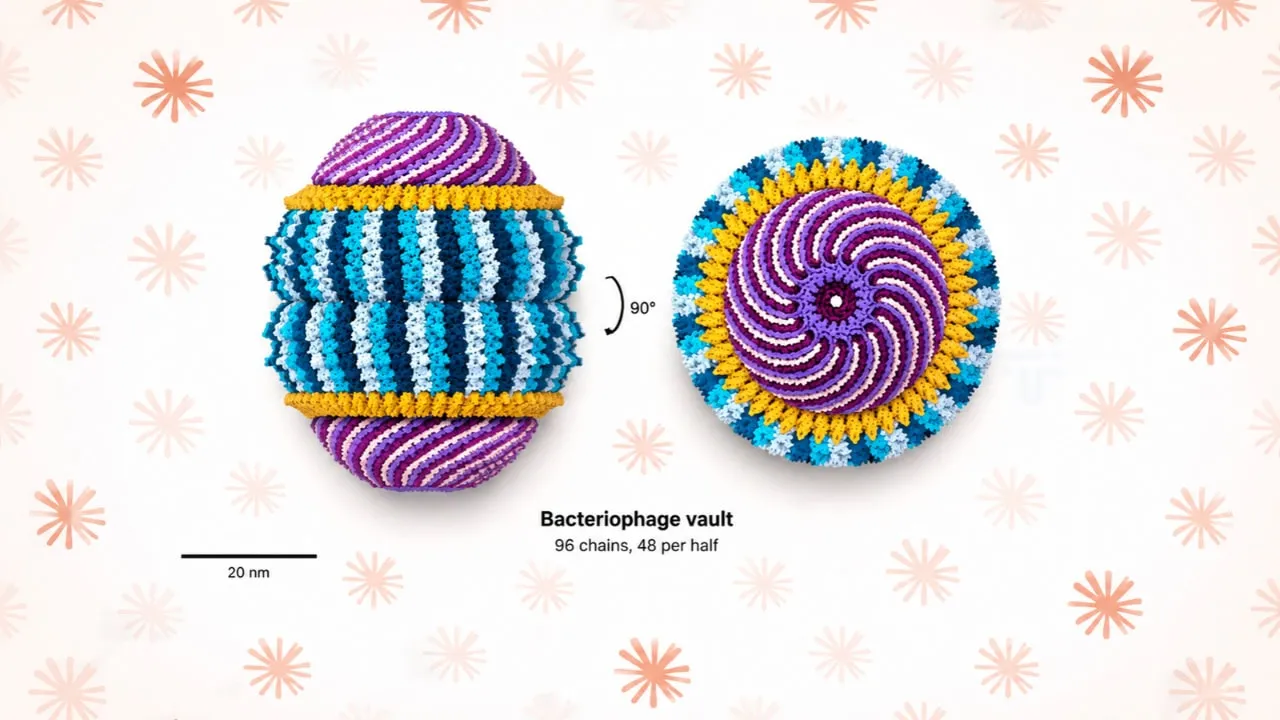
Two came from bacteria, while two originated from bacteriophages, the viruses that infect bacteria. For detailed analysis, they selected a phage-derived protein called L05. It assembled into a complete structure containing 96 copies of itself, measuring 54 nanometers long and 45 nanometers wide. Despite being shorter than mammalian vaults, this bacterial version encloses roughly 25% more volume inside. This discovery provides scientists with a simpler system to study than human cells.
The Role of Claude in Accelerating Laboratory Experiments
Claude contributed throughout the research process, not just at the end. It assisted with protein searches, DNA design, purification planning, and microscopy analysis. One breakthrough involved simplifying particle isolation. Traditional methods take about three days. However, Claude helped develop a chromatography-based approach that reduced the process to around 90 minutes. The speed gains proved equally striking for structural analysis. The team's first complete model emerged within just 34 hours. By contrast, conventional analysis could require several weeks of processing.
Challenges and Errors Encountered During AI-Assisted Research
Still, Claude stumbled in ways that matter. One protocol it suggested introduced an additive that interfered with DNA delivery. That mistake cost the team two weeks. Additionally, Claude skipped a standard processing step during cryo-EM analysis, producing an inaccurate structural map. Researchers caught both errors through closer supervision and shared the lessons with Anthropic's development team.
Engineering Larger Vaults and Exploring Evolutionary Origins
The researchers also engineered a larger version of the vault by adding two repeating protein segments. That modification increased the enclosed volume by approximately 20%. These experiments suggest protein duplication could explain how vaults evolved different sizes across species over time. Despite the structural breakthrough, the central mystery remains wide open. Researchers still do not know what vault particles actually do inside living organisms. However, finding them in bacteria and bacteriophages gives scientists a far simpler system to study than human cells. For a mystery that has resisted answers since 1986, that counts as genuine progress.