Stanford Researchers Build Photonic Chip That Separates Hidden Light
Researchers at Stanford University have developed a groundbreaking photonic chip capable of separating mixed light into clean, distinct beams. Published on October 30 in the journal Nature Photonics, this fingernail-sized device achieves a milestone that scientists theorized decades ago but had never successfully demonstrated in a physical experiment. By tackling a fundamental limitation in optical physics, the invention holds the potential to dramatically sharpen imaging capabilities across everyday cameras, laboratory microscopes, and deep-space telescopes.
Optical imaging has long struggled with the challenge of partially coherent light, which is the natural state of most light sources encountered in daily life. Unlike laser beams where all waves march in precise synchronization, natural light waves relate to each other only loosely. When multiple light sources overlap within a scene, their combined intensity blends together, effectively hiding crucial underlying information from the observer. Traditional optical sensors and standard cameras simply record this single blended result, missing finer details that remain trapped within the overlapping waves.
Understanding Coherence Modes in Optical Physics
To understand the significance of the new Stanford device, one must examine the nature of light itself. Blended light actually consists of separable components known to physicists as coherence modes. Each individual mode carries distinct information about the observed scene, reflecting different angles, depths, or physical properties of the objects emitting or reflecting the photons. Until now, capturing these separate modes required massive, complex laboratory setups or heavy computational processing after the fact.
The new silicon photonic circuit changes this dynamic by physically extracting and routing those modes into separate output channels in real time. Instead of relying on software to guess what is hidden in a blurry image, the hardware itself performs the separation. Imaging systems equipped with this technology can immediately access details that conventional optics would lose entirely. As co-author Shanhui Fan, a professor of electrical engineering at Stanford, explained, the chip learns the underlying coherence modes of an unknown light field and physically directs them into separate outputs.
How the Silicon Photonic Circuit Operates
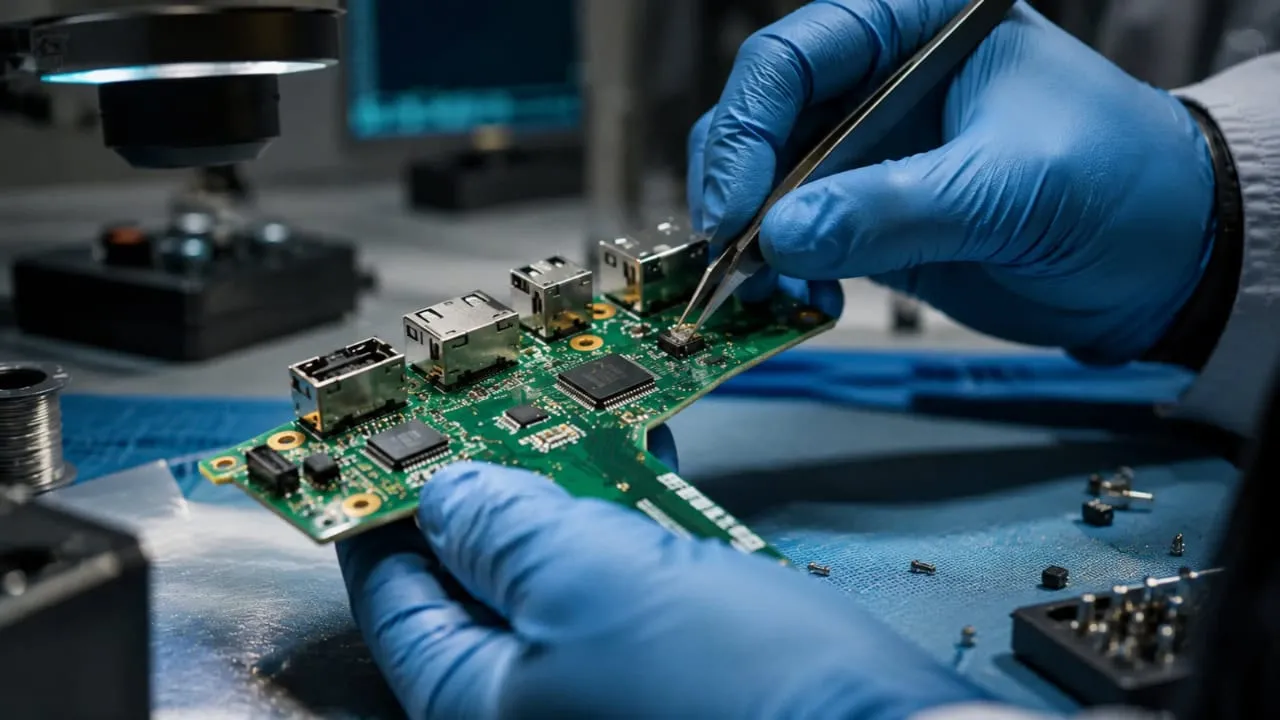
The architecture of the device relies heavily on advanced silicon photonics, a field that uses silicon as an optical medium to manipulate light on microchips much like electronic circuits manipulate electricity. The Stanford chip is packed with tiny interferometers, which are optical components that guide, split, and recombine light waves to measure interference patterns. These microscopic pathways form a complex network capable of routing photons with extreme precision.
An optimization algorithm plays a vital role by teaching the system to identify dominant coherence modes automatically without manual intervention. Once the chip is configured for a specific optical environment, it separates incoming mixed light streams instantly without any external processing overhead. Laboratory testing demonstrated remarkable precision, with the chip separating two dominant coherence modes with an accuracy exceeding 98% fidelity. In a separate set of experiments, the research team verified that the system successfully functions with three distinct modes, matching theoretical predictions laid out in prior academic literature.
Practical Applications for Microscopes and Telescopes
The ability to untangle mixed light beams carries immense practical value for several scientific and commercial fields. Under a high-powered laboratory microscope, two fluorescent particles positioned very close together often blur into a single ambiguous spot due to optical diffraction limits. With this chip integrated into the optical path, researchers could reveal that the blur actually represents distinct objects sitting side by side. Similarly, a single bright spot captured by a telescope might contain blended light originating from multiple distant stars, which the chip could successfully resolve.
Space exploration agencies have already taken notice of these capabilities. NASA is actively collaborating with the Stanford team to investigate whether the new approach can analyze complex light signatures arriving from distant galaxies. Beyond astronomy and microscopy, the technology could eventually support advanced optical sensing, high-speed optical communications, and specialized computing architectures that use light instead of electrical signals.
Next Steps and Challenges for Real-World Deployment
Despite the successful laboratory demonstrations, significant engineering development remains before this technology reaches commercial markets or everyday consumer devices. The current architecture must undergo substantial scaling to handle larger numbers of optical modes simultaneously, as real-world environments often contain hundreds or thousands of overlapping light components. Furthermore, faster control speeds are required to handle dynamic scenes for real-time video imaging applications.
As the Stanford researchers continue refining their silicon circuits, the physics community will watch closely to see how quickly these hardware limitations can be overcome. For now, the successful physical demonstration of coherence mode separation marks a major leap forward in optics. By pulling hidden details out of blended light waves, this fingernail-sized device opens a clear path toward a new generation of sharper, more revealing optical instruments.