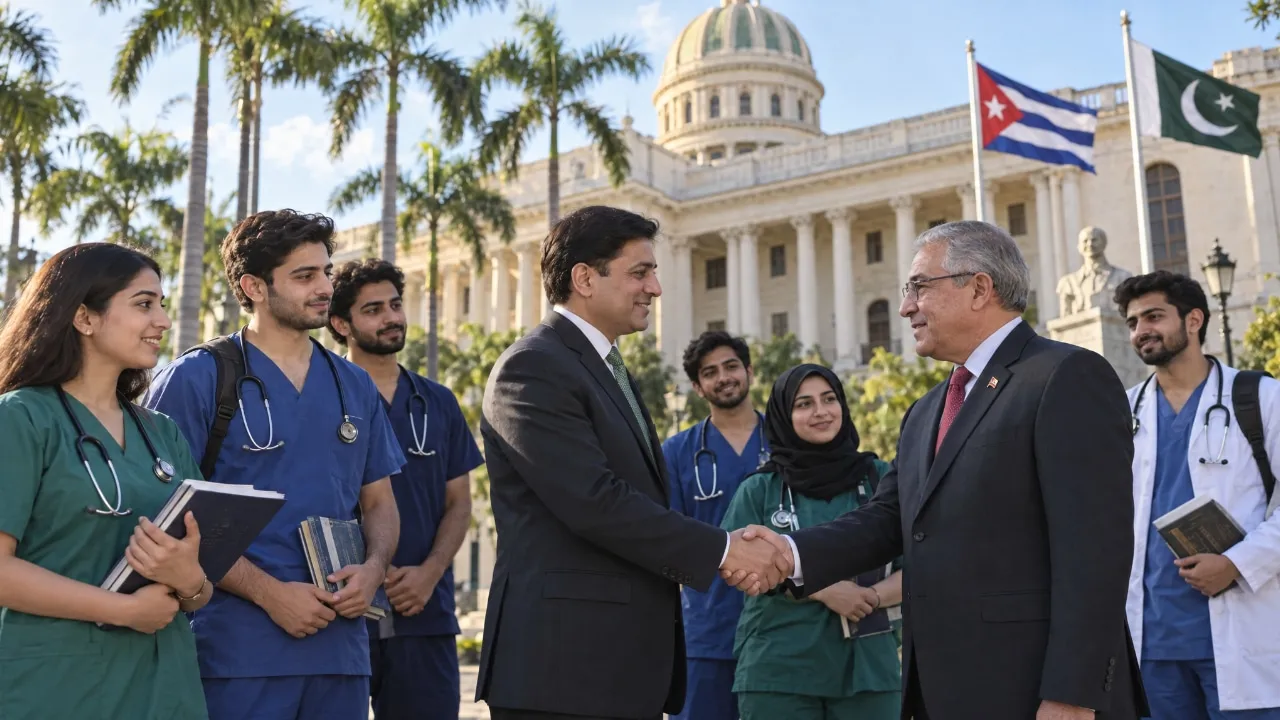
The Government of Cuba has offered 11 undergraduate scholarships for Pakistani students for 2027, including 10 in Medical Sciences and one in the General Category, in a major boost to educational cooperation between the two countries.
The offer was discussed during a meeting between the Executive Director, Higher Education Commission (HEC), Prof. Dr Zia Ul Haq, and the Ambassador of Cuba to Pakistan, H.E. Mr Damian Cordero Torres, at the Cuban Embassy in Islamabad.
What the Scholarship Package Includes
Under the 2027 batch, ten scholars will study medicine at Cuban universities that are known for a community-oriented curriculum. The eleventh scholar will enroll in a non-medical undergraduate programme designated as the General Category. All scholars will receive full tuition coverage, accommodation, and health insurance provided by Cuban institutions.
In addition, the Cuban government will supply a monthly stipend to cover basic living costs. The stipend amount has not been disclosed publicly, but it is intended to complement the partial financial support pledged by the Government of Pakistan.
How the Agreement Was Reached
The scholarship offer emerged from a bilateral meeting held on the Cuban Embassy premises in Islamabad. Prof. Dr Zia Ul Haq, representing Pakistan's Higher Education Commission, thanked the Cuban side for its continued generosity. He also raised the prospect of extending similar opportunities to students from underserved and underdeveloped regions of Pakistan, a suggestion that was welcomed by Ambassador Damian Cordero Torres.
During the discussion, the Cuban Ambassador presented data on the academic performance of Pakistani medical students already studying in Cuba. The data showed that Pakistani scholars have consistently achieved passing grades and have integrated well into the Cuban health-education system.
Financial Support From Both Governments
The Government of Pakistan will provide partial financial support to the selected scholars through monthly stipends during their studies in Cuba. This arrangement mirrors previous cooperation agreements where Pakistan funded students studying abroad in fields such as engineering and agriculture.
By sharing the cost of living expenses, both governments aim to make the programme financially viable for a larger pool of applicants. The joint funding model also signals a deepening of diplomatic ties that extend beyond traditional trade and cultural exchanges.
Background of Cuba-Pakistan Educational Cooperation
Educational links between Cuba and Pakistan date back to the early 2000s, when Cuba began offering medical scholarships to students from developing nations as part of its international solidarity policy. Pakistan first sent a small cohort of medical students to Cuba in 2005, and the partnership has expanded gradually.
Cuban medical schools are renowned for their emphasis on primary health care and preventive medicine, aligning with Pakistan's need for physicians skilled in community health. Over the past two decades, more than 200 Pakistani students have completed degrees in Cuba, many of whom now serve in rural health posts across Pakistan.
Impact on Pakistani Students and the Health Sector
The new scholarships open a pathway for Pakistani students to obtain a medical degree at no tuition cost, a rare opportunity given the high fees of private medical colleges in Pakistan. For the eleven scholars selected, the programme offers a chance to study in a multilingual environment, as instruction is delivered in Spanish with English support.
Graduates are expected to return to Pakistan, where they can contribute to the shortage of doctors in underserved provinces such as Balochistan and Khyber Pakhtunkhwa. The General Category scholarship may attract students interested in fields like public health, nursing, or health administration, further broadening the health workforce.
Selection Process and Timeline
Applications will be opened by the Higher Education Commission in early 2025. Candidates must meet the standard eligibility criteria for overseas scholarships, including a minimum academic standing, proficiency in Spanish or willingness to undergo language training, and a clear statement of intent to serve Pakistan after graduation.
The selection panel, chaired by Prof. Dr Zia Ul Haq, will shortlist applicants based on academic merit and socioeconomic need. Finalists will be notified by the end of 2026, giving them time to arrange visas, travel, and pre-departure orientation.
According to the Cuban Ambassador, the first group of scholars is expected to depart for Cuba in January 2027, aligning with the start of the Cuban academic year.
What to Watch for Next
Key milestones to monitor include the official release of application guidelines by the HEC, the announcement of stipend amounts by both governments, and the visa issuance schedule at the Cuban Embassy in Islamabad.
Stakeholders such as Pakistani medical colleges, health NGOs, and policy makers will be watching the programme's rollout to assess its scalability for future batches.
In the longer term, the success of the 2027 cohort could pave the way for expanded scholarships in other disciplines, reinforcing the educational bridge that has been built over two decades of cooperation.