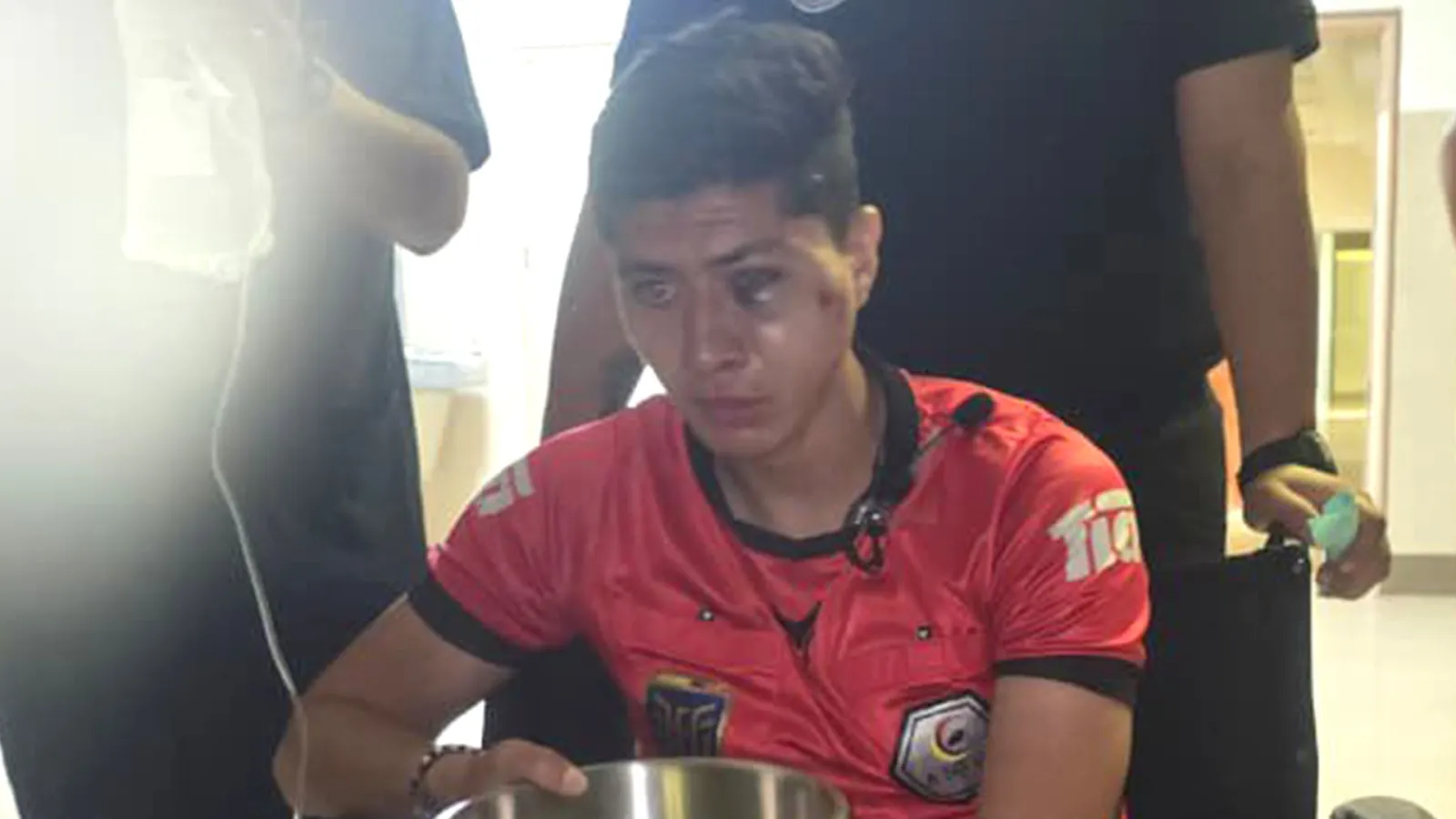
Jhon Perlaza, a midfielder for Club Ciudad de Yantzaza, was handed an eight-year ban by the Ecuadorian Football Federation (FEF) after he threw a rock at assistant referee Lenin Giovanni Ojeda Nunez during a third-tier match, leaving the official with facial injuries that required emergency surgery.
The incident occurred in the 96th minute of the game against Club Rio Aguarico FC, prompting the match to be abandoned and sparking a nationwide outcry over violence in sport.
What Exactly Happened on the Pitch?
According to eyewitness accounts and a viral video circulating on social media, Perlaza entered the dugout area, picked up a stone from the ground, and hurled it directly at Ojeda Nunez. The rock struck the assistant referee in the face, causing him to collapse to the ground. Medical personnel rushed him onto a stretcher and then into an ambulance.
#ATENCIÓN | La Federación Ecuatoriana de Fútbol (FEF) adoptó medidas disciplinarias provisionales contra Jhon Michel Perlaza Salas y el Club Ciudad de Yantzaza https://t.co/cFEcFvsy8G pic.twitter.com/u8zNzi4sWF
— El Universo (@eluniversocom) October 21, 2026
The video shows the moment the rock leaves Perlaza's hand, the impact, and the referee's immediate loss of balance. The clip quickly spread across platforms, prompting fans, officials and human-rights groups to condemn the act.
Terrible lo que pasó en Segunda Categoría. Agresión al asistente número 1 por parte de un jugador. Toda la información en videos e imágenes que adjunto. Que caiga todo el peso de la ley contra el agresor. pic.twitter.com/vgCe026Ied
— Joaquín Saavedra (@joacosaavedraq) October 20, 2026
How the FEF Responded
Within days, the FEF released an official statement confirming the severity of the injuries. "The assistant referee suffered serious injuries that required surgery and a 60-day recovery period," the federation said.
The disciplinary committee concluded that Perlaza had committed "physical aggression against a match official" and imposed an eight-year suspension from all football-related activities, effective until 19 October 2034. The federation also announced its intention to ask FIFA to extend the sanction worldwide, ensuring the ban would apply to any competition under FIFA's jurisdiction.
In addition to the personal ban, the FEF fined Club Ciudad de Yantzaza £1,521 and ordered the club to cover Nunez's medical expenses, which total £3,323.
Club Ciudad de Yantzaza's Reaction
Club Ciudad de Yantzaza issued an apology within 48 hours of the incident. The club's statement read, "As an institution, we categorically reject all acts of aggression, whether verbal or physical, both inside and outside sporting venues. We firmly believe that football should be a space of respect, coexistence, and fair play."
The club also confirmed that Perlaza had been released from his contract immediately after the incident, stating, "Once the person responsible for this regrettable incident was identified, the institution made the decision to remove him immediately, and he is therefore no longer part of our club."
Medical Impact on the Assistant Referee
Lenin Giovanni Ojeda Nunez was taken to a local hospital where surgeons performed emergency facial surgery to repair damage to his left eye and surrounding tissue. Doctors reported that the rock caused a fractured orbital bone, severe swelling, and bruising around the left eye.
Photographs released after the incident show Nunez in a wheelchair, holding a metal bowl, his face heavily swollen and his left eye visibly bruised. The medical team estimated a minimum 60-day recovery period, though long-term effects such as vision impairment remain a concern.
Legal and Regulatory Context in Ecuadorian Football
Violence against match officials is addressed under the FEF's disciplinary code, which aligns with FIFA's statutes on the protection of referees. The code mandates a minimum six-month suspension for any physical assault on an official, with the possibility of longer bans depending on the severity of the injury.
In recent years, Ecuadorian football has seen a rise in on-field aggression, prompting the federation to introduce stricter penalties and educational programs aimed at players, coaches and fans. The eight-year ban imposed on Perlaza is among the longest ever recorded in the country's football history.
Broader Implications for Ecuadorian Football
The incident has reignited debate over safety protocols for officials in lower-division matches, where resources are often limited. Critics argue that inadequate security measures, such as insufficient barriers between the dugout and the pitch, contributed to the ease with which Perlaza accessed the stone and launched his attack.
Sports administrators are now reviewing stadium standards for third-tier leagues, considering mandatory protective gear for referees and stricter monitoring of fan behavior. The FEF's decision to seek a worldwide ban signals a willingness to use international mechanisms to protect officials.
What Comes Next for the Parties Involved?
Perlaza's suspension will remain in force until 19 October 2034, unless the FIFA appeals process alters the duration. The club must pay the stipulated fines and medical fees, and it faces possible additional sanctions if the federation determines further negligence.
Ojeda Nunez is expected to undergo a series of follow-up appointments to assess his recovery and any lasting visual impairment. The FEF has pledged to cover any additional medical costs not included in the initial £3,323, provided they are documented.
Fans and advocacy groups are calling for a transparent review of security measures at third-tier venues. The federation has announced a meeting with club representatives next month to discuss mandatory safety upgrades.
Practical Takeaways for Players and Clubs
- Any physical aggression toward a match official can trigger a suspension of up to eight years, as demonstrated by this case.
- Clubs are financially liable for medical expenses incurred by officials injured during matches.
- Federations may seek worldwide enforcement of bans, meaning sanctions can affect a player's career beyond national borders.
- Teams should review dugout security, ensure no hazardous objects are within reach, and provide education on respect for officials.
By reinforcing these protocols, Ecuadorian football hopes to prevent a repeat of the violent episode that shocked the nation.