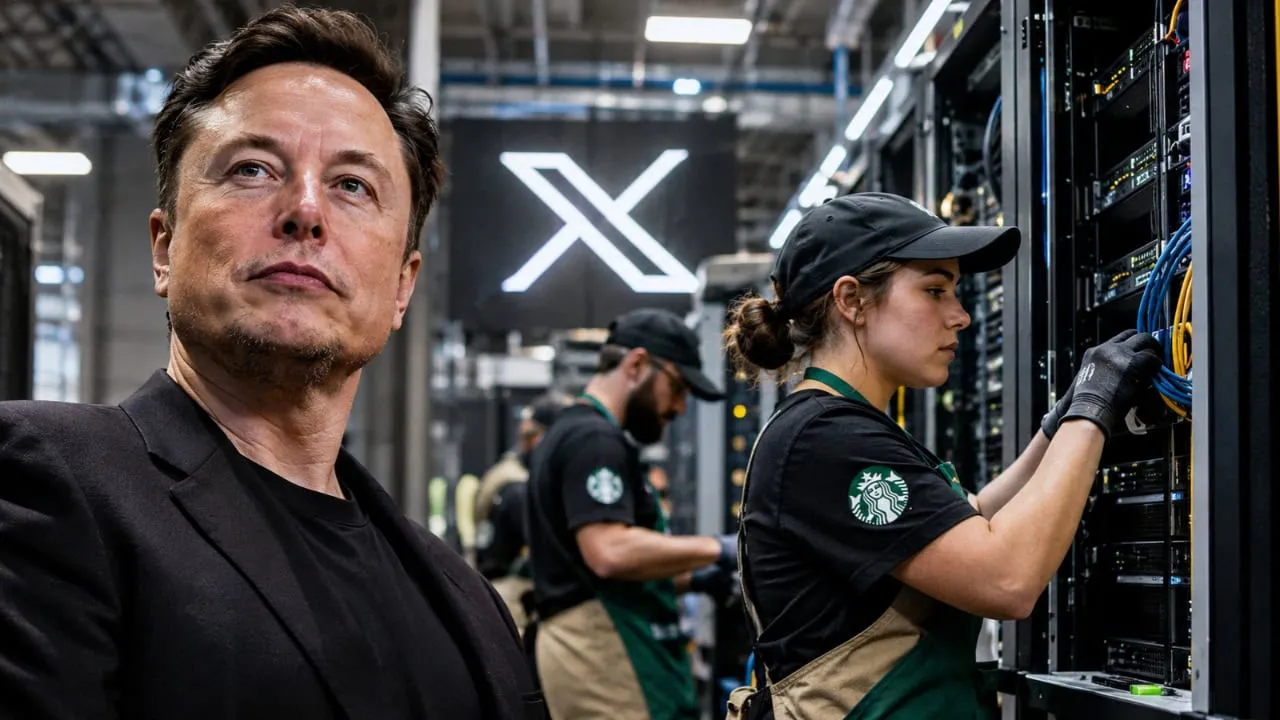
Elon Musk said former Starbucks baristas and Target shelf stockers are some of SpaceX's best data center construction workers while speaking at the TomorrowX Summit in Austin earlier this week.
What Musk Said About Hiring Non-Traditional Workers
During a session on workforce innovation, Musk explained that SpaceX built an internal team called ArmyX to manage its massive data-center expansion. He said the team breaks down every construction task into small, repeatable units that a new hire can master in just a few days. "You don't need people that have been doing networking cables for their whole life," Musk said. "Someone who previously worked as a barista or stocked shelves at a retail store can step in and perform well. Those are some of our best people, and they've never done data centers before."
Musk also singled out In-N-Out employees, praising their discipline and consistency. "Let me tell you, if you get some aces out of In-N-Out who've been making epic burgers all day long perfectly, they're going to do a damn good job of network cables," he added.
How ArmyX Works: Breaking Down Construction Tasks
ArmyX is not a subcontractor; it is an internal workforce development unit. The model follows a "modular task" approach that is common in manufacturing but rarely applied to data-center builds. Each phase, foundation pouring, rack placement, power-distribution wiring, and fiber-optic termination, is documented in a step-by-step playbook. New hires watch short video tutorials, then practice on a mock-up wall before moving to a live site.
This approach reduces the need for veteran installers who traditionally command higher wages and require years of on-the-job training. By standardising the work, SpaceX can offer a 20% pay increase to employees who volunteer for six-week stints at construction sites, encouraging internal mobility and faster staffing.
Where the New Data Centers Are Going
The ArmyX team currently supports SpaceX's expansion of the Colossus supercomputing complex across Memphis, Tennessee, and Southaven, Mississippi. SpaceX plans to operate six data-center facilities in that region by the end of 2026. The company is also tracking to bring roughly 200,000 GB300 chips online per month through the rest of the year, a pace that demands a steady flow of installation crews.
Why the Shift Matters for the Tech Industry
The broader AI industry now faces an unprecedented labor shortage for data-center construction. Capital expenditures across Big Tech are projected to reach $600 billion in 2026, and the demand for skilled electricians, network technicians and rack installers far outstrips supply. Companies are therefore experimenting with new hiring pipelines to avoid project delays.
Meta, for example, recently launched its "America's Workforce Academy" to train people in trade skills at pilot locations in Louisiana, Ohio, Indiana and Texas. The program mirrors SpaceX's philosophy of converting workers from unrelated sectors into data-center technicians.
Impact on Workers and Communities
For former baristas, shelf stockers and fast-food crew members, the shift offers a path to higher-pay, technical work without a four-year degree. The 20% pay premium for volunteers makes short-term assignments financially attractive, especially in regions where wages have lagged behind national averages.
Local economies in Memphis and Southaven stand to benefit from the construction boom. Increased employment translates into higher tax revenues, which can fund public services and infrastructure improvements. Moreover, the presence of a high-performance computing hub may attract ancillary businesses such as cloud-service providers and AI research labs.
What Comes Next for SpaceX's Data-Center Strategy
SpaceX has not disclosed a detailed timeline for each of the six facilities, but the end-2026 target suggests a phased rollout, likely with two sites becoming operational each year. The company will continue to monitor the effectiveness of the ArmyX model, adjusting playbooks as new hardware, such as the next generation of GB300 chips, is introduced.
Stakeholders should watch for quarterly updates from SpaceX's engineering reports, which will reveal the number of GB300 chips installed and the staffing levels at each site. If the modular hiring model proves scalable, other firms may adopt similar programs, reshaping the labor market for data-center construction nationwide.
Practical Takeaways for Readers
- If you have experience in fast-paced customer service or retail stocking, consider applying for short-term construction roles at SpaceX or similar tech firms.
- Keep an eye on corporate training programs like Meta's America's Workforce Academy for pathways into technical trades.
- Residents of Memphis and Southaven can expect increased job opportunities and potential community investment as the data-center complex expands.