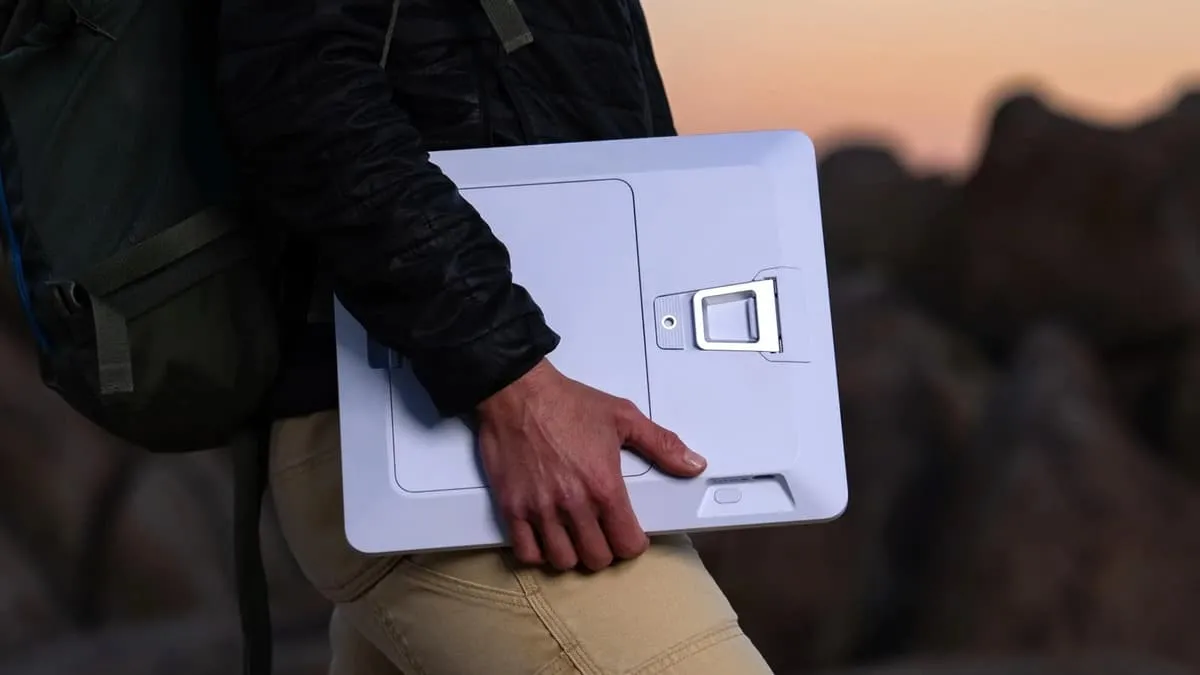
SpaceX has introduced the Starlink Mini 2, a new portable satellite internet terminal that combines a satellite dish, Wi-Fi router, and removable battery into a single device roughly the size of a laptop.
Unlike the original Starlink Mini, which requires an external power source, the new model can operate independently for up to 4.5 hours on a full charge.
The company has also reduced the device's thickness despite adding a battery, making the second-generation model slimmer than its predecessor.
How the Built-In Battery Powers the Starlink Mini 2
The biggest change in the Starlink Mini 2 is its integrated, removable battery.
SpaceX claims the battery can power the satellite terminal for up to 4.5 hours without requiring an external electricity source.
Users can extend the operating time by replacing the depleted battery with another charged unit. Additional batteries will be sold separately.
The device can also operate through a USB-C connection using a 60W power source, allowing users to power it without relying on the integrated battery.
This addresses one of the main limitations of the original Starlink Mini, which needed an external power supply to function.
Background context on satellite internet shows that power constraints have long been a challenge for mobile users in remote areas. Traditional satellite dishes require generators or vehicle power banks to operate in the field. By integrating a power source directly into the terminal, SpaceX is targeting outdoor enthusiasts, emergency responders, and travellers who need instant connectivity without hauling heavy generators.
Introducing Mini 2, the next-generation portable Starlink. Get up to 4.5 hours of connectivity on a single charge with the quick-swap battery, or plug in with USB-C.
With built-in Wi-Fi, all you need is a clear view of the sky to get online in 60 seconds.
Preorders are now open… pic.twitter.com/VRTuJZVBnH
— Starlink (@Starlink) November 10, 2026
Thinner Design and Portability Improvements
Despite adding a battery, SpaceX has reduced the Starlink Mini 2's thickness to 23.1mm, compared with 38.5mm on the original model.
However, the new terminal is slightly heavier because of horns, internal wiring, and the additional battery.
The Starlink Mini 2 weighs approximately 3.5 pounds, or 1.6kg, while retaining the compact design of its predecessor.
It also carries an IP67 dust and water resistance rating, allowing it to withstand exposure to dust and temporary immersion in water under specified conditions.
The terminal is designed for outdoor use, including camping, travelling, and working in locations without conventional internet infrastructure.
Engineers achieved this slim profile by optimising the internal layout of the components. The reduction in thickness makes the device much easier to slide into a backpack alongside laptops and tablets.
Pricing and Early Access for US Customers
The Starlink Mini 2 is being offered to selected customers in the United States for $999, according to preorder invitation screenshots shared online.
The price includes the satellite internet terminal and one year of Starlink's Roam Unlimited service.
SpaceX values the included 12-month subscription at $2,100.
However, the $999 price applies to the invitation-based bundle, and the company has not announced a separate retail price for the hardware.
Preorders are currently available by invitation to selected US customers.
SpaceX says availability will expand to more customers and countries, although it has not announced a specific timeline for the wider rollout.
Market analysts note that bundling hardware with multi-month service plans is a common strategy for telecommunications companies entering new niches. This approach guarantees recurring revenue while subsidising the upfront cost of advanced hardware for early adopters.
Technical Specifications and Connectivity Options
The Starlink Mini 2 maintains high performance standards while introducing physical upgrades. The built-in Wi-Fi router ensures that users do not need to carry separate networking gear to broadcast a local wireless signal.
With the 60W USB-C power input, users working inside vehicles or stationary bases can plug into standard power banks or car chargers. This flexibility ensures that even if the internal battery runs dry during a long task, power from an external brick keeps the connection alive.
The IP67 rating protects the sensitive internal electronics from harsh weather. Campers caught in heavy rain or field researchers working in dusty environments can rely on the housing to prevent environmental damage.
As SpaceX prepares for a broader commercial release, consumer demand for self-powered satellite hardware will test the production capabilities of the aerospace manufacturer. Observers will watch for retail pricing announcements and international regulatory approvals in the coming months.