Huawei Launches Mate X8 With Magnetic Crease Flattening System
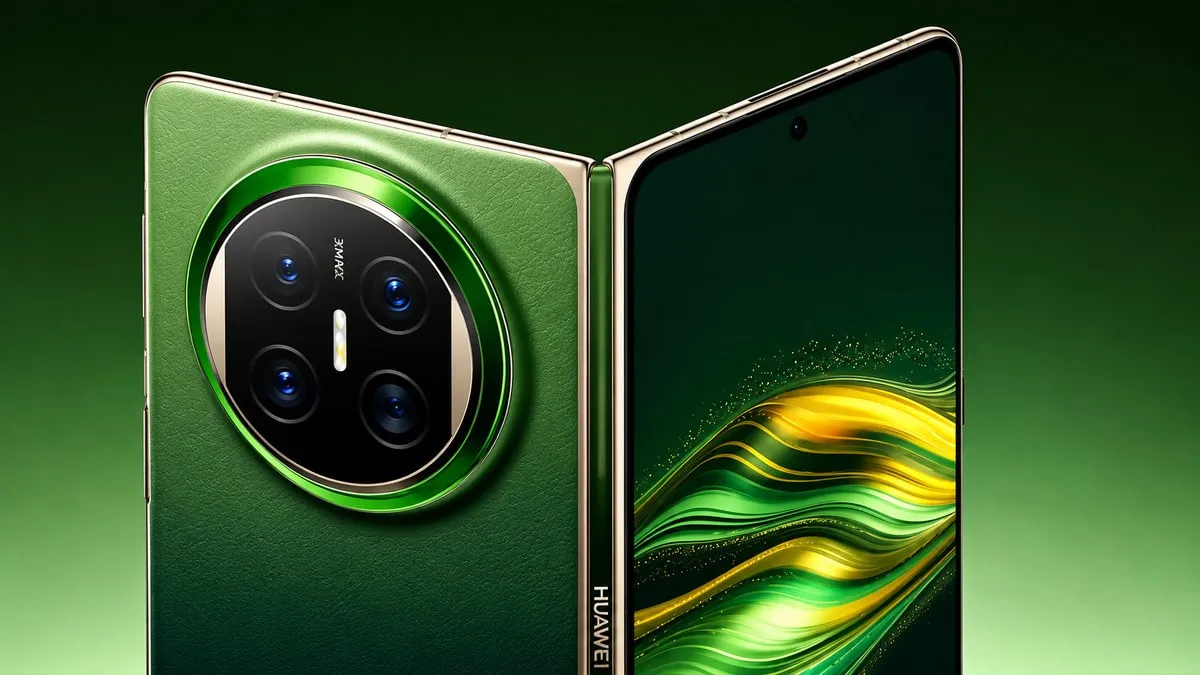
Huawei is using magnets to address one of foldable phones' most visible problems. The Mate X8, launched in China on November 24, introduces a magnetic flattening system that the company says improves inner-screen flatness by 90% over the Mate X7.
Foldable devices have long struggled with visible and tactile creases along the hinge line where the flexible display bends. By applying a novel magnetic approach, the manufacturer attempts to offer a smoother viewing surface while maintaining structural durability for everyday use.
Design and Display Specifications
The system combines a 0.1mm magnetic composite, steel reinforcement, and a micron-level filling process. Huawei says the steel laminate improves bending stiffness by 140% and achieves 99.9% recovery after bending. Its reported measurements put the screen's crease height difference as low as 15 microns.
The Mate X8 opens to an 8.2-inch OLED display with a 2424 × 2340 resolution and a nearly square shape. Its 6.54-inch cover screen uses dual-layer OLED technology with a 2444 × 1132 resolution. Both support adaptive 1-120Hz refresh rates and 1440Hz PWM dimming.
Huawei rates the cover display at 12,000 nits at 1% average picture level, or APL, and 6,000 nits at 20% APL. The inner display reaches 8,000 and 4,500 nits under the corresponding conditions. These are Huawei's laboratory peak-brightness figures.
The inner screen also receives ultra-thin glass and an anti-reflective coating. The phone measures 4.2mm unfolded and 8.95mm folded. It carries IP58 and IP59 ratings.
The standard model uses third-generation Kunlun Glass. The Collector's Edition uses Xuanwu Kunlun Glass. The five finishes are Purple Gold Brocade, Azure Sky Black, Snowy White, Qingyun Brocade, and Danxia Brocade.
Internals, Performance, and Software
Every version uses the Kirin 9050 Pro processor and HarmonyOS 7.0. The chip combines a nine-core, 16-thread Linxi CPU, a Maleoon GPU with second-generation hardware ray tracing, and a Da Vinci NPU.
Huawei claims 31% higher overall performance than the Mate X7. Its published chip figures also cite improvements in CPU, GPU, and NPU performance. These remain manufacturer measurements.
Standard models offer 12GB RAM with 256GB or 512GB storage. Collector's editions provide 16GB RAM with 512GB, 1TB or 2TB storage.
Huawei also says combining cellular and Wi-Fi antennas increases antenna area threefold and improves signal strength by 2dB.
Camera Capabilities and Optional Modules
The built-in system combines 50MP main, 40MP ultrawide and 50MP periscope cameras, alongside Red Maple color sensing. The main sensor differs between the standard and Collector's editions.
All versions support the optional Ruiying Z10 camera module. It adds a one-inch 50MP RYYB sensor, optical stabilization, and 10x continuous optical zoom. Huawei specifies a software update and a dedicated connection case for Mate X8 support.
Battery, Pricing, and Release Schedule
The phone has a 6,200mAh battery with 66W wired and 50W wireless charging. Reverse wireless charging is also supported.
Approximate Chinese prices start at $1,950 for 12GB/256GB and $2,100 for 12GB/512GB. Collector's editions cost around $2,400 for 16GB/512GB, $2,550 for 16GB/1TB and $3,150 for 16GB/2TB.
Presales began on November 24. The first four configurations go on sale on December 4 at 10:08 a.m. China time, equivalent to 02:08 GMT and 07:08 PKT. The 2TB model follows on December 20 at the same time, in Purple Gold Brocade and Azure Sky Black.
Chinese launch offers include up to 12 interest-free installments and a trade-in subsidy of approximately $120. International availability, including Pakistan, remains unconfirmed.