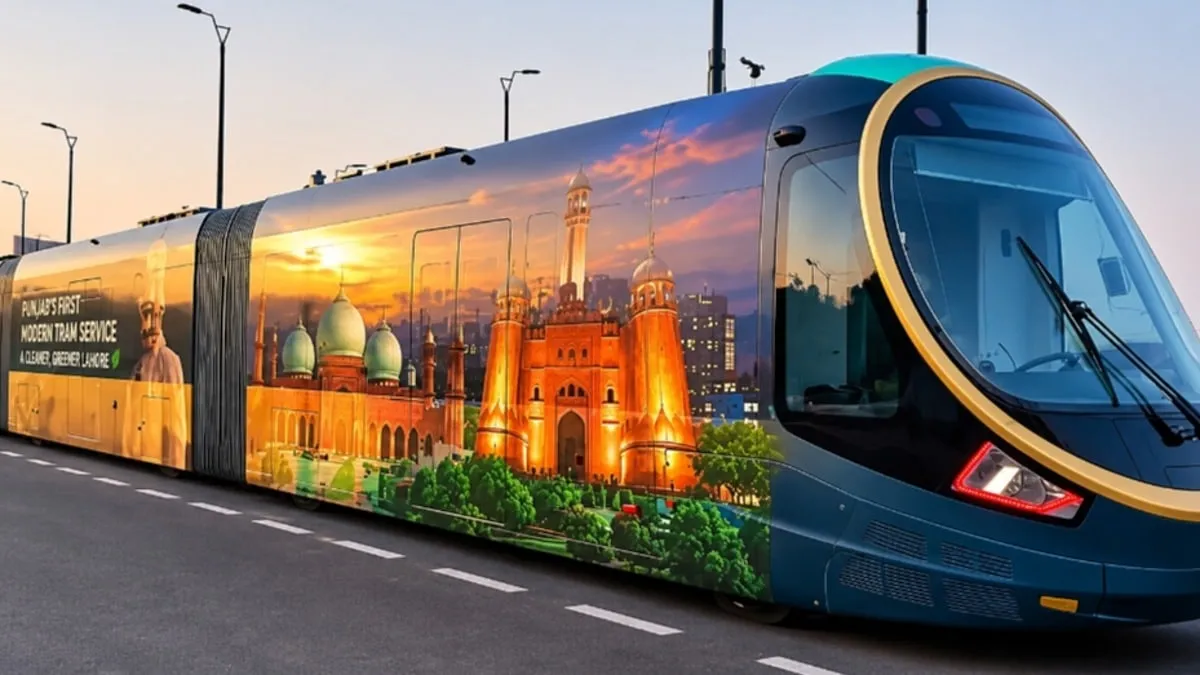
The Punjab government is preparing to introduce a tram service in Lahore as a pilot project, with officials evaluating a route that links the Central Business District (CBD) Square to The Mall via several of the city's busiest streets.
The plan follows the decision to pause the earlier Yellow Line tram project on Canal Road because of environmental concerns, and it targets a launch next month.
What Is the Proposed Lahore Tram Route?
According to a senior official of the Punjab Mass Transit Authority (PMA), the pilot will follow a circular corridor that starts at CBD Square, proceeds through key intersections, and returns to the starting point. The detailed sequence is:
- CBD Square
- Kalma Chowk
- Gulberg Main Boulevard
- Jail Road
- China Chowk
- The Mall
- Town Hall intersection
- Return to CBD Square via the same streets
This alignment connects Lahore's central business and commercial districts, providing access to major shopping, office and cultural zones. While alternative alignments are under review, the CBD Square-to-The Mall corridor remains the priority for the pilot.
Punjab has stepped into a new era of futuristic development and next-generation progress! The arrival of the track-less SRT tram, set to hit the streets of Lahore next week, is another exciting milestone in our journey towards a modern, future-ready Punjab.
Every passing day… pic.twitter.com/P6SfgUyjX6
— Maryam Nawaz Sharif (@MaryamNSharif) November 25, 2026
Why Was the Yellow Line Tram Project Shelved?
The earlier Yellow Line proposal envisioned a tram running along Canal Road, a major green corridor that runs parallel to the River Ravi. Environmental assessments raised concerns that construction and ongoing tram operations could damage the riverbank ecosystem and reduce green space. A senior PMA official told Dawn that the government therefore halted the Canal Road plan and redirected its focus to a less environmentally sensitive central route.
The shift reflects a broader policy trend in Punjab to balance infrastructure development with urban sustainability, especially after public pressure from environmental groups and local residents.
لاہور میں جدید ٹرانسپورٹ کے ایک نئے دور کا آغاز!
لاہور کی سڑکوں پر آنے والی جدید ٹریک لیس الیکٹرک ٹرام کی پہلی جھلک دیکھیں!
یہ کوئی عام ٹرام نہیں بلکہ جدید ٹیکنالوجی سے لیس ایک ایسا سفری نظام ہے جو بغیر ریلوے پٹریوں کے سڑکوں پر چلنے کی صلاحیت رکھتا ہے۔
جدید اور خوبصورت ڈیزائن… https://t.co/8muyXiJ5tg pic.twitter.com/11dpgv8q6V
— 𝗨𝗦𝗠𝗔𝗡 𝗠𝗨𝗚𝗛𝗔𝗟 (@MughalZaada001) November 28, 2026
What Are the Tram's Technical Specifications?
For the pilot, Punjab has purchased a single tram from a Chinese manufacturer. The vehicle is already in Lahore, parked at CBD Square, and its key features are listed below:
| Feature | Details |
|---|---|
| Length | 30 meters |
| Passenger capacity | 300 people |
| Number of trams purchased | 1 |
| Estimated cost | Less than Rs. 1 billion |
| Manufacturer | Chinese company |
| Project phase | Pilot project |
The official noted that similar tram models are already in operation on several Chinese city routes, indicating proven reliability and performance in mixed-traffic environments.
How Much Is the Lahore Tram Project Expected to Cost?
The purchase price of the single tram is reported to be under Rs. 1 billion. This figure covers only the vehicle itself. The government has not disclosed the total budget for ancillary works such as road modifications, dedicated stops, signaling systems or traffic-management upgrades that will be required to integrate the tram into Lahore's existing streets.
When Is the Pilot Expected to Begin?
Punjab officials have stated that the tram pilot is due to launch next month. Preparations are ongoing, but a precise inauguration date and a detailed operating schedule have not yet been announced.
The Traffic Engineering and Transport Planning Agency (TEPA) is conducting a detailed study of the corridor, focusing on turning radii for the 30-meter vehicle, lane allocations, and potential stop locations. TEPA's findings will shape the final operational plan.
Should the pilot prove successful, the government may consider expanding the service to additional routes or increasing the fleet size.
پبلک ٹرانسپورٹ میں انقلاب- وزیراعلیٰ پنجاب مریم نواز شریف کا لاہوریوں کے لیے ایک اور جدید ترین تحفہ!
لاہور کی سڑکوں پر چلے گی -الیکٹرک ٹرام (SRT) ریل کی پٹڑی بچھانے کی ضرورت نہیں، ربڑ کے ٹائروں اور ورچوئل ٹریک پر دوڑے گی! pic.twitter.com/FLfxWVWEC1— Hasnat Ahmad Koot 🇵🇰 (@Hasnat_A_Koot) November 28, 2026
Will the Tram Run on Dedicated Tracks or Share Roads?
Initial plans suggest the tram will operate in mixed traffic, sharing lanes with private vehicles, buses and two-wheelers. A senior PMA official warned that managing a tram alongside regular traffic could be challenging, especially at busy intersections such as Kalma Chowk and Town Hall.
TEPA is evaluating whether dedicated tram lanes are feasible along parts of the corridor. The agency is analysing traffic flow data, turning points and stop placement before deciding on any permanent lane segregation.
Is This a One-Off Pilot or the Start of a Permanent System?
The current effort is explicitly described as a pilot project. It will employ a single tram to test operational viability, passenger demand, and integration with Lahore's traffic management framework.
If the pilot meets performance and safety benchmarks, Punjab may approve further trams and consider permanent routes across the city. No timeline or commitment for additional vehicle procurement has been disclosed at this stage.
Background: Lahore's Public-Transport Landscape
Lahore, Pakistan's second-largest metropolis, relies heavily on buses, auto-ricksaws and a growing network of ride-hailing services. The city's rapid population growth, estimated at over 13 million residents, has strained existing road capacity and contributed to chronic congestion, especially along Gulberg Main Boulevard and The Mall.
Previous attempts to introduce rail-based transit, such as the Orange Line Metro Train, have shown that high-capacity rail can relieve pressure on major arteries. However, the cost and construction time for full-scale metro lines are substantial. A tram pilot offers a lower-cost, quicker-to-implement alternative that can be evaluated before committing to larger investments.
What to Watch for as the Pilot Moves Forward
Key indicators that will shape the future of Lahore's tram ambitions include:
- Ridership numbers during the pilot phase
- Impact on traffic flow at critical junctions
- Public feedback on comfort, safety and convenience
- TEPA's final recommendations on lane allocation and stop design
- Budgetary approvals for any required infrastructure upgrades
Stakeholders such as the Lahore Chamber of Commerce, local residents' associations and environmental NGOs will likely monitor these factors closely.
Practical Takeaways for Lahore Residents
Commuters who live or work near CBD Square, Gulberg, Jail Road or The Mall should anticipate temporary roadwork and possible changes to lane markings as TEPA finalises the tram's path. The single tram will have a capacity of 300 passengers, meaning peak-hour crowding could be limited unless additional vehicles are added later.
Businesses along the corridor may experience increased foot traffic if dedicated stops are installed, while drivers should be prepared for possible mixed-traffic adjustments, especially at turning points.
Next Steps for the Government and Agencies
In the coming weeks, TEPA will submit its route-study report to the Punjab Mass Transit Authority. The PMA will then decide on the final operational model, mixed traffic versus dedicated lanes, and announce any supplementary infrastructure spending.
Once the pilot launches, the government expects to collect performance data for at least six months before deciding on expansion. Until then, the single tram remains the centerpiece of Punjab's experimental approach to urban mobility in Lahore.