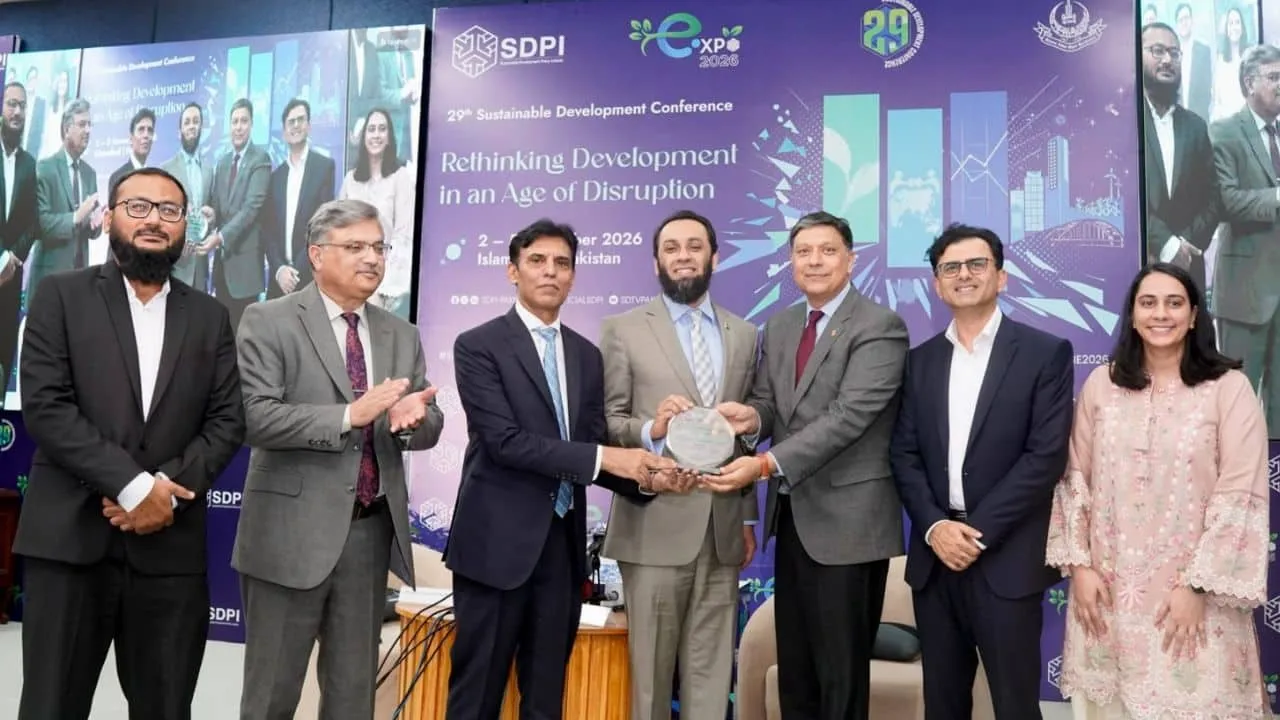
Nestle Pakistan Wins Two Awards at Sustainability Development Conference
Nestle Pakistan secured two accolades at the 29th Sustainable Development Conference (SDC) and Sustainability Investment Expo (SIE) held in Islamabad. As Pakistan faces increasing climate and resource pressures, the event brought together industry leaders, policymakers, and international experts to discuss pathways toward sustainable growth and environmental resilience.
Federal Minister for Information and Broadcasting Attaullah Tarar presented the awards to representatives of Nestle Pakistan. The company received the Sustainability Award in the Circular Economy and Resource Efficiency category, alongside the Best Pavilion Presentation Award for its display at the exhibition.
Understanding the Sustainable Development Conference and Global Goals
The Sustainable Development Conference serves as a major annual forum in Pakistan for addressing environmental challenges, economic stability, and social development. Organized to foster dialogue among public and private stakeholders, the conference aligns local development efforts with international frameworks.
The recognition of Nestle Pakistan ties directly into the United Nations Sustainable Development Goals. Specifically, the company's initiatives support SDG 13 for Climate Action, SDG 2 for Zero Hunger, and SDG 12 for Responsible Consumption and Production. These frameworks guide organizations in balancing commercial operations with environmental stewardship and resource conservation.
Transforming Agriculture and Food Systems Through Technology
During the conference, Nestle Pakistan co-hosted a high-level plenary session titled Transforming Pakistan's Agriculture and Food Systems in an Age of Disruption: AI for Regenerative and Climate-Smart Agriculture. The panel featured perspectives from corporate leaders, United Nations agencies, research institutes, and academic bodies.
Faisal Nadeem, Head of Technical at Nestle Pakistan, opened the discussion by drawing attention to mounting pressures on cultivable land and soil health. He stressed the necessity of accelerating the transition toward regenerative farming methods that restore soil, optimize water usage, and enhance farm resilience against changing weather patterns.
Global Commitments and Local Agricultural Realities
Katarzyna Grzybowska, Sustainability Delivery Manager at Nestle S.A. Global, outlined the corporate objective to source 50 percent of key ingredients from farmers using regenerative practices by the year 2030. She noted that Nestle Pakistan has already reached approximately halfway toward meeting this target.
Grzybowska emphasized that environmental solutions must account for local economic realities and keep farmers at the center of the transition. Long-term investments across the entire food supply chain remain essential to maintain these agricultural practices over time.
Perspectives on Food Security and Public-Private Partnerships
Anita Hirsch, Country Director for the World Food Programme in Pakistan, discussed the broader implications of climate disruptions on food supply continuity. She underscored the necessity of community-based approaches, artificial intelligence, and supply chain solutions to strengthen food security and provide predictable income for vulnerable populations.
Dr Abid Qaiyum Suleri, Executive Director of the Sustainable Development Policy Institute, noted the potential of smart agriculture and public-private partnerships in accelerating sustainable transitions. Additionally, Dr Zaigham Shahzad, Associate Professor at the Lahore University of Management Sciences, highlighted the role of education and research, including a newly launched certification program developed alongside Nestle.
On-the-Ground Initiatives Across Pakistan
The themes discussed during the conference plenary reflect practical projects currently active across Nestle Pakistan's operational footprint. The company is actively scaling regenerative agriculture practices across 125 farms, using 135 solar systems and 25 biogas plants to power agricultural activities.
Water conservation forms another core component of these operational efforts. Drip irrigation systems cover 299 acres, while smart soil moisture sensors operate across 722 acres to optimize water usage and protect soil health.
Progress Toward Environmental Targets
Nestle Pakistan reported a 48 percent reduction in greenhouse gas emissions by 2025 as part of its ongoing journey toward net-zero emissions. The enterprise also achieved 100 percent water regeneration across its Waters business operations.
In the domain of circular economy and waste management, the Clean Gilgit-Baltistan Project facilitated the collection and management of more than 11,000 tons of plastic and paper packaging waste. At the concurrent Sustainability Investment Expo, the Nestle pavilion exhibited these integrated approaches covering regenerative farming, climate action, and waste reduction.