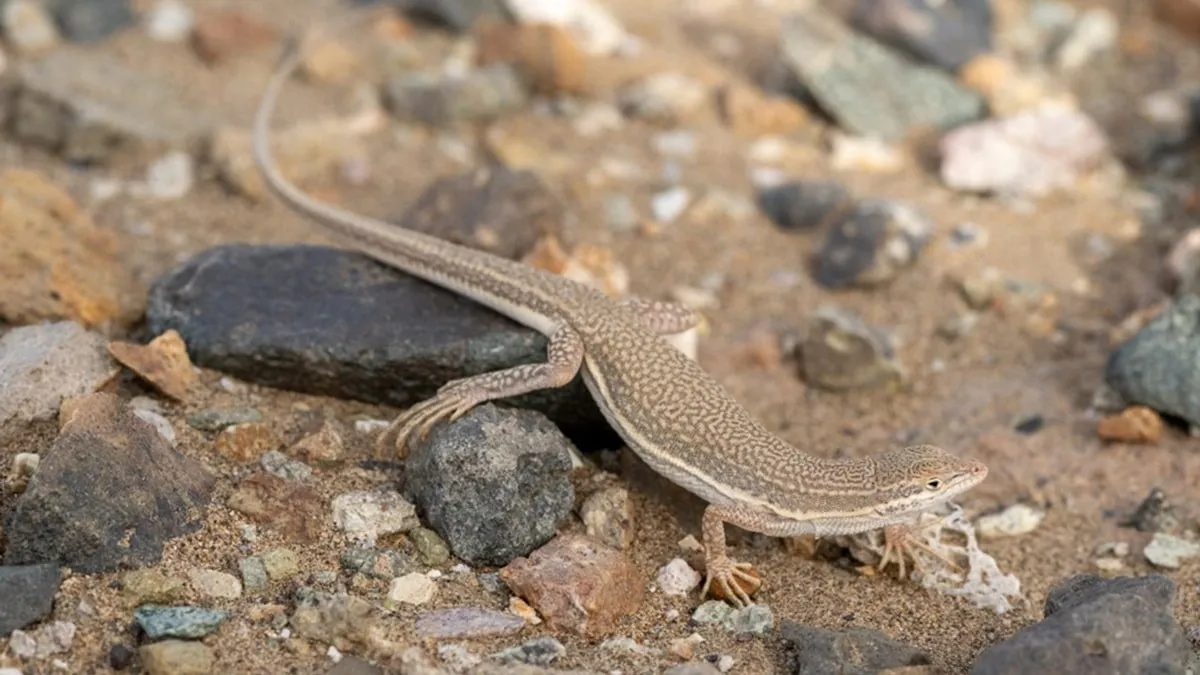
New Lizard Species Eremias Chagaiensis Discovered in Balochistan
An international team of researchers has discovered a new lizard species in Balochistan's Chagai District. The species, named Eremias chagaiensis, was discovered on low sand dunes and is distinguished by its maze-like brown markings across its back. Researchers documented the lizard at four locations during field surveys conducted between 2022 and 2025. Its body measures up to 5.7 centimeters, excluding its tail, which can grow more than twice as long as its body. This discovery adds a unique reptile to the regional taxonomy and sheds light on the biodiversity hidden within remote arid landscapes.
Unlike other racerunner lizards that typically have lengthwise stripes, the newly discovered species has winding brown patterns that remain visible in both young and adult lizards. The research was led by Rafaqat Masroor of the Pakistan Museum of Natural History, who said the discovery highlights how little is known about the region's wildlife. Balochistan deserts remain some of the least studied ecosystems in South Asia, leaving vast gaps in regional ecological records. The persistence of uncatalogued fauna in these arid zones demonstrates the vital need for continued field surveys and comprehensive biological inventories.
How Researchers Identified the New Species
Researchers initially noticed that the newly discovered lizard closely resembled Eremias graphica, a species identified in Iran in 2023. However, genetic analysis of two mitochondrial genes and one nuclear gene, along with comparisons of body proportions and scales, confirmed that it represents a distinct species. The findings also identified E. fasciata as its closest relative in the mitochondrial analysis, with approximately 10.6 percent genetic differences between the two species in the genes examined. These rigorous scientific methods ensure that taxonomic classifications reflect genuine evolutionary divergences rather than mere regional variations.
The study also confirmed the presence of another lizard species, Eremias fasciata, in Pakistan through modern specimen examination and DNA analysis, more than a century after it was first reportedly recorded in the country. This historical verification closes a long-standing knowledge gap regarding the distribution of E. fasciata within South Asian borders. Advanced laboratory techniques allow contemporary biologists to re-evaluate century-old records and confirm species identities with high precision. By combining field observations with molecular diagnostics, the research team resolved complex questions about regional reptile populations.
Habitat and Ecology of Eremias Chagaiensis
The researchers found the new species primarily in loose sand, particularly on low dunes and sandy patches near desert shrubs, where the lizards dig burrows. It was absent from nearby gravel plains, which were inhabited by E. fasciata. This clear ecological separation indicates that the two species occupy distinct microhabitats despite sharing general geographic ranges. Understanding these habitat preferences helps scientists comprehend how desert reptiles partition resources and adapt to harsh environmental conditions.
Desert ecosystems in Balochistan present extreme survival challenges, including high temperatures, scarce water, and shifting substrates. Lizards belonging to the Eremias genus are well adapted to arid environments, using behavioral mechanisms like burrowing to escape midday heat. The physical characteristics of E. chagaiensis, such as its slender proportions and long tail, likely aid in navigating loose sand dunes. Field observations across the four documented locations provide crucial baseline data on population distribution and local ecology.
Significance of Desert Biodiversity in South Asia
"Balochistan's deserts are among the least explored places in South Asia. Finding a new lizard here tells us how much is still undocumented," Masroor said. This statement underscores the broader challenge facing conservationists and biologists working in remote regions. Limited access, harsh terrain, and security constraints have historically restricted scientific expeditions in parts of Balochistan. Consequently, many microhabitats and endemic species remain entirely unknown to science.
Documenting new species serves as the foundational step for any meaningful conservation strategy. Without knowing which organisms inhabit an area, governments and environmental agencies cannot properly assess ecological risks or designate protected zones. As human pressures, infrastructure projects, and climate shifts begin to alter arid regions, baseline surveys become increasingly urgent. The identification of E. chagaiensis provides a compelling reason to increase funding and logistical support for field biology across South Asian deserts.
Future Research and Conservation Outlook
The successful conclusion of surveys spanning from 2022 to 2025 demonstrates the value of long-term field research. Researchers plan to continue studying the behavioral ecology, population density, and broader geographic distribution of E. chagaiensis. Further genetic studies may also reveal additional insights into the evolutionary history of racerunner lizards across the Iranian plateau and South Asian borderlands. Monitoring these populations over time will help determine if environmental changes pose any immediate threats to their survival.
The reconfirmation of E. fasciata alongside the discovery of E. chagaiensis enriches the herpetological records of Pakistan. Academic institutions and natural history museums will likely use these findings to update regional checklists and educational materials. As scientists share their data through peer-reviewed channels, the global scientific community gains a clearer picture of reptile evolution in desert biomes. Public awareness of these discoveries also fosters greater appreciation for the hidden biodiversity thriving in remote landscapes.