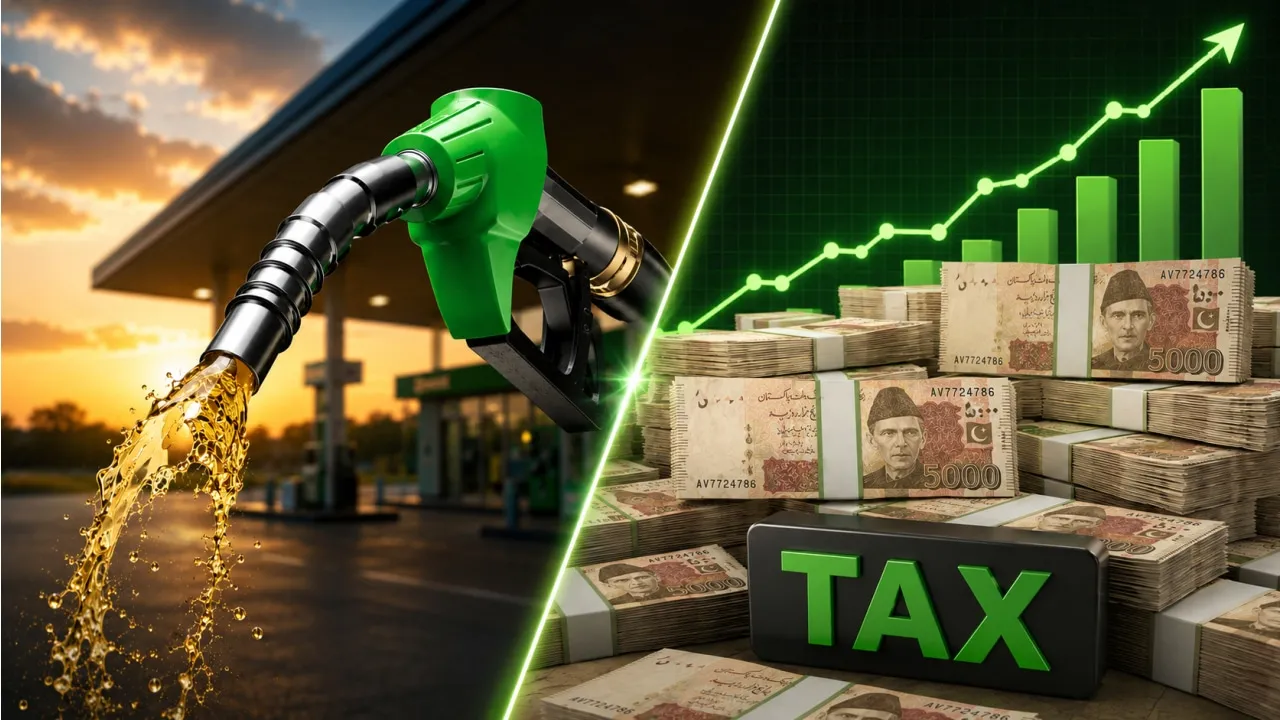
Pakistan Petroleum Levy Collections Hit Massive Figures
The federal government collected more than Rs. 1.1 trillion from petroleum consumers through the petroleum levy during the first nine months of 2026, adding to the financial burden on people buying fuel across Pakistan. Official figures show that the government received Rs. 1,126.34 billion in petroleum levy collections between January and September 2026. The amount was collected over just nine months, as the government continued to receive revenue from charges imposed on petroleum products.
In addition to the petroleum levy, the government collected approximately Rs. 47 billion through the separate Climate Support Levy on petroleum products during the same period. Together, the two levies generated more than Rs. 1.7 trillion in revenue from petroleum products between January and September 2026. This massive influx of capital reflects the heavy taxation framework placed on everyday energy consumption in the country.
Citizens across all provinces bear the weight of these charges whenever they fill up their vehicles or purchase goods transported by road. Energy costs directly influence the price of nearly every consumer good, meaning that high fuel taxes ripple through the entire domestic economy. Understanding these fiscal mechanisms helps citizens see the direct relationship between state revenue collection and household expenses.
How Petroleum Levy Revenue Works in Pakistan
Unlike income tax collected by the Federal Board of Revenue, the petroleum levy is classified as non-tax revenue and goes entirely to the federal government. Its collections have increased sharply, rising from Rs. 580 billion in FY2022-23 to Rs. 1.22 trillion in FY2024-25 and Rs. 1.57 trillion in FY2025-26. This classification means the funds bypass standard resource-sharing formulas with the provinces, placing the money directly into federal accounts.
Non-tax revenues serve as a vital tool for the federal administration to manage budget deficits and meet internal financial obligations. Because the petroleum levy does not share the same statutory distribution rules as federal divisible pool taxes, policymakers rely on it heavily during periods of fiscal stress. The steady consumption of petroleum products ensures a reliable and daily stream of cash into the national treasury.
The mechanics of the levy allow the administration to adjust rates through executive notifications without needing legislative approval for every change. This flexibility makes it an attractive instrument for revenue generation, even as it draws criticism from consumer advocacy groups and transport associations. The heavy reliance on fuel taxation highlights the structural challenges present in broadening the direct tax base.
The Role of International Monetary Fund Targets
The government has also linked petroleum levy collections to its fiscal targets under the International Monetary Fund program, while currently charging Rs. 80 per litre on petrol and high-speed diesel. International lenders frequently mandate specific revenue collection floors to ensure developing economies maintain macroeconomic stability and service their external debts. Meeting these structural benchmarks remains a central priority for economic managers negotiating bailout packages.
Under structural adjustment programs, fiscal discipline often requires maximizing non-tax revenues when direct tax collection falls short of projections. The petroleum levy offers a ready mechanism to satisfy international monitors who scrutinize quarterly budgetary performance. Consequently, consumers often absorb higher per-litre charges as the state works to align its fiscal indicators with agreed targets.
Independent economists frequently debate the trade-offs of using fuel taxes to satisfy international loan conditions. While the approach secures immediate budgetary inflows, it creates inflationary pressures that affect lower-income households disproportionately. Balancing international commitments with domestic economic relief remains a persistent challenge for federal policymakers.
Understanding the Climate Support Levy on Fuel
Alongside the primary petroleum charge, the separate Climate Support Levy added approximately Rs. 47 billion to state coffers during the first nine months of 2026. This environmental charge reflects growing global and domestic pressures to account for the ecological costs associated with fossil fuel consumption. Revenues raised through environmental mechanisms are theoretically earmarked to address climate vulnerabilities, though exact disbursements remain tied to broader federal budget allocations.
Pakistan remains highly vulnerable to extreme weather events, making climate adaptation financing a critical national priority in recent years. Environmental levies on carbon-emitting products provide a direct way to generate funds for disaster resilience and sustainable infrastructure projects. However, adding ecological charges to an already heavily taxed fuel supply increases the immediate financial pressure on motorists and industrial users alike.
The coexistence of multiple levies on a single litre of fuel demonstrates the complex layer of statutory deductions applied at the pump. Each charge serves a distinct policy goal, ranging from general deficit reduction to environmental mitigation. For the average consumer, these administrative distinctions translate into higher at-the-pump prices regardless of global crude oil market fluctuations.
Impact of High Fuel Taxes on Businesses and Citizens
The financial impact of maintaining a levy of Rs. 80 per litre on petrol and high-speed diesel extends far beyond private vehicle owners. Commercial transport operators, agricultural producers, and manufacturing units depend heavily on diesel fuel to run machinery and deliver goods to market. When fuel input costs rise sharply, businesses pass those expenses down to the final consumer, driving up inflation across food, utilities, and retail sectors.
Commuters using public transport systems experience immediate fare increases whenever fuel prices adjust upward due to heavy tax components. Small business owners operating delivery vans or backup generators face compressed profit margins as operational costs mount. These widespread financial strains underscore the systemic importance of energy pricing in everyday life.
Consumer rights organizations frequently call for a rationalization of fuel taxation to ease the cost-of-living crisis affecting millions of households. They argue that excessive reliance on indirect taxes penalizes working-class citizens more severely than progressive direct taxation models. As federal authorities continue to monitor their fiscal metrics, the debate over fair taxation policies remains a central issue in national public discourse.