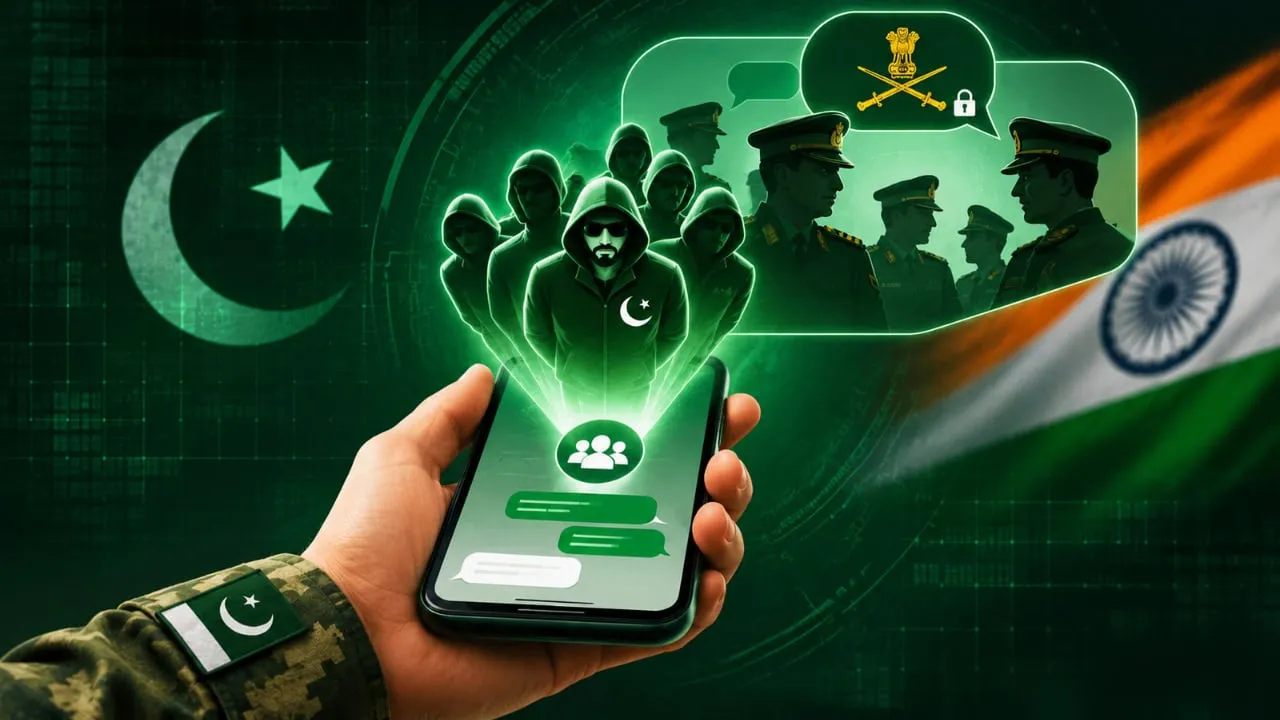
Indian Security Agencies Place Armed Forces on High Alert After Major Digital Breach
Pakistani intelligence operatives successfully infiltrated at least 13 unofficial WhatsApp groups used by personnel from the Indian Army, paramilitary forces, and civil defence organizations. Following the discovery of this security breach, Indian security agencies placed all armed forces on high alert to prevent further leaks of sensitive information.
The unauthorized access exposes persistent vulnerabilities in how defence personnel manage digital communications. Investigators discovered that operatives gained entry into these private circles by using spoofed or compromised Indian mobile numbers. Intelligence officials suspect that these actors relied on smuggled SIM cards to bypass verification protocols and avoid detection by monitoring systems. Previous investigations conducted by the National Investigation Agency and regional border-state police units have already exposed established SIM-smuggling rings connected to foreign intelligence services.
How the Infiltration and Honey-Trap Operations Were Uncovered
The entire security breach came to light last week following a specific investigation into suspicious online activity. An operative operating under the alias "Soniya" managed to join a digital circle named "All India Defence Civilian Mutual Transfer Posting." Within this group, the individual falsely claimed to be a scientist working for the Defence Research and Development Organisation.
During the ensuing interactions, the operative engaged in extended conversations with a civilian staff member. According to security findings, this staff member allegedly leaked sensitive defence information in exchange for money.
Security analysts note that this tactic fits a broader pattern of online espionage targeting Indian military personnel. Earlier this year, an Indian Air Force Wing Commander fell victim to a comparable operation. In that instance, a suspected operative posed as a woman seeking assistance from a therapist and successfully extracted confidential details over a period exceeding two months.
Past Espionage Cases Involving Defence Scientists
The recent WhatsApp infiltration echoes high-profile espionage cases from recent years that targeted key research personnel. In 2023, the Anti-Terrorism Squad of Maharashtra arrested senior Defence Research and Development Organisation scientist Pradeep Kurulkar. Investigators accused him of sharing classified details regarding the BrahMos missile project with a foreign operative who posed as a London-based software engineer on WhatsApp.
These incidents demonstrate that intelligence operatives frequently target individuals associated with strategic defence projects through consumer messaging applications. The shift toward digital espionage reflects a reliance on social engineering rather than traditional physical break-ins to acquire state secrets.
Directives Issued by the Defence Ministry to Secure Communications
In response to the discovery of the 13 compromised groups, the Defence Ministry issued a strict advisory. This directive orders all military and civil defence organizations to upgrade their digital security protocols immediately.
The advisory was distributed across multiple major security institutions, including the Central Reserve Police Force, the Border Security Force, the Sashastra Seema Bal, and the Indo-Tibetan Border Police. Group administrators must now execute rigorous identity verifications for every participant in their messaging circles. Any unidentified or suspicious accounts must be removed instantly.
Furthermore, the directive imposes a strict ban on all personnel. Members of the armed forces and associated civilian staff are now formally barred from sharing official or classified information on consumer platforms like WhatsApp.
Wider Vulnerabilities in Consumer Messaging Apps
The repeated security failures emphasize the inherent risks of employing consumer-grade messaging software for auxiliary military communication. While official networks employ encrypted, government-regulated infrastructure, personnel often create unofficial groups for peer-to-peer coordination, mutual transfers, and administrative convenience.
These unofficial groups lack the centralized oversight and security monitoring present in official military networks. Consequently, operatives exploit this gap by introducing cloned accounts or fake identities that blend into large groups containing hundreds of members.
Security experts emphasize that maintaining operational security requires total compliance with communication bans. The enforcement of the new Defence Ministry advisory marks a critical step toward eliminating unauthorized digital channels across all branches of the security apparatus.