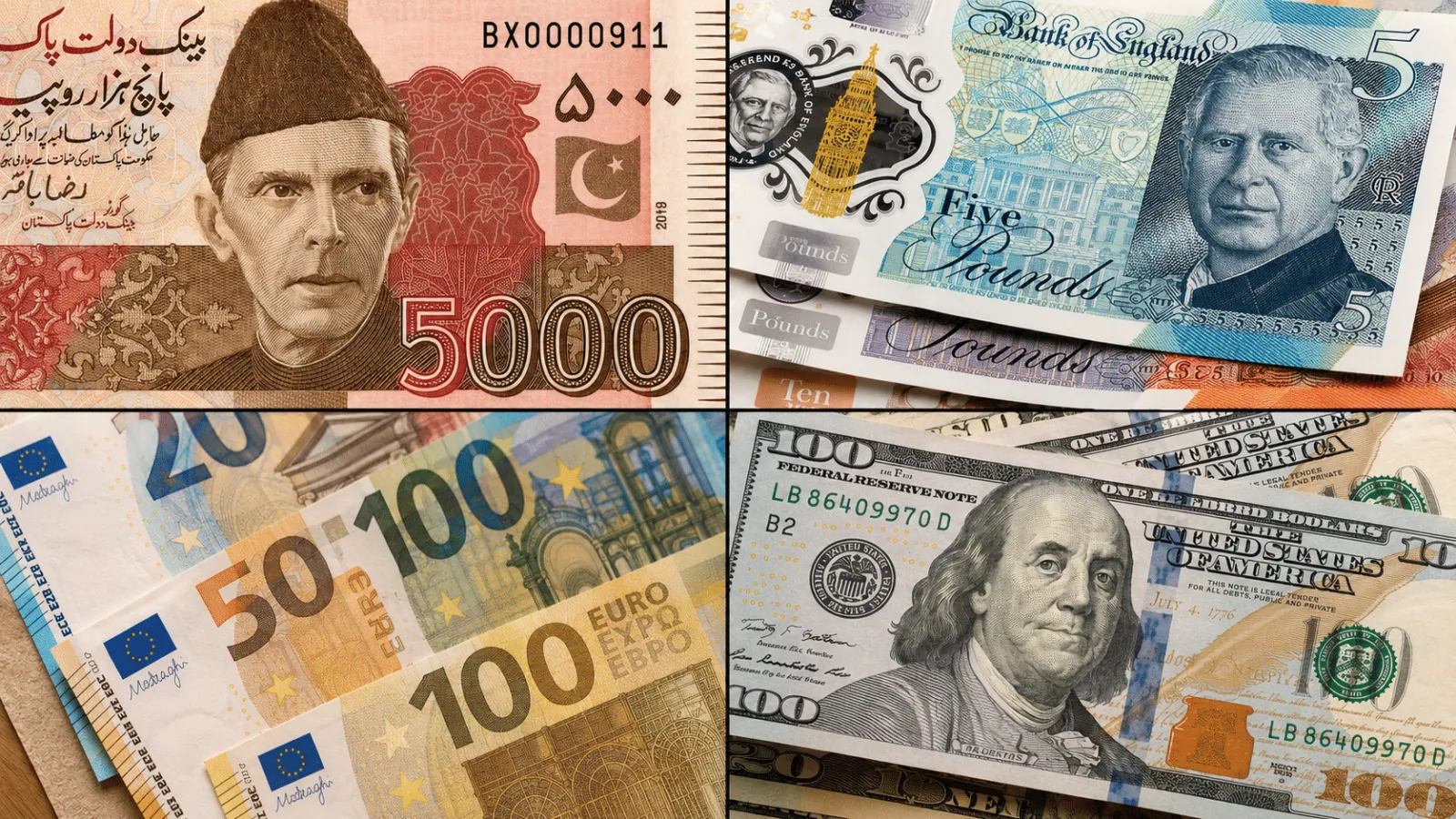
The Pakistani rupee closed in green against the US dollar for the 278th consecutive day on Friday. Market participants watched closely as the local currency finished the session at 276.66 after gaining one paisa against the greenback today. This ongoing movement marks a continuation of a financial trend that has persisted through various economic pressures.
Financial authorities have observed this steady performance despite external geopolitical strains, particularly the ongoing Gulf war. The currency market has maintained specific patterns, allowing the local currency to preserve its standing against major foreign exchange units over an extended trading period.
How Long Has the Pakistani Rupee Been Recovering?
The Pakistani rupee has consistently reported gains against the dollar since December 25, 2025. This unbroken sequence of positive closes spans hundreds of trading sessions, creating a notable record in modern national financial history. Analysts attribute this stretch to sustained foreign exchange management and steady remittance inflows from overseas workers.
Each trading day brings incremental adjustments, keeping the local unit on an upward trajectory. While global markets face volatility due to regional conflicts in the Middle East, the domestic currency market has absorbed these shocks through targeted monetary policies and foreign exchange reserves management.
Performance Against the British Pound and European Currencies
Beyond the US dollar, the local currency recorded substantial movements against major European monetary units on Friday. The rupee gained Rs. 2.2 against the British Pound in the latest trading session. This shift reflects broader adjustments in cross-currency valuations across international exchanges.
Similarly, the currency advanced against the single European currency by securing a gain of Rs. 1.55 against the Euro. Such movements demonstrate that the strengthening trend extends beyond North American markets, impacting transactions involving European trading partners.
Gains Against Regional and Commonwealth Currencies
Trading desks also reported significant upward movement against Commonwealth and regional currencies at the end of the week. The rupee climbed by Rs. 3.82 against the Australian Dollar, marking one of the largest single-session shifts among tracked currencies. Concurrently, the local currency added Rs. 1.63 against the Canadian Dollar.
In the Gulf region, where many citizens maintain financial ties, the currency gained one paisa against the UAE Dirham. Meanwhile, the exchange rate remained stable against the Saudi Riyal, showing little variance during Friday's trading hours.
Understanding the Broader Exchange Rate Data
Comprehensive market data collected between November 3, 2026, and November 6, 2026, illustrates the daily progression of these values. On November 3, the US dollar stood at 276.7137, gradually moving down to 276.6609 by November 6. This represents a modest change of 0.0092 over the specified timeframe.
During the same multi-day window, the Euro moved from 309.7810 on November 3 to 309.5006 on November 6, registering a change of 1.5458. The British Pound transitioned from 371.2391 to 370.6288, reflecting a change of 2.1980 across the four-day period.
Analysis of Commonwealth Currency Fluctuations
Australian Dollar figures showed a notable shift, starting at 193.0216 on November 3 and closing at 190.1905 on November 6, resulting in a change of 3.8244. Canadian Dollar rates shifted from 198.1480 to 196.6318 over the same span, marking a change of 1.6270 for local importers and exporters.
Other tracked units, such as the Malaysian Ringgit and Chinese Yuan, exhibited narrower trading bands. The Malaysian Ringgit moved from 67.8969 to 68.2271, while the Chinese Yuan recorded 41.4630 on November 3 and ended at 41.4796 on November 6, with a minor negative change of -0.0026.
Implications for Gulf Region Remittances and Trade
The stability and recovery of the local currency hold direct relevance for trade and financial transfers linked to the Gulf region. With the Gulf war creating uncertainties in global energy markets, maintaining currency value helps cushion domestic fuel import costs. Expatriate workers sending funds home also experience predictable conversion rates during these weekly sessions.
Regional currencies like the UAE Dirham and Saudi Riyal saw minimal absolute change, recording 75.3229 and 73.7074 respectively by the close of November 6. These tight ranges provide certainty for businesses engaged in bilateral commerce with Gulf Cooperation Council member states.