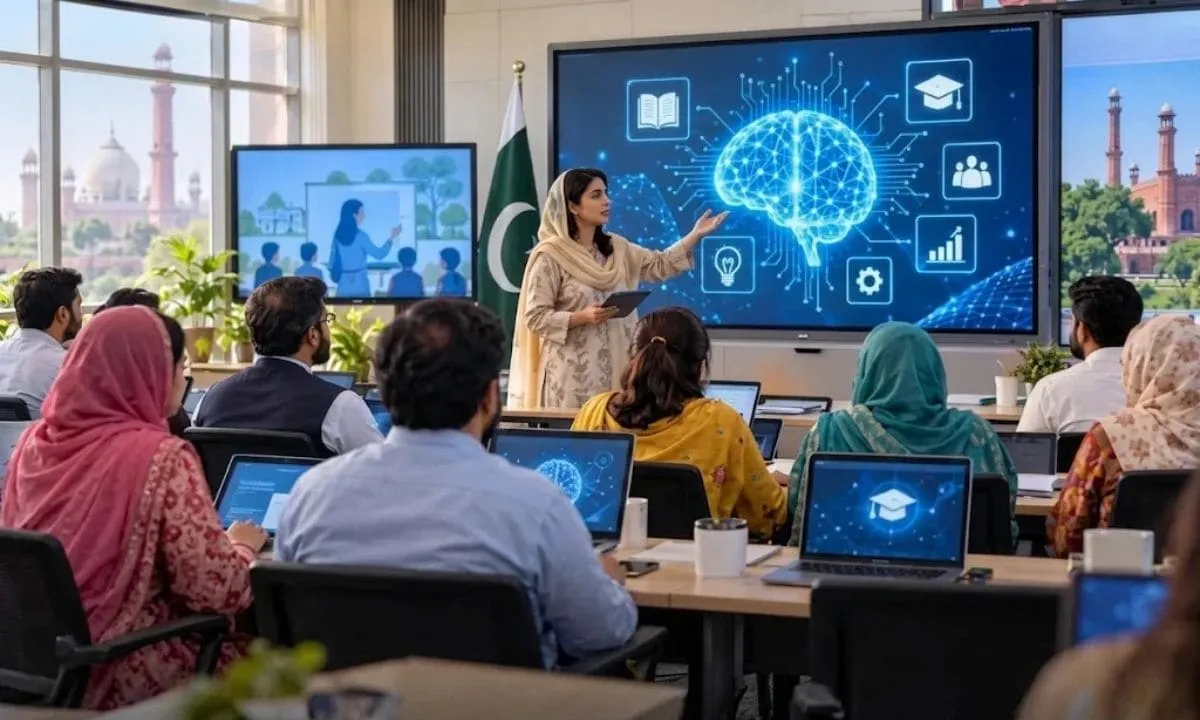
Punjab Launches Artificial Intelligence Training Programme for Public School Teachers
The provincial government of Punjab will train 25,898 public school teachers in Artificial Intelligence (AI) beginning November 23, as part of an effort to introduce modern technology in the education sector. This massive administrative undertaking represents a major shift in how public education approaches classroom technology, bringing advanced digital concepts directly to educators across the region.
Modernising public instruction requires structured training initiatives that reach educators at every administrative level. By focusing on artificial intelligence, education authorities want to equip teachers with digital tools that can transform daily instruction and administrative duties. The scale of this initiative means thousands of schools will soon integrate new technological methods into their standard curriculums.
How the Teacher Training Programme is Organised
The School Education Department is organising the programme in collaboration with PECTAA. AI focal persons from across the province will be trained at the tehsil level in five batches. The first batch will train on November 23 and 24, and the final batch from December 1 to 3. This phased approach allows administrators to manage attendance and instructional quality effectively across multiple locations.
Structuring the schedule into five distinct groups ensures that every tehsil handles the instructional workload without overwhelming local facilities. The tight timeline requires careful coordination between provincial administrators and local education offices to ensure all scheduled dates run smoothly. Trainers will deliver specific modules during each batch session, building up to the final group completion in early December.
Nomination Process and Attendance Requirements
One teacher from every government primary and elementary school will be nominated to take part. Chief Executive Officers (CEOs) of Education have been instructed to make the nominations and ensure attendance. Participants must bring a laptop, smartphone, or school tablet to the sessions. These hardware requirements ensure that every attendee can practice directly with the software and tools being demonstrated.
School leaders carry the responsibility of selecting appropriate candidates who can effectively absorb the material and share it later. Mandating specific personal or school devices turns each session into a hands-on workshop where attendees interact directly with digital interfaces. Chief Executive Officers of Education must verify that all nominated personnel report to their designated tehsil locations on time.
What Educators Will Learn During the Sessions
The training will cover the use of AI tools for lesson planning, student assessments, educational content development, and addressing the individual learning needs of students. It will also address the safe, ethical, and responsible use of AI in classrooms. Educators will explore practical applications that simplify complex administrative tasks while enhancing student engagement.
Lesson planning often consumes significant time for educators, so automated assistance can streamline the creation of daily syllabi. Student assessments and tailored content development allow instructors to target specific learning gaps within mixed-ability classrooms. Furthermore, understanding the ethical dimensions of technology ensures that students interact with digital systems safely and responsibly.
The Role of AI Focal Persons in Schools
After completing the course, the AI focal persons will help other teachers in their schools complete the training and adopt AI-based teaching methods. This peer-to-peer model creates a multiplier effect, spreading technical knowledge beyond the initial group of attendees to reach entire school faculties. Focal persons act as resident experts who guide their colleagues through software adoption and troubleshooting.
School-level mentoring bridges the gap between high-level provincial policy and daily classroom routines. When focal persons return to their respective primary and elementary schools, they take charge of practical implementation. This internal support system helps institutions maintain momentum long after the formal tehsil-level workshops conclude.
Background on Educational Technology Integration
Integrating digital tools into public schools has been a gradual process across various educational jurisdictions. Authorities increasingly recognise that technological literacy forms a core component of modern instruction. Previous initiatives typically focused on basic computer literacy or digital administrative systems rather than advanced software applications.
Introducing artificial intelligence marks a distinct step forward compared to traditional computer lab setups. Modern educational frameworks increasingly rely on software that adapts to student performance and provides data-driven insights. By introducing these concepts through designated focal persons, the administration builds internal capacity without requiring massive external intervention for every single school.
Administrative Responsibilities and Next Steps
Managing a project involving 25,898 educators demands rigorous oversight from regional authorities. Chief Executive Officers of Education oversee the nomination lists to confirm that every primary and elementary institution is represented. Compliance with attendance rules remains mandatory for all selected personnel throughout the scheduled dates.
Following the completion of the final batch on December 3, attention will shift entirely to school-level execution. Focal persons will begin the task of mentoring their peers and introducing new teaching workflows inside classrooms. Observers will monitor these developments to assess how effectively digital methods take root in everyday public instruction across Punjab.