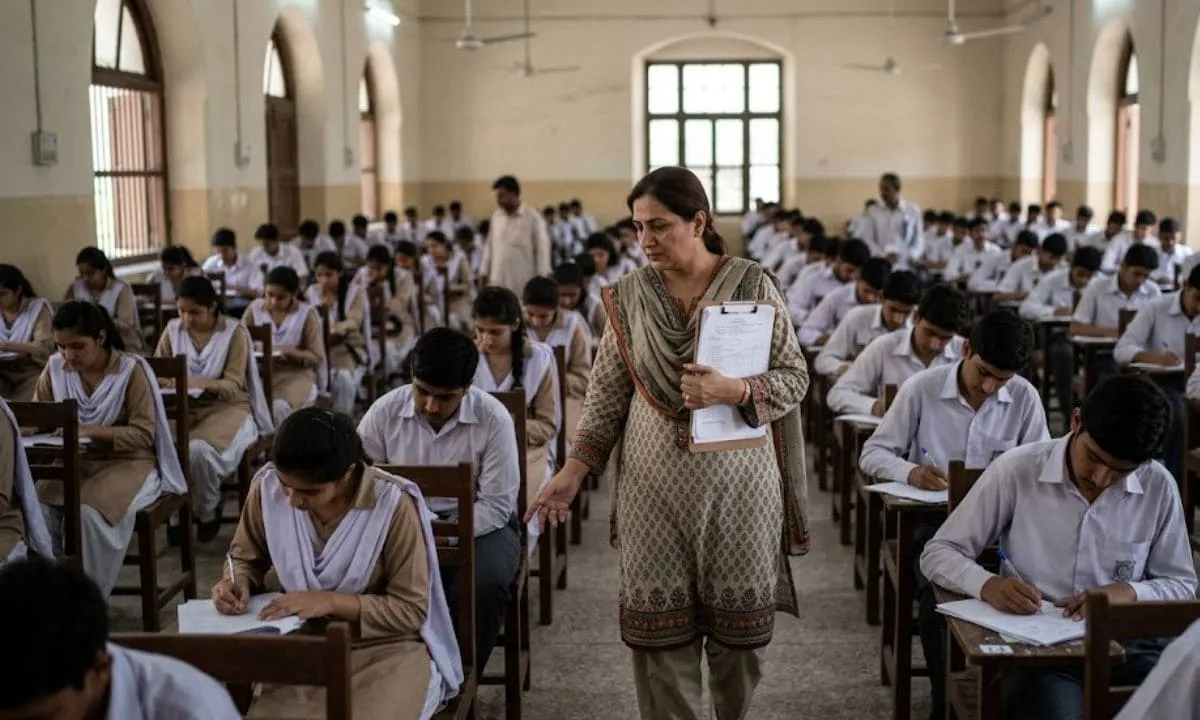
The Punjab Education Curriculum, Training and Assessment Authority (PECTAA) announced on Tuesday that the Mid-Term School-Based Assessment (SBA) for government school students in Grades 1 to 8 will be held from December 7 to 18, 2026.
The official notification also provides the full date sheet, grade-wise syllabus, paper pattern and Standard Operating Procedures (SOPs) that schools across Punjab must follow.
What Are the Exact Dates and Procedures for the Mid-Term SBA?
Schools will generate examination papers through the Item Bank System (IBS), which becomes available on December 1, 2026. The generation window runs from December 1 to 6, allowing each school to select items that match the prescribed syllabus.
Examinations are scheduled for December 7-18, 2026. After the last paper is completed, teachers will mark the answer scripts and prepare student report cards between December 8 and 23, 2026.
Final results must be uploaded to the designated online portal between December 28 and 31, 2026. The timeline gives schools a short but defined period to enter marks, verify data and publish outcomes.
Why Did PECTAA Introduce a Smart Syllabus for Classes 9-12?
Yesterday, PECTAA issued a smart syllabus for Classes 9 to 12, cutting course content in several subjects by 25 to 30 percent. The reduction is intended to streamline learning, reduce overload and focus students on core concepts that are most likely to appear in the 2027 board examinations.
The new syllabus will be used for Matric and Intermediate board examinations in 2027. By trimming material, the authority hopes to improve overall pass rates and allow teachers to devote more classroom time to skill-building activities.
How Was the Smart Syllabus Rolled Out?
The syllabus release followed a two-phase approach. Phase one covered Classes 9 and 11, while phase two addressed Matric (Class 10) and Class 12. In addition to the general syllabus, PECTAA issued specialised versions for computer science, for Christian students and for Matric Technical streams.
Two subjects - Tarjuma-tul-Quran and Ethics at the Matric and Intermediate levels - have not yet been released. The authority indicated that those syllabi are under final review and will be published later.
What Did the PECTAA Spokesperson Say About the Changes?
A PECTAA spokesperson explained that the smart syllabus is being prepared in line with the academic needs of students. He said it is meant to ease preparation for the board examinations, give students more structured guidance and help them focus on key course material.
The spokesperson added that the authority will publish the complete details on Saturday, allowing students of Classes 9 to 12 to understand which changes apply to their upcoming board exams.
Background: How Punjab's Assessment System Has Evolved
Punjab introduced the School-Based Assessment model in 2019 to complement annual examinations and provide continuous evaluation. Over the years, the system has been refined to include item banks, digital result portals and clear SOPs for each assessment phase.
Mid-Term SBAs are a critical checkpoint for students in Grades 1-8, offering teachers a snapshot of learning progress before the final year-end exams. The schedule released this year aligns with the province's broader effort to synchronize assessment calendars with the national academic year.
Impact on Stakeholders
For teachers, the December 1-6 IBS window means they must coordinate with subject experts to select appropriate items and ensure that each paper meets the prescribed difficulty level. School administrators will need to arrange invigilation staff, secure examination venues and communicate the timetable to parents.
Students in Grades 1-8 will sit for the SBA during a two-week period that coincides with the winter break in many private schools, but not in government schools. The result-upload window at the end of December gives families a clear expectation of when final marks will be available.
For secondary-level students, the smart syllabus will affect textbook publishers, coaching centres and private tutors, all of whom must adjust their material to reflect the reduced content.
What Are the Next Steps?
PECTAA will release the complete SBA guidelines on Saturday, including sample question papers, marking schemes and the exact SOPs for result uploading. Schools are expected to acknowledge receipt of the guidelines within three working days.
After the SBA period, the education department will conduct a verification audit of uploaded results to ensure data integrity. Any discrepancies will be communicated to the respective schools for correction before the final publication.
Regarding the smart syllabus, the authority will hold a series of webinars for teachers in early January 2027 to explain the new structure and answer implementation queries. The unpublished syllabi for Tarjuma-tul-Quran and Ethics are slated for release by the end of March 2027.
Practical Takeaways for Parents and Students
- Mark December 7-18, 2026 as the SBA examination window for Grades 1-8.
- Ensure that your child's school has generated papers from the IBS between December 1-6.
- Expect report cards to be ready by December 23 and final results to appear online by December 31.
- For students in Classes 9-12, review the new smart syllabus once it is published on Saturday to understand the reduced content scope.
- Stay alert for upcoming teacher webinars that will clarify how the new syllabus impacts board preparation.
By adhering to the announced timelines and familiarising themselves with the revised curriculum, students, teachers and parents can navigate the 2026-27 academic year with greater confidence.