Punjab Cabinet Approves Rawalpindi Heritage Protection
The Punjab provincial cabinet, chaired by Chief Minister Maryam Nawaz Sharif, has approved the designation of several historic markets and buildings in Rawalpindi's Walled City as protected heritage sites. This major administrative decision marks a turning point for the preservation of historical architecture within the region, ensuring that centuries-old structures receive formal legal protection against unauthorized alterations and urban decay. Government officials and cultural preservationists have long debated the fate of these aging districts, which face mounting pressure from commercial expansion and population growth. By placing these landmarks under official state protection, the provincial administration aims to halt the deterioration of cultural assets that define the identity of the old city.
The formal approval follows recommendations submitted by the Directorate General of Archaeology, which outlined the urgent need for conservation measures across the affected zones. The designated area covers an expansive territory measuring 2,546 kanal and six marla. This specific geographic boundary includes vital commercial arteries and residential sectors where historical buildings stand side by side with modern storefronts. State authorities will now enforce stricter zoning and architectural controls within these perimeters to prevent further loss of historic fabric. Property owners and local businesses operating inside the protected zone will be subject to new guidelines designed to preserve the visual and structural integrity of the streetscapes.
Details of the Rs. 5.886 Billion Heritage Conservation Project
To implement this preservation mandate, the Tourism, Archaeology and Museums Department will carry out the Heritage Conservation and Urban Revitalization of Walled City Rawalpindi project at an estimated cost of Rs. 5.886 billion. This substantial financial allocation represents one of the largest investments in urban heritage conservation for the region in recent years. Funds will be channeled directly into meticulous restoration work, infrastructure upgrades, and public amenity improvements across the designated zones. Government planners have structured the financial outlay to cover both immediate structural stabilization of vulnerable buildings and long-term urban renewal objectives.
The funding will support a multi-faceted operational strategy executed by specialized conservation architects, engineers, and urban planners. Workers will tackle structural decay, remove illegal encroachments, and upgrade basic municipal services without compromising the historical aesthetic of the neighborhoods. Financial transparency and rigorous project monitoring will accompany the disbursement of the budget to ensure that every rupee contributes directly to the revitalization goals set by the provincial government. Local contractors and specialized artisans skilled in traditional building techniques are expected to participate in the restoration works.
What the Heritage Conservation and Urban Revitalization Project Includes
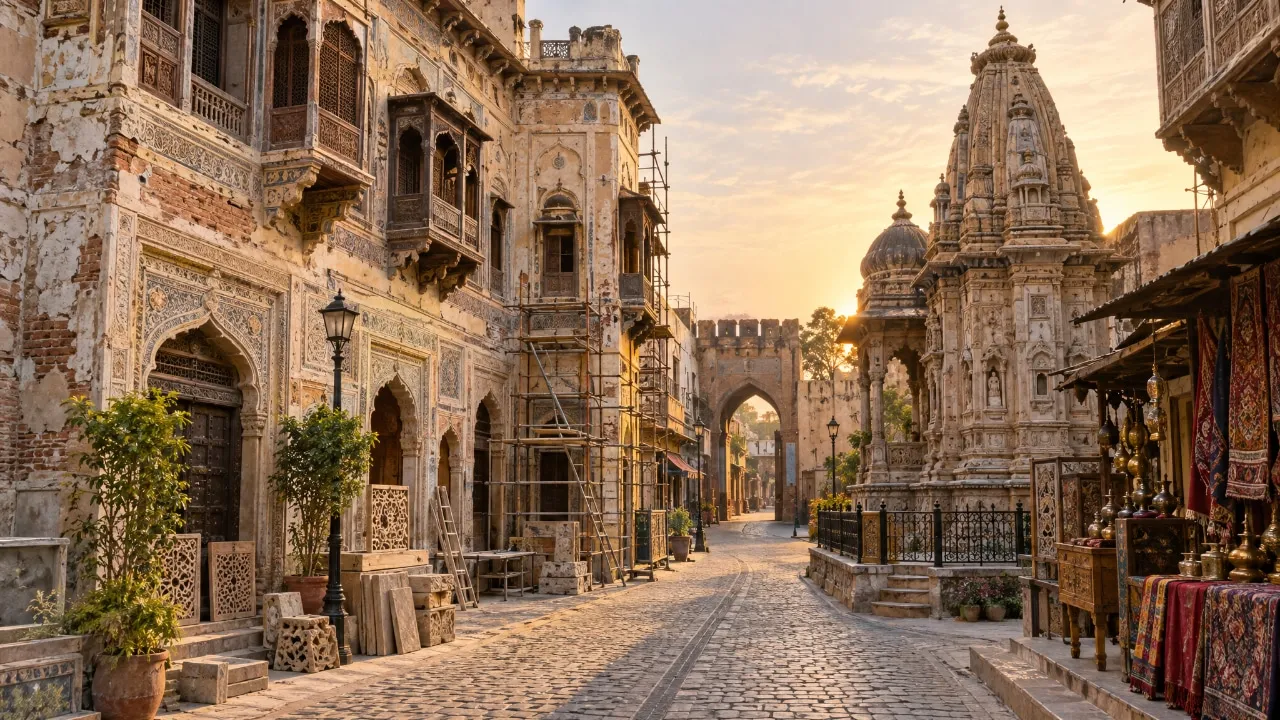
The project aims to restore historic buildings to their original condition, improve external facades, develop pedestrian-friendly streets, install underground electricity cables, and rehabilitate public spaces. Decades of haphazard commercial development have left many historic facades hidden beneath layers of modern signage, plaster, and wiring. Workers will carefully peel back these intrusive additions to reveal the original masonry, woodwork, and architectural details characteristic of the era in which the buildings were constructed.
The installation of underground electricity cables addresses a major hazard and visual blight in the old city, where tangled webs of overhead power lines currently mar views of ancient facades. Pedestrian-friendly street designs will restrict vehicular traffic in certain congested lanes, allowing visitors and residents to walk safely through the historic bazaars. Public spaces, including small neighborhood squares and community gathering points, will undergo rehabilitation to create clean, green, and welcoming environments for the public. These physical improvements are intended to revitalize local economic activity by attracting cultural tourism to the heart of Rawalpindi.
Architectural Eras Reflected in Rawalpindi Walled City
Rawalpindi's Walled City is home to historic buildings reflecting the Mughal, Sikh, and British periods. However, rapid urbanization and encroachments have gradually obscured much of the area's historic character. The Mughal influence appears in early masonry techniques and courtyard designs, while subsequent Sikh rule introduced distinct decorative woodwork, frescoes, and residential layouts. The British colonial era added civic architecture featuring robust brickwork, arched porticoes, and administrative buildings that blended European concepts with local traditions.
This architectural layering tells the story of the city as a regional crossroads of trade, culture, and governance over hundreds of years. Successive generations altered buildings to suit changing commercial and residential needs, often masking older architectural elements beneath newer construction. The upcoming conservation initiative relies on historical records and archaeological surveys to differentiate between these periods, ensuring that restoration efforts respect the chronological evolution of each individual structure.
Landmarks Included in the Protected Heritage List
With the cabinet's approval, several landmarks have been added to the protected heritage list, including Bagh Sardaran Complex, Central Jamia Mosque, Haveli Sujan Singh, Haveli Mohan Singh, Krishna Temple, Haveli Durga Niwas, Kalyan Das Temple, and Khurshid Cinema. These sites represent a diverse cross-section of religious, residential, and cultural architecture that served the multi-faith community of Rawalpindi throughout its history. Structures like the Krishna Temple and Kalyan Das Temple highlight the rich religious pluralism of the city's past, while grand residential properties like Haveli Sujan Singh showcase elite craftsmanship from the nineteenth century.
The historic assets, spread over 2,546 kanal and six marla, including Jamia Masjid Road, Purana Qila Bazaar, Sarafa Bazaar, Bhabra Bazaar, and Bagh Sardaran Road, will be restored to their original historic appearance. Bazaars such as Sarafa Bazaar and Bhabra Bazaar remain active commercial hubs where merchants sell jewelry, textiles, and traditional goods daily. Balancing active commercial operations with archaeological preservation will present a unique challenge for project managers, who must coordinate closely with local traders to minimize business disruptions during construction phases.
Next Steps for the Walled City Restoration
Following the cabinet approval, the Tourism, Archaeology and Museums Department will finalize procurement processes, engineering designs, and contractor selections for the multi-billion rupee initiative. Public awareness campaigns will inform local residents and business owners about upcoming construction schedules, traffic diversions, and regulatory changes associated with the protected status. Officials will also establish oversight committees to monitor construction quality and ensure adherence to international heritage conservation standards throughout the project lifecycle. Observers and residents will watch closely as physical work begins on the ground, marking a new chapter in the preservation of Punjab's urban heritage.