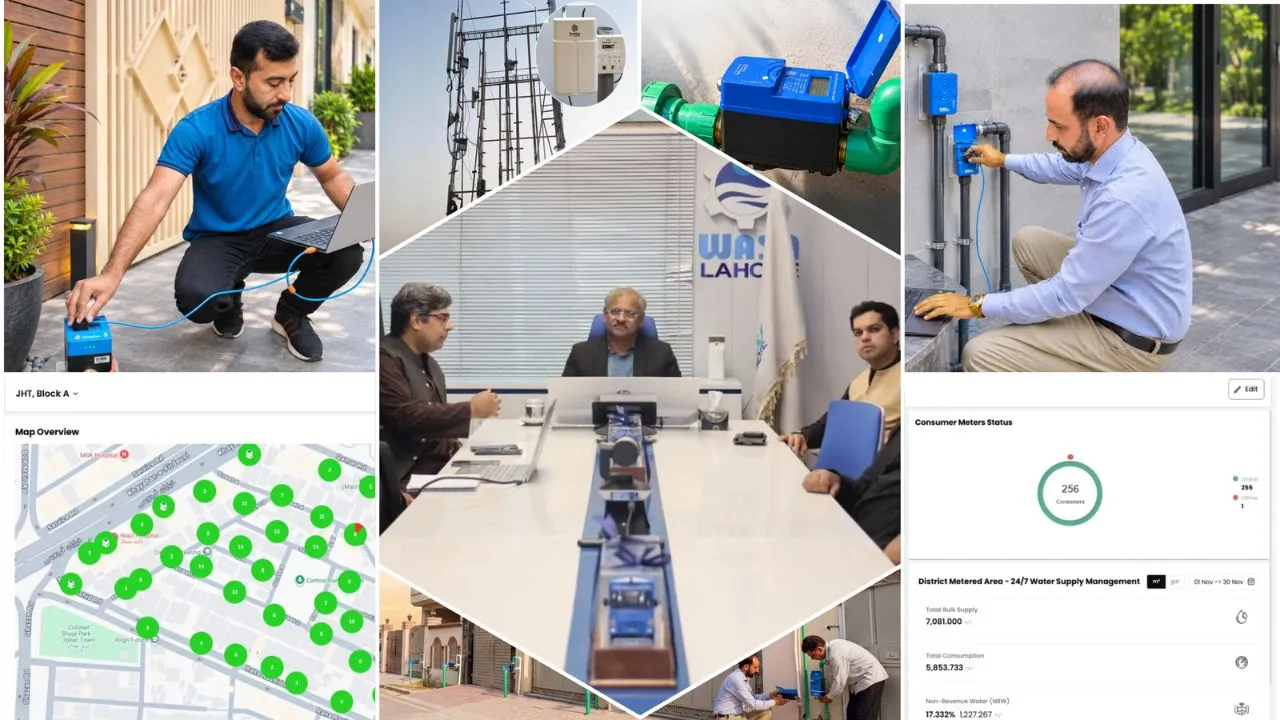
Understanding Pakistan First LoRaWAN Enabled AMI Smart Water Network
Water and Sanitation Agency Lahore, known as WASA Lahore, and DynaSys Networks formally announced the one-year milestone of successful implementation for Pakistan's first citywide LoRaWAN based automated water metering system. The project represents a significant shift from traditional practices toward modern utility management by deploying advanced technology across urban infrastructure. By replacing older methods with a digital framework, the initiative addresses long-standing challenges in resource monitoring and public service delivery.
The collaboration brings together public sector administration and private technical expertise to tackle pressing municipal issues. Water scarcity and inefficient distribution have historically plagued urban centers, making technological intervention necessary. The deployment in Lahore serves as a practical model for how regional authorities can upgrade essential services through targeted digital investments. Both organizations worked closely to establish a functional framework that operates at scale within a dense urban environment.
How the Johar Town Pilot Project Was Implemented
The planning and implementation in Johar Town, Lahore for the first phase was carried out between July and September 2025. During this period, technical teams installed specialized hardware and established the necessary connectivity to support the automated infrastructure. The total number of live smart water meters has crossed 1,100, marking a practical shift in how local households interact with municipal water services.
Johar Town was selected as the testing ground due to its dense residential layout and representative consumption patterns. Technicians integrated the hardware with a centralized software platform to ensure seamless data transmission. The rapid deployment demonstrated the feasibility of scaling IoT solutions within existing neighborhoods without causing prolonged disruption to daily civilian life. The success of this initial phase paved the way for broader operational adoption.
The Technology Behind LoRaWAN Smart Water Metering
At the heart of this modernization is a sophisticated, centralized command and control center that aggregates real-time data from LoRaWAN water meters from across the city as well as providing remote valve control for each water meter. This leap in technology allows WASA Lahore to monitor water consumption patterns remotely and control losses, eliminating the inefficiencies of traditional manual billing and oversight.
LoRaWAN, which stands for Long Range Wide Area Network, is a low-power wireless protocol designed specifically to connect battery-operated devices over long distances. It allows the meters to transmit small packets of data efficiently while consuming minimal power. This connectivity standard is ideal for urban utility deployments because it penetrates physical obstacles like buildings and underground chambers far better than standard cellular signals, ensuring reliable data flow from every installed meter.
Official Perspectives on Digital Utility Transformation
Leadership from both collaborating entities highlighted the broader significance of the deployment for the national technology and utility sectors. Public administrators pointed to the necessity of modernizing administrative frameworks to meet growing urban demands. Private sector developers emphasized the importance of homegrown technological applications in addressing local systemic issues.
“WASA Lahore's initiative to embrace digital utility management is truly a model for the rest of the country,” said Mudasser Javaid, Director at WASA Lahore. He added that “by digitizing our water infrastructure, we are not only improving service delivery for our citizens but also ensuring that our precious water resources are managed with the precision and accountability that modern urban centers demand.”
Director Javaid further noted that “by prioritizing data-driven governance, WASA Lahore is ensuring a more sustainable and efficient future for all residents. We are also impressed to see that Pakistan's IoT solutions are helping solve Pakistan's challenges.”
“At DynaSys, we believe that innovation is real once it solves real problems,” stated Ali Akhtar, Founder and CEO of DynaSys Networks. He continued by saying that “we have developed and rolled out Pakistan's first city scale LoRaWAN smart water metering infrastructure and we are proud to state that it has transformed water utilities through accurate data, proactive asset management, and sustainable water use.”
Chief Executive Akhtar also emphasized the collaborative aspect, stating that “it is the beginning of a smarter future for Pakistan's water sector. We are honored to partner with WASA Lahore to set a new national benchmark for digital water management.”
Real-Time Anomaly Detection and Consumer Protection
The platform provides vital safeguards for both the agency and its consumers. Through the DynaSys IoT platform and LoRaWAN network, relevant anomalies are expeditiously detected. The system automatically triggers alarms in the command-and-control center, allowing WASA Lahore's maintenance teams to address issues before they escalate into major service disruptions or significant water loss.
This capability provides consumers with more accurate, reliable service while enabling the agency to protect vital infrastructure with unprecedented speed and accuracy. Manual meter reading often resulted in delayed billing discrepancies and undetected pipe leaks that persisted for weeks. Automated alerts ensure that maintenance crews receive precise location data for pipe bursts or unusual consumption spikes immediately, reducing repair times and minimizing waste.
Broader Impact on National Infrastructure and Utilities
This project reinforces WASA Lahore's and DynaSys' role as leaders in Pakistan's broader journey toward digitalization of water management, proving that locally developed and deployed IoT solutions can effectively solve national infrastructure challenges. By moving away from house-to-house manual data collection toward an automated, AI-ready LoRaWAN Smart Water Network, the initiative stands as a testament to public-private capability.
The success of the Johar Town installation offers a scalable blueprint for other municipalities facing similar resource management pressures across the country. As urban populations expand, municipal authorities face mounting pressure to optimize existing supplies rather than simply sourcing new ones. Deployments of this nature demonstrate that digital interventions can yield measurable improvements in conservation and revenue collection without requiring entirely new supply reservoirs.