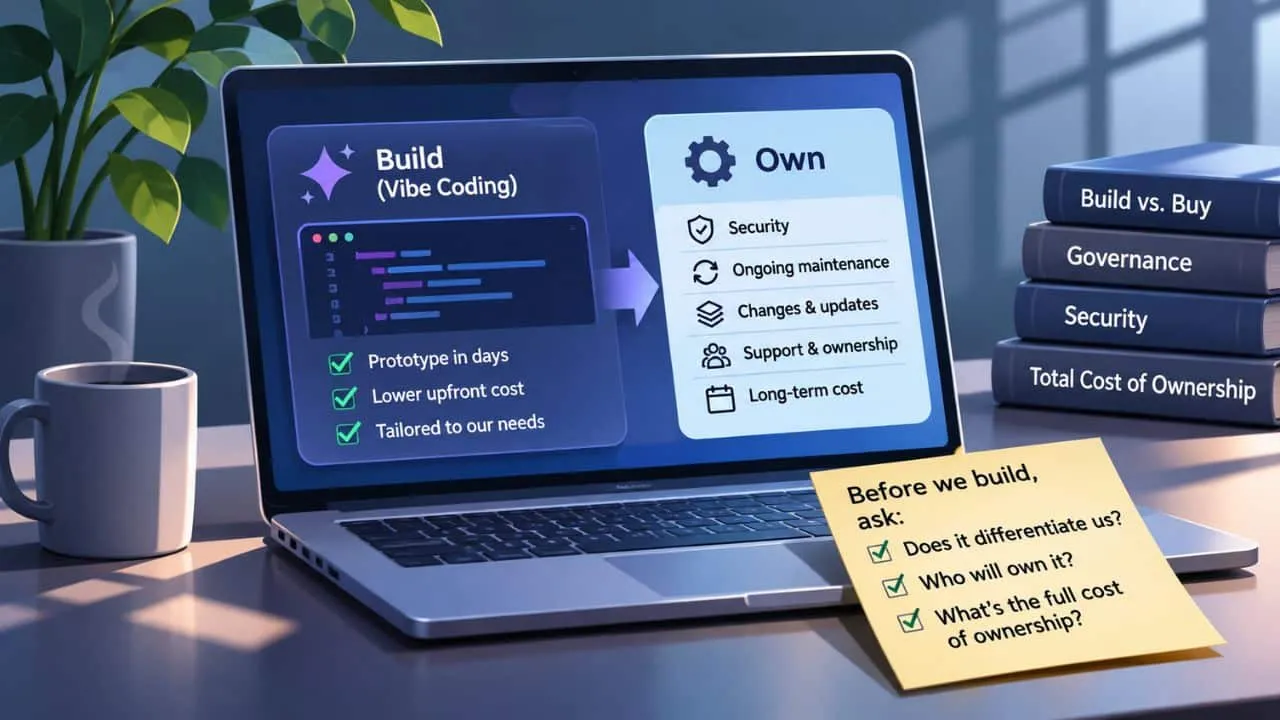
Boardrooms and budget meetings increasingly feature a familiar frustration as teams review software expenses. When looking at another software-as-a-service renewal or another platform that almost fits operational needs, leaders now ask if they could just build the solution internally. A few years ago, the answer was often no because custom software required dedicated developers, long timelines, and substantial budgets.
Artificial intelligence-assisted development has transformed that reality entirely, allowing individuals with strong domain knowledge to turn ideas into working prototypes in days or sometimes hours. While this shift is profound, being capable of building software is not the same as being prepared to own it, marking the start of a revised build-versus-buy conversation in modern enterprises.
Why the Case for Building Software Internally Is Growing
The justification for building tools internally is stronger than it has been in years due to falling upfront costs for testing ideas. However, the greater opportunity lies in relevance because internal staff understand company problems in ways external vendors cannot. A finance team knows precisely where an invoicing process breaks, while an operations manager knows which system employees actually use regardless of official procedures.
Artificial intelligence gives the people closest to those problems a greater ability to shape, prototype, and test the software meant to solve them. Data from Retool's 2026 Build vs. Buy report revealed that 35% of surveyed builders had already replaced functionality from at least one software-as-a-service product with something custom-built.
Building makes particular sense when software captures knowledge unique to the company, directly improves the value it provides, or gives the business greater control over its data. Despite these advantages, something that proves easy to build does not automatically make it worth owning over the long term.
Day One Is No Longer the Most Expensive Part of Development
This dynamic is where vibe coding can easily mislead organizations by hiding future obligations. Artificial intelligence has dramatically reduced the cost of getting to day one, but it has not eliminated day 500.
Software still requires continuous operation because application programming interfaces change, security vulnerabilities appear, and business processes evolve. Someone must still test, patch, monitor, and support what has been built. A finance associate might create an invoicing application over a weekend, but six months later, dozens of people may depend on it while sensitive financial data flows through it.
At that point, the question is no longer who built the application, but who owns it. Security makes this distinction even more critical for organizations handling sensitive customer, financial, or health data.
Security Risks in Artificial Intelligence Generated Code
Veracode's 2025 GenAI Code Security Report found that 45% of the artificial intelligence-generated code it tested contained security weaknesses. For businesses handling sensitive data, those vulnerabilities can quickly transform into severe compliance and security risks.
This reality does not mean companies should stop building with artificial intelligence tools. It means that once software moves from an experiment to active production, it requires proper information technology involvement, security measures, governance, and long-term ownership.
Vibe coding has successfully changed the economics of prototyping, but it has not changed the economics of owning software.
How to Decide Between Building and Buying
The new economics of software does not mean every software-as-a-service subscription should disappear from corporate balance sheets. If an existing platform already solves a common business problem well, rebuilding it internally may simply move the cost from an external vendor into the organization.
Before a team decides to build a tool, three specific questions are worth asking. Organizations must determine if the software genuinely differentiates the business, if it will improve customer experience, and if it solves something existing software cannot.
Teams must also evaluate who owns the software after launch, focusing not on who can build it today, but on who will maintain, secure, and support it years from now. Finally, businesses need to calculate the total cost of ownership rather than only looking at the cost of creation, remembering that the first version might be cheap while the software lifecycle is not.
What Vibe Coding Means for the Future of Enterprise Technology
At JBS, this distinction is increasingly important in how teams think about building with artificial intelligence. Non-technical teams should absolutely experiment and prototype, particularly when it helps translate deep domain knowledge into technology. However, when an application becomes important to the business, it needs to be treated like something the business intends to own.
The build-versus-buy debate has not disappeared, but artificial intelligence has simply moved the line. It has given the people closest to business problems far more ability to shape the technology that solves them. That represents a significant opportunity, as long as organizations do not confuse the ease of creating software with the responsibility of running it.