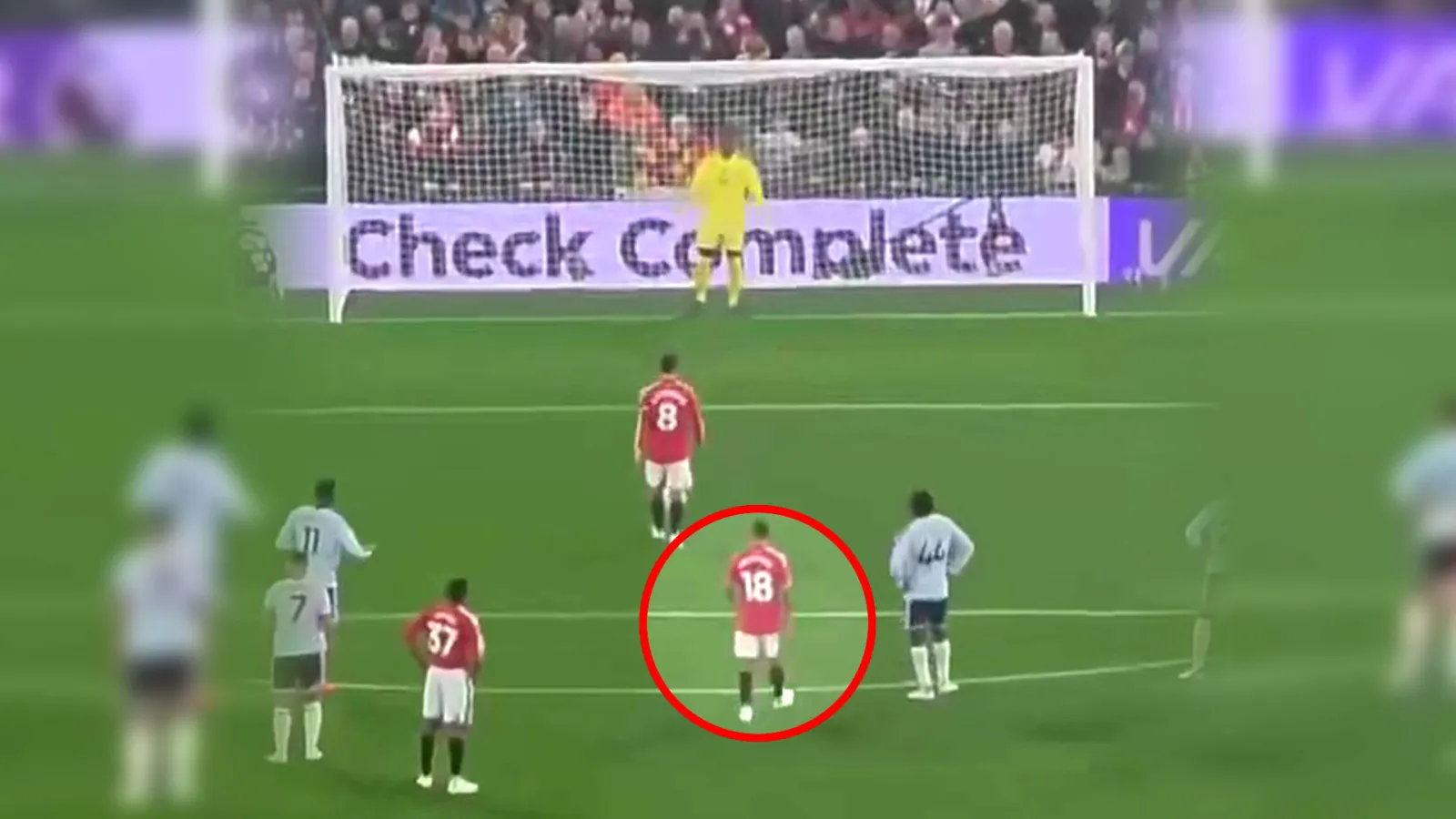
Manchester United supporters observed a curious sight during the club's 4-4 Premier League draw with Aston Villa on Sunday: Belgian midfielder Youri Tielemans appeared to replicate Bruno Fernandes' penalty run-up and strike technique.
The Red Devils fell behind 2-0 within the first four minutes of the match at Old Trafford. Bruno Fernandes pulled one back from the spot in the 16th minute, sending the ball to the bottom-right corner and halving the deficit.
From a camera positioned in the stands, a video clip showed Tielemans stepping up to the edge of the penalty area, mirroring Fernandes' approach, stance and follow-through. Fans quickly took to social media to speculate on the purpose of the imitation.
One commenter wrote, "Trying to make the keeper focus on him maybe?" while another added, "Mature that is! He is already in a position where he doesn't have to react suddenly if the penalty is saved, he is already in motion to react actively so actually it's very clever." A third fan suggested, "He's not just mimicking Bruno but dragging the keeper's attention to himself, more like trying to confuse the other markers around him."
What Tielemans Said About the Mimicry
Tielemans has previously addressed why he copies Fernandes' penalty routine. In an interview on his way into a training session, the Belgian explained, "It's to time my run into the box." The statement indicates that the replication is a personal timing device rather than a tactical ploy to distract the opposition.
Understanding Penalty Run-Up Techniques
In modern football, a penalty taker's run-up is a carefully rehearsed component of the strike. The angle, stride length, and foot placement can affect ball trajectory, power, and the keeper's perception. Players often develop a signature approach that they repeat to build muscle memory and confidence.
Bruno Fernandes, Manchester United's designated penalty taker, typically uses a measured three-step approach, planting his non-kicking foot slightly to the left of the ball before striking with his right foot. The technique aims to keep the keeper guessing while delivering a precise placement.
When a teammate mirrors that motion, it can serve two purposes: first, it reinforces the taker's rhythm, and second, it may create a visual distraction for the goalkeeper, who might briefly focus on the moving figure rather than the ball.
Why Teams Use Decoys During Set-Pieces
Decoy movements are common in free-kick and corner situations, where players make runs or feints to pull defenders out of position. In penalty scenarios, the effect is subtler, but research from sports psychologists suggests that any additional visual cue can increase a keeper's cognitive load, potentially affecting reaction time.
However, the Premier League's Laws of the Game stipulate that only the designated taker may approach the ball before it is kicked. Any other player stepping onto the penalty spot before the kick is taken would be penalised for encroachment. Tielemans stayed outside the marked area, merely imitating the motion from a short distance away, thus remaining within the rules.
Impact on the Match and Fans' Reaction
The 4-4 result saw United come back from two-goal deficits twice, ultimately securing a point. While the mimicry did not directly influence the final score, it generated a wave of discussion among supporters, analysts, and pundits on social platforms.
Fans appreciated the insight into Tielemans' personal preparation, and the clip quickly amassed thousands of views, highlighting the growing appetite for behind-the-scenes tactical nuances in Premier League football.
Manager Michael Carrick's Post-Match Comments
United's interim manager Michael Carrick addressed the overall performance after the match. He said, "It's a tough one to digest in some ways because, you know, there are moments which end up being key moments. We're kind of beating ourselves a little bit in many ways, which is disappointing and it's making things difficult."
Continuing, Carrick added, "But, at the same point, the rest of the game of football has been very good, for the most part. We didn't give them an awful lot. They didn't create an awful lot and I thought we created a lot, we had a lot of control." He praised the team's "progression" and "moments of pressure," but concluded, "I'm just disappointed we haven't won, to be honest. We did more than enough to win the game today and I'm really disappointed that we haven't taken all three points."
Historical Context: Penalty Mimicry in Football
Instances of players copying a teammate's penalty routine are not new. In the 1990s, Liverpool's Steven Gerrard once shadowed Michael Owen's run-up during a training drill to internalise timing. More recently, during the 2022 World Cup, a French midfielder was seen echoing Kylian Mbappé's approach in a warm-up, prompting debate about psychological tactics.
These examples illustrate that while the practice is rare in competitive matches, it is a recognized method for players to calibrate their own movements against a proven template.
What to Watch for in Future United Games
Going forward, observers will likely keep an eye on whether Tielemans continues to use Fernandes' run-up as a timing cue, especially in high-pressure moments such as late-game set-pieces. United's coaching staff may also integrate this visual cue into broader training drills, reinforcing consistency across the squad.
Additionally, the incident may prompt discussions among referees about the fine line between permissible mimicry and illegal encroachment, though current guidance suggests no breach occurred.
Practical Takeaways for Fans and Players
- For supporters, the clip offers a glimpse into the mental preparation behind elite penalty takers.
- For aspiring players, observing a teammate's repeatable routine can serve as a useful timing reference, provided it complies with the Laws of the Game.
- Coaches may consider incorporating controlled mimicry drills to help players develop consistent run-up patterns.
While the match ended in a point, the episode adds another layer to the evolving narrative of Manchester United's season, highlighting the subtle psychological tools players employ on the world's biggest stage.